

Harvest Opens on a Split Pulse Market
The pulse harvest is finally rolling in western Canada, but at a slower-than-usual pace. As of August 17, only 18% of the Saskatchewan pea crop was in the bin, similar to last year but far behind the 10-year average of 55%, with lentils just 13% combined. The late start isn’t a problem yet, but it does mean the crop needs a stretch of favourable weather to avoid quality issues. Early reports add another wrinkle: pea yields are coming in lighter than the good-looking crop stands suggested. Harvest still has to move north before the yield debate can be settled. For now, average yields remain the working assumption.
What makes this year unusual is how differently the two halves of the pea market are setting up. Based on an average yield, the yellow pea crop would be roughly 30% smaller than last year, and total yellow supplies would drop by about 650,000 tonnes, tightening the balance sheet considerably. Green peas are the flipside; even with a smaller crop, the heavy old-crop carryover pushes green (and minor) pea supplies to nearly 900,000 tonnes. Even an optimistic export program would leave ending stocks at a multiyear high. Recent US acreage data tells the same story, with American growers cutting yellow pea acres 12% while expanding greens by 20%.

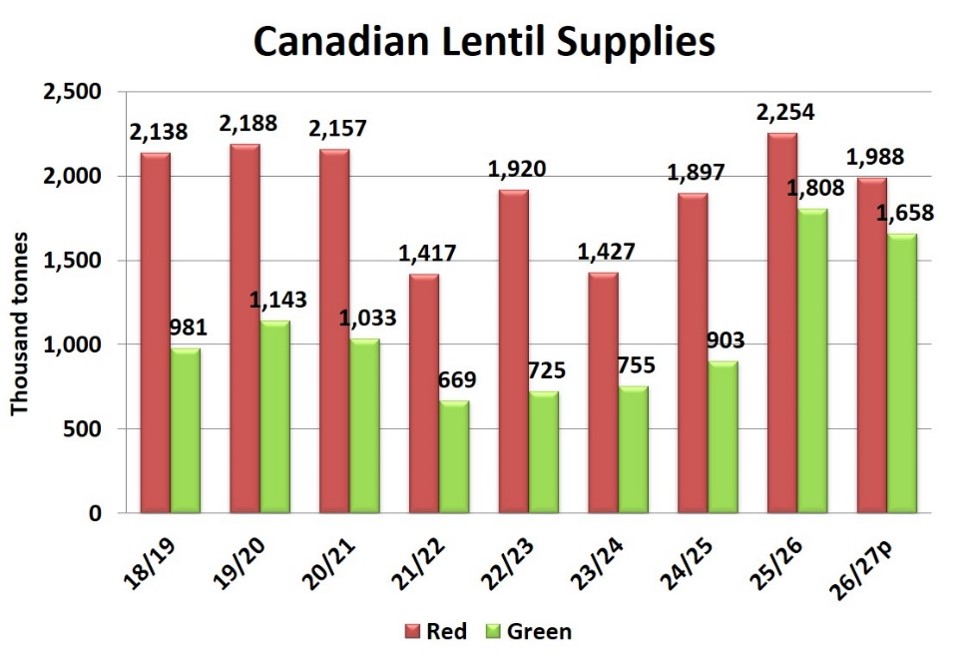
Lentils are following the same script. Canadian red lentil production is expected to fall about 10% this year, which would bring red supplies down to well-balanced levels, while the green lentil classes remain buried under carryover stocks even though their production shrank the most. One caution on the red side of the ledger: combined red lentil production from Canada and Australia could reach 4.0 mln tonnes or more, as a big Australian crop offsets the smaller Canadian one. That keeps South Asian demand at the centre of the price outlook.
Of course, supplies are only one side of the story. On the demand front, export prospects are positive for all pulses, but there are differences by class. As mentioned in previous reports, the outlook for yellow peas and all classes of lentils largely hinges on the monsoon situation in India. Indian pulse imports have been steady during the summer, which could be a good sign for the months ahead. August and September rains still matter the most, both for the kharif crop and for the rabi plantings of chickpeas, lentils and peas that follow. As of mid-August, nationwide monsoon rains are 13% lower than the long-term average. For yellow and green peas, China is the other major destination, with some positive signals emerging.
This is a year to know which side of the split each crop sits on. Prices for all pulses are expected to recover from the harvest lows, but for yellow peas and red lentils, tightening Canadian supplies and strong export prospects argue for more patience. For green peas and green lentils, the large carryover will cap rallies and periods of strength deserve attention as selling opportunities.
Pulse Market Insight provides market commentary from Chuck Penner of LeftField Commodity Research to help with pulse marketing decisions.