

Black Sea Disruptions Shift Pulse Demand Toward Canada
Over the past several years, Russia has grown into one of Canada’s largest competitors in pulse markets, especially for yellow peas into China and India, along with growing volumes of lentils and chickpeas moving into Turkey and South Asia. That’s what makes the current barriers to shipping out of the Black Sea region so important for the year ahead. The situation could change quickly, but for now the disruptions are limiting movement from two major exporters at the very time importers are lining up new-crop coverage. The early market signals suggest that demand is starting to shift toward Canada.
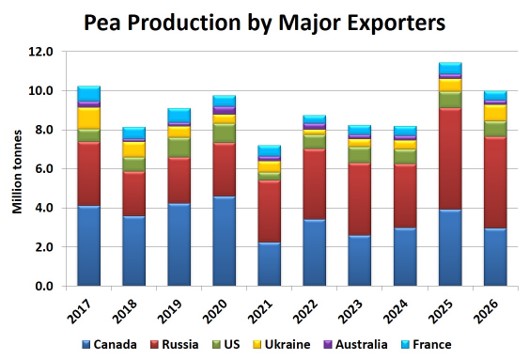
The disruptions are landing in a year when pea supplies were already tightening. Production among major exporters is forecast just under 10.0 mln tonnes, down almost 1.5 mln tonnes from last year’s peak, with the largest declines in Canada and Russia. Effective export availability will shrink even more than the production numbers suggest: France has become a much smaller exporter in recent years, US volumes are limited by changes to food aid policy, and Australia typically ships less than half of its modest pea crop. Take Black Sea movement out of that picture, even partially, and the remaining exportable supplies of yellow peas become much more concentrated in western Canada.
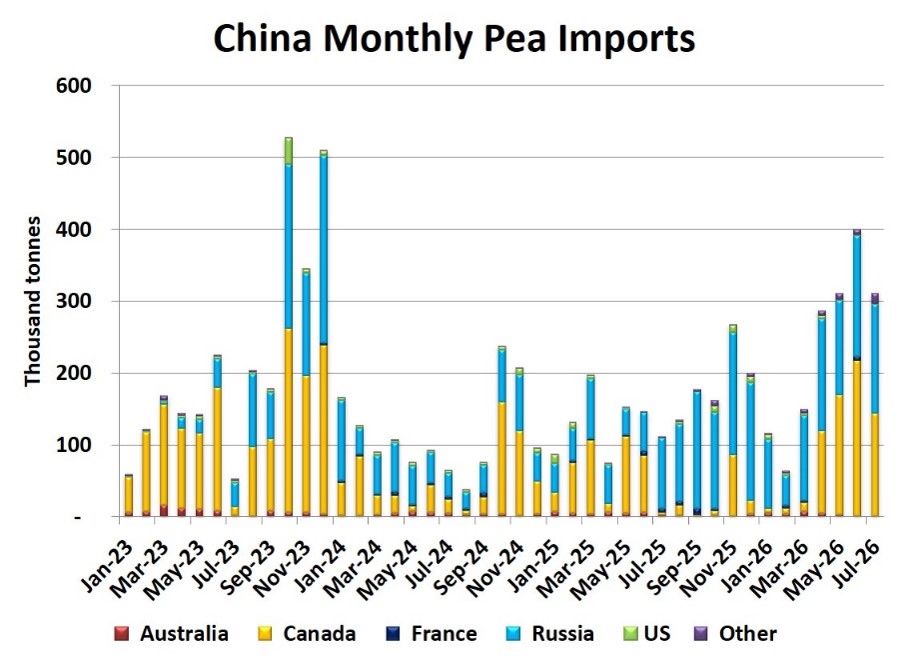
The clearest signal is coming from India. Yellow pea prices in Mumbai jumped more than US$50 per tonne in late August to their highest levels since mid-2024, with Kanpur values following. Notably, other Indian pulse prices haven’t moved the same way, which suggests this isn’t about India’s own crops – it looks like concern about access to supplies from Canada and Russia, the two origins that dominate its pea imports. China tells a similar story: it imported nearly 300,000 tonnes of peas in July, double the 5-year average for the month, with Russia the largest origin at just over 151,000 tonnes and Canada close behind. If Black Sea movement stays constrained, a large share of that Russian business will be looking for a new home.
The effects reach beyond peas. Kazakhstan, which ships pulses through some of the same corridors, exported a record 409,700 tonnes of lentils in 2025/26, mostly to Türkiye and China, and its 2026 acreage is reported lower.
For chickpeas, difficulties moving Russian supplies into South Asia could redirect some of Pakistan’s import requirements, at a record pace so far in 2026. Pakistan’s largest sources are Australia (desis) and Russia (small calibre kabulis) and restricted supplies could move more demand toward Canadian kabulis, particularly the smaller calibres.
A few words of caution are in order. Shipping barriers can ease as quickly as they appear, and Russian product has a way of finding other corridors, at least for some of its tonnage. It’s also worth remembering that for peas, the yellow pea market will see a greater impact than greens or maples. And with harvest running well behind normal across the prairies, quality is still a question mark for all pulse crops.
For growers, the setup leans supportive. Bids for most pulses appear to have put in their seasonal lows, and the combination of smaller Canadian supplies and import demand rerouted away from the Black Sea gives the usual postharvest recovery extra fuel, particularly for yellow peas. Keep in mind that in 2025/26 (without these friendly factors), the move in yellow pea bids from the September low to the spring high was nearly $2.00 per bushel. Red lentils could also see some support, especially if Indian monsoons don’t improve and South Asian buying stays strong, although the big Aussie crop will keep a lid on prices. The heavier-supplied classes, green peas and green lentils alike, will still find rallies capped by carryover, so periods of strength remain selling opportunities. Watching how the Black Sea situation develops will be worth the effort this fall, as it has become a bigger swing factor in the pulse price outlook.
Pulse Market Insight provides market commentary from Chuck Penner of LeftField Commodity Research to help with pulse marketing decisions.