

Export Outlook is Bright for Pulse Markets
There may be a few more tweaks to the supply side of the equation for Canadian pulses, but the situation is fairly well set for 2026/27. Reduced acreage and lower yields than last year mean smaller crops, but those are partly offset by large inventories carried over from last year. Overall, 2026/27 pulse supplies are comfortable but not burdensome. This year though, supply levels could be a less important factor than demand in the 2026/27 outlook. And early on, those demand signals look friendly.
This year’s pea export outlook is different than the last few years when either China or India was not in the market, due to trade restrictions. This fall, both countries are in the market for Canadian peas which means a stronger demand picture for a full marketing year (fingers crossed). Granted, this double-barreled demand would have a stronger impact on yellow peas than greens. On its own, this is already positive, but it’s likely that both countries will be in the market for even larger volumes in 2026/27.
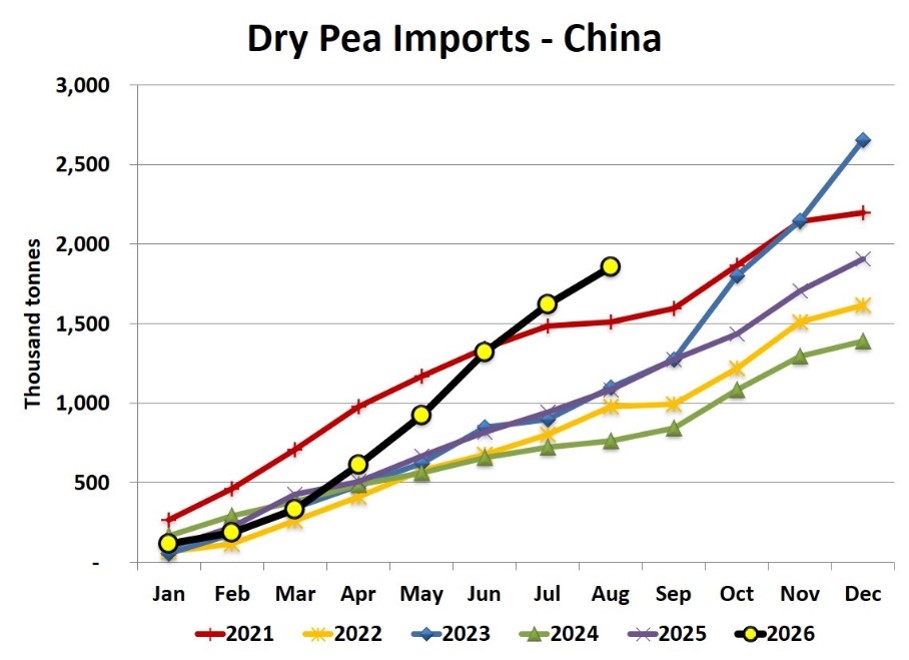
Chinese pea imports were slow to start 2026 but once tariffs on Canadian peas were removed, volumes turned strongly higher. Year-to-date imports are already 1.85 mln tonnes, well above previous records and market signals suggest this strong pace will continue. Demand from food and fractionation users is solid while rising prices for feed ingredients such as soymeal are making peas more attractive in the feed channel. Demand for Canadian peas could see an even larger gain, due to the difficulties of shipping peas out of Russia or Ukraine.
India is the other large part of Canadian pea demand, with positive signals there too. Through the first four months of its 2026/27 marketing year (April to March), Indian pea imports were 525,000 tonnes, almost double last year and that’s with a 30% tariff on imports. More recently, yellow pea prices in India made a sharp move higher, partly due to concerns about availability of Russian peas. Prices for desi chickpeas (the substitute crop for yellow peas) have also turned up strongly, which may be related to a smaller Australian crop.
Looking further ahead, below-normal rainfall during India’s monsoon season is expected to cause reductions in its pulse production, with some price effects already starting to show up. If prices continue to rise, the Indian government could decide to reduce import tariffs on peas, which would stimulate more demand for Canadian supplies, especially if Russian peas remain harder to access.
India’s lentil tariffs (currently at 10%) could also be reduced, depending on the outcome of the current kharif season and the outlook for the rabi (winter) crop in the coming months. The kharif season is close to harvest and the tur (pigeon pea) crop will likely be hit hard, as monsoon rains were particularly short in the south of the country where tur is grown. Prices for tur have already started to rally and this could trigger more demand for Canadian green lentils as a substitute.
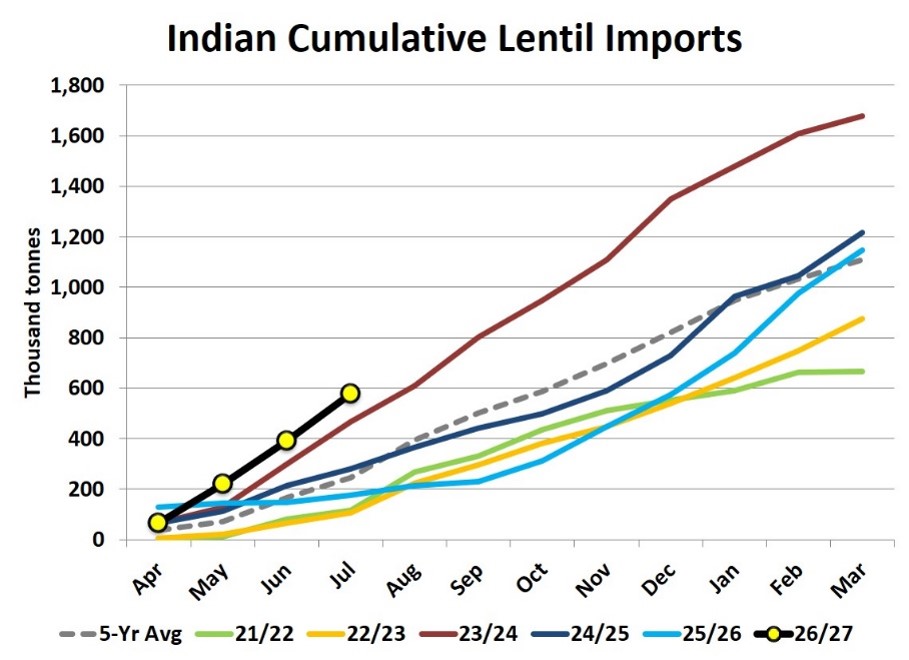
Lentil demand by India has already been strong, even before weather concerns started to show up. So far in its 2026/27 marketing year, India has imported 578,000 tonnes of lentils, a record pace and more than three times larger than last year’s start. Indian lentil imports are normally slow in the months right after its rabi harvest, and while past performance isn’t a guarantee that the record pace will continue, this unusually large demand is certainly an important signal. And if the rabi lentil harvest in early 2027 is threatened, demand could rise further. The only caution for Canadian demand is that Australia is expecting a record crop of red lentils, which would limit Canadian export potential.
Bids for all types of pulses are already rising in western Canada, although some of those gains are simply normal seasonal strength after harvest. These interesting possibilities for stronger-than-usual demand have the potential to add even more upside in the coming months for peas, lentils (and chickpeas).
Pulse Market Insight provides market commentary from Chuck Penner of LeftField Commodity Research to help with pulse marketing decisions.