

Pea Exports Race Ahead While the Lentil Rally Catches Its Breath
Two months into the 2026/27 marketing year, the demand picture for Alberta’s two biggest pulse crops is starting to split. Pea exports are running at a very strong pace, and a full-year program that looked ambitious a month ago now looks increasingly achievable. Lentils, meanwhile, have seen the first leg of their postharvest rally stall, and the export outlook has been trimmed. The two markets are starting to call for different marketing tactics.
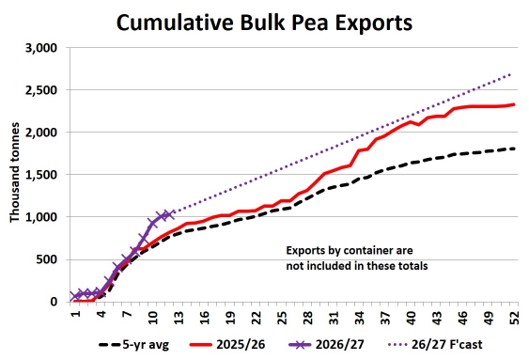
August pea exports reached 148,400 tonnes, nearly double the five-year average for the month and the quickest start since 2017/18. The weekly data since then has remained strong: 1.03 mln tonnes of bulk exports moved through the first 12 weeks, already 38% of a full-year forecast of 2.7 mln tonnes. Add another 550,000 tonnes of non-bulk exports for a total program of 3.25 mln, up from 2.66 mln tonnes last year.
China’s pea imports from all origins are running at a record pace that could clear 3.0 mln tonnes this calendar year. The Canadian export forecast includes 1.2 mln tonnes to China plus 1.0 mln to India, the high end of the past decade but well below what India bought routinely before its import restrictions. With the smaller 2026 Canadian crop offset by the big carryover, supplies are essentially unchanged from last year. Yellow pea availability, not demand, looks like it will be the main limit for exports.
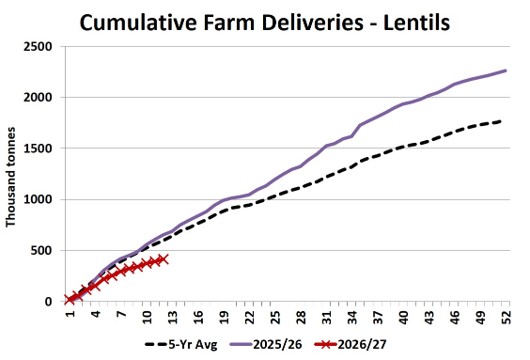
The lentil picture is more complicated. Our 2026/27 export forecast was recently trimmed by 100,000 tonnes to 2.50 mln tonnes. Green (and other) lentil expectations stay at 950,000 tonnes, up from 800,000 last year on strong Indian demand, while the red lentil forecast comes down to 1.55 mln, slightly below last year, on heavier competition from Australia. The warning sign shows up in the delivery data, with farmers moving just 417,000 tonnes through 12 weeks against an average of 601,000 tonnes, only about 12% of on-farm supplies versus the average of 24%. So far, exports have kept up to average, but without more product entering the pipeline, the pace is likely to slow in the coming weeks.
India remains the pillar under the lentil market, with Apr-Aug imports of 641,900 tonnes the strongest start on record, even after an August lull. Rabi planting is just getting underway, and while below-average October rain in some key pulse regions bears watching, it is too early for conclusions. Australia is the counterweight for red lentils: a record crop is about to be harvested and prices there are already near multiyear lows.
Prices reflect the split. Pea bids are continuing to firm up through the fall, with yellows leading the way and narrowing the gap with greens. Green lentil bids staged a strong recovery from the late-August lows, with small greens up more than eight cents per pound and large greens up six, though the rally has paused in recent weeks. Red lentil bids have shown much less response.
The playbooks differ by crop. The ongoing yellow pea rally means sellers can be more patient, with less upside likely in greens and maples. For green lentils, the first rally filled buyers’ initial needs, and with more Indian business expected in the coming months, gains are still possible in the coming months. For red lentils, expectations should stay modest with India’s rabi planting progress the swing factor to watch through the winter.
Pulse Market Insight provides market commentary from Chuck Penner of LeftField Commodity Research to help with pulse marketing decisions.