

Better Outlook for 2026/27 Pea Demand
The Canadian pea market has been affected by import restrictions by its major customers for quite a few years. In fact, there hasn’t been a full marketing year that hasn’t seen some sort of Indian or Chinese trade barrier since 2016/17. While not all restrictions have gone away, prospects for 2026/27 are looking brighter and should mean better movement and prices.
The biggest impact should be seen in yellow peas. Back in November 2017, India imposed 50% import tariffs on Canadian yellow and green peas, as well as restrictions on the number of tonnes allowed into the country. For yellow peas, that lasted until December 2023 but has continued for greens. Once those restrictions were dropped, yellow peas were allowed into India with zero tariffs until November 2025, when 30% tariffs were reimposed. China had been importing Canadian peas without any restrictions until March 2025, when it imposed 100% tariffs. These tariffs lasted for a full year, and pea exports to China are just starting to show up again in the StatsCan trade data.
The combined effect of these Indian and Chinese restrictions is that since 2016/17, there hasn’t been a single complete marketing year without some sort of barrier to Canadian pea exports. For example, the 2025/26 marketing year included 30% Indian tariffs since November 2025 and 100% Chinese tariffs from August 2025 to February 2026. Fortunately, pea imports by other Asian countries such as Bangladesh and Pakistan helped fill in the demand gap.
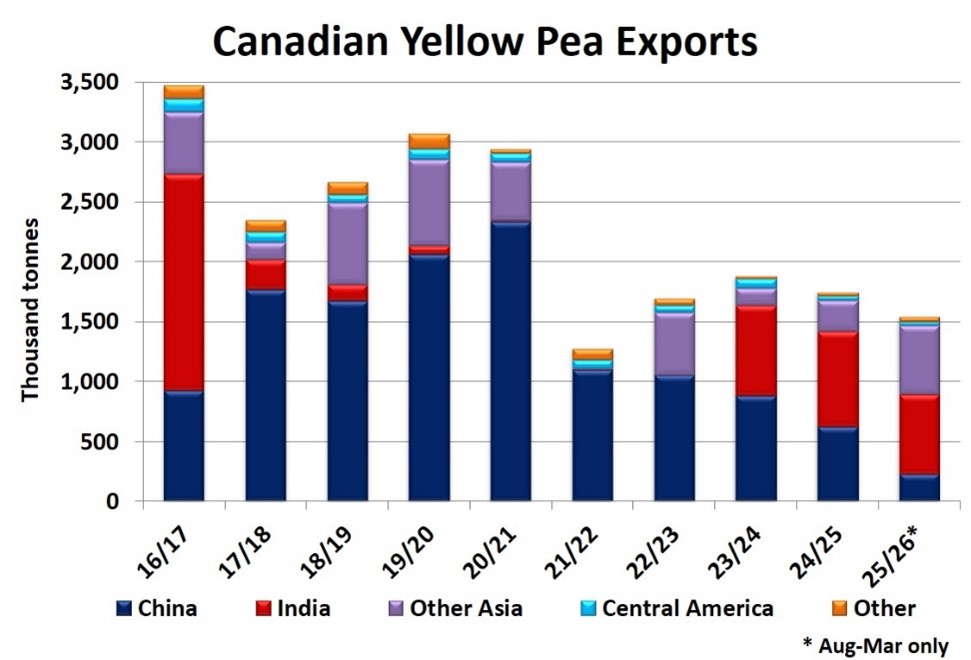
For 2026/27, the crop year will start with a brighter outlook. India still has its 30% import tariffs, although those aren’t high enough to stop trade entirely. And if, as some observers are forecasting, El Niño causes a shortfall in monsoon rains, India may need to lower those trade barriers later. More importantly, China will be back in the market for the full 2026/27 marketing year. With both of Canada’s two dominant buyers looking for yellow peas this fall and beyond, demand will be strong and will help draw down supplies to lower levels. All else equal, that should support prices.
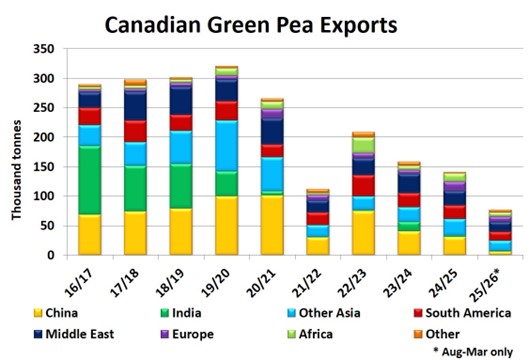
The situation for green peas won’t change as much. Canadian green pea exports are more broadly dispersed across more buyers, so India and China don’t dominate quite as much as in yellow peas. India still maintains 50% tariffs and volume restrictions on green pea imports, which has shut down trade. On a positive note, China will return as a buyer and should help with early-season movement. One note of caution though: the volume of Canadian green pea exports has been trending lower for several years. The situation in late 2024/25 and the first seven months of 2025/26 was affected by Chinese tariffs but the outlook is still a bit concerning.
Of course, a lot can change in 2026/27. Canadian pea production is very much an open question, as are crops in other competing exporters. The monsoon situation in India and the possible effect on its kharif and rabi crops is the other big variable that could cause big shifts on the demand side of the equation. For now, it looks like 2026/27 could turn into a more positive year for Canadian pea markets.
Pulse Market Insight provides market commentary from Chuck Penner of LeftField Commodity Research to help with pulse marketing decisions.