| DAMAGE |
- Pea leaf weevil will feed on chickpeas but is not considered a pest of concern.
- The size of a grain of rice, this non-native invasive insect has emerged in recent years as a threat to Alberta’s field pea, faba bean, and chickpea pulse crops.
- Complicating growers’ pea leaf weevil defense is the fact that this insect appears intermittently, and in some years it’s a significant problem, while in others it’s just a minor inconvenience.
- The grey adult weevil feeds on leaf margins (notching) and growing points of host seedlings.
- Usually chickpea plants will survive this defoliation, however, adult females will lay large numbers of eggs at the base of the plants.
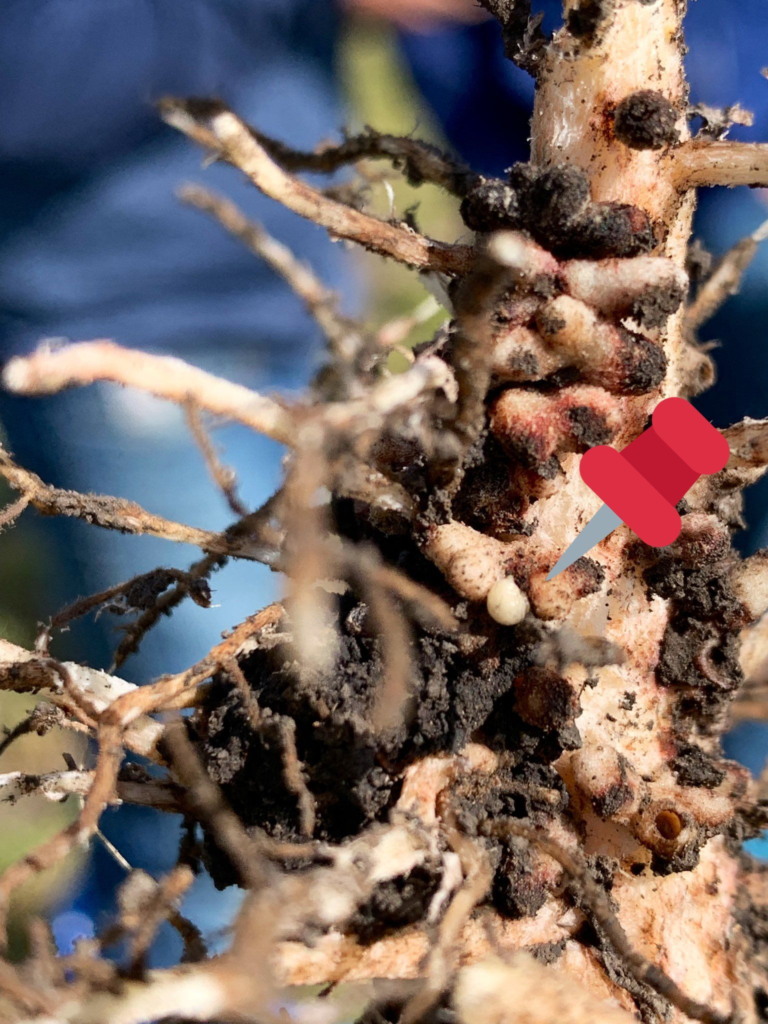
- The main concern is when the larvae hatch and burrow into the soil. They cause more serious damage by feeding on nitrogen fixing nodules on the roots of the plant, reducing nitrogen to the crop, resulting in poor plant growth and low seed yields.
|
| LIFE CYCLE |
- The pea leaf weevil produces one generation per year.
- The adult overwinters in soil within or adjacent to alfalfa, other perennial legume crops, or tree shelters. In May through June, eggs are laid on or near developing chickpea plants.
- In the spring adults disperse, up to a few kilometres, mainly by flying when temperatures are above 17°C or walking short distances. Each female lays up to 300 eggs throughout the summer in the soil near or on developing plants.
- The larvae hatch in one to three weeks, and move to Rhizobium nodules on the root, where they feed.
- Once the larval stage is complete, the insect pupates and emerges as an adult once again in late July through September.
- Newly emerged adults search for any pulse crops to continue feeding
- before overwintering.
|
| CONTROL |
- Occasional monitoring to look for the characteristic U-shaped notches on seedlings in early spring is advised.
- Up to the 5th node stage, examine the clam leaf of 10 plants for the notches at each of five sites along the field edge and another five sites within the field when the pea crop is at the second or third node stage. If notches occur on the lower leaves but not on the clam leaf, then the weevil has likely already laid its eggs and it’s too late to spray.
- The proportion of seedlings with terminal leaf damage (ex. leaf notches) provides an adequate indication of overall plant damage, and to some extent, potential yield losses.
- Use seed treatments where pea leaf weevils are a constant threat. Otherwise, apply recommended foliar sprays against adults as requiring. Keep monitoring as weevils may re-invade fields.
|
| ECONOMIC THRESHOLD |
- The adult is difficult to observe; therefore, economic thresholds are determined by the severity of notches in the plants at various points of the field - 30% of seedlings with damage (leaf notching) on the clam leaf during the 2nd to 5th node stage.
- The crop is not susceptible to damage after the 6th node stage or it is too late to attempt control.
|
| RESOURCES |
|
| REFERENCE |
|