A Quick Conversation About Aphanomyces Video


APG Research & Extension Manager Dr. Jenn Walker shares how to watch out for Aphanomyces in this YouTube short.

APG Research & Extension Manager Dr. Jenn Walker shares how to watch out for Aphanomyces in this YouTube short.
With more than 700 pages of valuable crop protection information, spraying guidelines and safety information, the Crop Protection Guide is a trusted and valuable resource for farmers and agronomists.
For more information and to order your copy of the 2025 edition of the Blue Book go to albertabluebook.com.
The Blue Book is collaboratively produced by Alberta Canola, Alberta Grains and Alberta Pulse Growers.
Alberta Pulse Growers’ Zone 3 and Zone 5 present Back to Basics on Feb. 20, 2025 in Fort Saskatchewan, AB. This event features: Mark A. Olson discussing Pea and Faba Agronomy; a Market Update from Suzanne LeClerk of Market Master: Dr. Jenn Walker talking about Mitigating your Risks: Root Rot Complex; APG’s Nevin Rosaasen talking policy: and area farmers discussing their experiences. Register here.
By Sheri Strydhorst, PhD, PAg – Sheri’s Ag Consulting Inc.
Understanding and complying with Pre-Harvest Intervals (PHIs) are critical for safe pulse crop production.
WHO? All pulse growers who use pesticides. It is particularly important for pulse growers who need to spray herbicides, fungicides or insecticides later in the growing season.
WHAT? The PHI is the MINIMUM amount of time between applying a pesticide and swathing or harvesting the crop.
WHEN? The PHI for many pulse fungicides is 14 to 30 days. For example, if a pulse crop is intended to be swathed or harvested on August 15th, you cannot spray certain fungicides later than July 16th or August 1st, depending on the product. The PHI for harvest aids is 2 to 10 days and the PHI for insecticides ranges from 1 to 30 days.
WHY? Compliance with PHIs is a legal requirement to ensure that pesticide residues do not exceed the maximum residue limits (MRL), established by the Food and Drugs Act (FDA). If your pulse crop is found to have residue levels which exceed the MRLs, the grain could be seized, destroyed or forbidden for export.
HOW? PHI information is found on pesticide labels, the Keep it Clean website and in The Blue Book.
Learn more in the video below as Dr. Strydhorst discusses PHIs with APG’s Dr. Jenn Walker.
Check out the new Ascochyta Scorecard Calculator available on the APG app! If you are a pea grower who is getting rain as the crop is coming into flower, check out this valuable tool. Don’t have the app yet? Click here. Get a quick overview on how to use the new calculator from Dr. Jenn Walker, APG Research & Extension Manager, below. For optimal 360 degree viewing, watch on your smartphone. Click and hold cursor to change view in any direction.
Harvest Management and Storage of Pulse Crops
The 2022 growing season was off to a cool start and saw average rainfall for most parts of the province. Hot temperatures near the end of July and early August hastened maturity in peas and lentil crops across the southern province. Chickpeas will also soon be ready. Faba beans and soybeans tend to be ready later in the harvest season. Growers may be looking for information on harvest tips to maintain premium quality pulses and insight into storage in case of pulse carry-over into the new year in anticipation of higher prices.
Harvesting pulses can be a challenge. Wind, recent rains and heavy stands can result in lodging or, in some cases, the crop completely lays over (peas). Short crops can lead to missing bottom pods or trouble feeding into the combine. Specialized pickup teeth such as duck feet, can help feed the crop and ensure headers are harvesting all of the pods and stems. Providing the field was rolled after seeding, in most cases, experienced operators with the right headers can harvest almost all the lodged or short crop. Lifters, rock dams and other aftermarket accessories can provide growers a smoother harvest experience. Flex headers with tilt options as well as draper headers and pea augers are features that seasoned pulse growers are often seeking to help with harvest. Lentils, although a shorter crop, still stand erect and are not usually as challenging as a lodged pea crop. In the case of all pulses, care should be used when threshing to minimize cracks, splits and damage to seeds. Grasshoppers are also an issue with many of them, or their insect parts, showing up in the sample. If choosing to act against grasshoppers with a late season insecticide, take note of the pre-harvest interval and choose a chemistry that will allow adequate period prior to swathing or harvesting.
Chickpeas have small beaks connected to the seed coat and require special attention to avoid separating from the seed. Harvesting of pulses can begin when the seed moisture is still above commercially dry. In the case of peas, dry at 16% moisture, experienced growers begin combining between 19-20% moisture to minimize cracks and splits. Peas, lentils, chickpeas and fabas can all be dried in aeration down to their commercially dry specifications quite rapidly and without concern.
Producers do have to pay attention to temperature while binning pulse crops. Although moisture content may be near targets, the temperature of harvested pulse crops themselves can be quite warm. Care should be taken, especially with lentils and peas harvested at ambient air temperatures over 20 degrees Celsius. Temperature and moisture are the contributing factors to growth of mold and fungi that can result in spoiling, heating, and subsequent crop quality downgrades. Conditioning, by coring the entire centre of the bin through removing two or three loads (depending on size of bin and size of trucks) can be a good strategy to ensure moisture migration following harvest does not result in spoiling at the top of the bin (winter) or the bottom of the bin (spring).
Handling of pulse crops should be done with attention, and, where possible, conveyors should be used. When using augers, ensure the motor is not running at full throttle (low to mid) and ensure the auger is full of product. This minimizes cracks and splits in the augering process. Care should be taken to avoid augering and dropping crop from high heights where possible and to minimize additional handling if at all possible.
Many farmers continue to explore the option of carrying over peas and lentils to subsequent crop years. Peas are a good option for storing longer term. Peas have lower tannins than green lentils or fabas. Over time, tannins in the seed coat cause oxidation and discolouration can occur. High tannin faba beans, Desi chickpeas, maple peas and high tannin lentils run a greater risk of oxidation if storing additional crop years, something to be aware of if considering longer term storage. Once in storage, it is important to monitor bins as sweating can occur months down the road and can lead to spoiling within areas of the bin. Pulling a few loads from the core of the bin is the prudent way to ensure your pulses are conditioned and will continue to make the grade when delivered into the future.
For more information, visit:
https://keepitclean.ca/pulses for pre-harvest intervals.
https://albertapulse.com/wp-content/uploads/2020/01/PAMI.pdf for Improved Management of Stored Pulses research from PAMI.
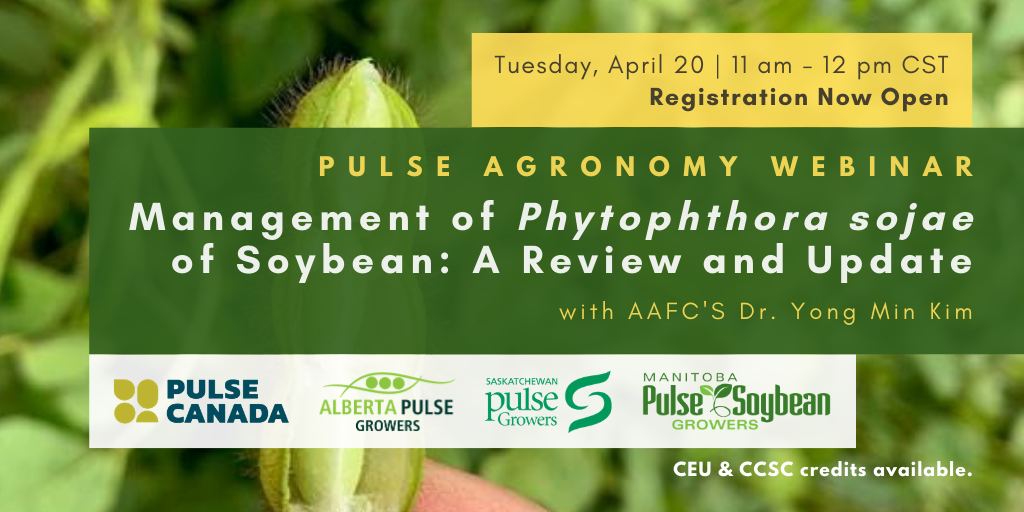
During this webinar Dr. Yong Min Kim, Crop Production Pathologist at the Brandon Research and Development Centre, Agriculture and Agri-Food Canada will discuss: • Other root rot diseases of soybeans and pulse crops (eg. Fusarium root rot, etc), • Phytophthora sojae in Canadian soybean fields • Types of host resistance • Pathotype diversity • Best management practices *CCA and CCSC credits available. Click here to register.

Sectional control technologies are widely available across the Canadian prairies for modern day sowing, seeding and planting equipment. With funding from the Canadian Agricultural Partnership, the Prairie Agriculture Machinery Institute conducted in-field testing during the 2020 growing season to measure seeded overlap acres of different seeding equipment. Three different types of air seeder equipment were tested in-field to determine actual product overlap on both a pea and canola crop at headlands and around an obstacle.
This Phase II report can help farmers determine which sectional control technology may be a fit on their farm and inform them of importance of calibration to ensure proper shut off and reduced overlap.
By Mark Olson
Questions abound when it comes to the inoculation of pulse crops: Is it necessary to inoculate at all? After I have grown a specific pulse in the field once before, do I have to inoculate again? Is there any merit in “double-inoculating” a pulse crop? What about using rhizobia inoculants in combination with growth promoting organisms?
In many parts of the world where there is a long history of growing pulse crops, inoculation is not actually as common. Comparatively, Western Canada has a relatively short history of growing annual crops and nitrogen-fixing annual grain legumes such as pulses. As well, each pulse-kind has a specific bacterium to which the symbiotic relation is formed, and these bacteria are necessary to optimize the benefits of nitrogen fixation. There is no question that applying an inoculant to the seed (or in the seed row) to meet the pulse crops’ nitrogen requirements is more cost-effective than applying a manufactured nitrogen fertilizer and is of huge benefit in lowering a cropping system’s overall environmental impact.
Although rhizobia introduced into the soil environment by inoculation do survive, the bacteria’s exponential reproduction over several years before growing a pulse again may make the residual populations less effective at fixing nitrogen. For that reason, applying inoculant every time when growing a pulse crop is considered a best management practice and lowers risk to the grower dealing with poor or zero nitrogen fixation in their crop.
Fields that have never had a pulse species of any kind are often referred to as “virgin fields” and some growers will inoculate with two different formulations of inoculant (i.e. liquid and granular) for the first time growing that pulse species on the field. This is referred to as “double” or “dual” inoculation and is a common practice within the soybean industry upon ‘first’ and ‘second-time’ soybean land. In pulse crops, research on dual inoculation is limited and whether a grower chooses to double-inoculate on virgin fields is dependent on their propensity for risk and the planned economics of doing so.
The addition of other and/or multiple biologicals to inoculants has become increasingly common. Tag Teamâ and Jumpstartâ, as examples, contain Penicillium bilaiae, a naturally occurring soil fungus which is able to solubilize the tightly bound soil nutrient phosphorous. Phosphorous is critical to root development and the inclusion of Penicillium bilaiae results in a visibly more extensive root systems which in turn increases water, macro, and micro-nutrient uptake from the soil. These product/product combinations were one of the first-generation biologicals to appear in markets across Western Canada.
In addition, there are numerous plant growth promoting rhizobacteria (PGPRs) in combination with inoculants on the market. Nodulator Duo SCGâ is just one example of a granular inoculant that combines the nitrogen-fixing of Rhizobium leguminosarum for pea and lentil together with a bacteria Bacillus subtilis. The addition of Bacilis subtilis increases root and shoot biomass which in turn enhances water and nutrient absorption as well as assists the crop ability to survive under less than ideal environmental conditions
“LCO” or ‘lipochitooligosaccharide’ technology is where a specific molecule amplifies the communication (sometimes referred to as “Nod factor”) between the plant and rhizobium, initiating the formation of nodules regardless of poor environmental conditions.
Tagteam BionQâ is another example of a product but with LCO technology and multiple organisms: Rhizobium leguminosarum, Penicillium bilaia, Bacillus amyloliquefaciens and Trichoderma viren. All these products are added to increase nodulation and root mass for enhanced water and nutrient uptake.
It should be noted that this is not an exhaustive list of product or product combinations with inoculants. The product names mentioned as examples are not an endorsement of their effectiveness and whether they are of economic benefit. Pulse growers are encouraged to talk to their local agrologist as to which inoculant product fits best with their farming operation.
By Mark Olson
Pulse crops as legumes are a valuable component in diversifying Western Canadian cropping systems. Their ability to fix nitrogen from the air reduces the need for nitrogen fertilizer, lowering the carbon footprint as well as making a more sustainable cropping system overall.
When pulse crops are inoculated with a species-specific bacteria (rhizobia) nodules are formed around the root hairs of the host plant. This is a mutually beneficial relationship where the plant provides the rhizobium with sugars and mineral nutrients, and in return the rhizobium provides nitrogen to the plant.
Nitrogen is not only the nutrient required in the largest quantity by all crops but forms the basis for their total seed protein content percentage. Inadequate amounts of nitrogen will not only limit plant growth and yield but will also result in lower than average seed protein. For these reasons, proper inoculation is mission critical for Alberta growers.
When successfully inoculated (dependent upon pulse species), the crop can fix anywhere from 40 to 90% of its own nitrogen requirements. Faba bean has the highest nitrogen fixation percentage (90%) of all annually grown legume crops. In contrast, dry bean would have one of the lowest percentages (40%) with all other species falling somewhere in between.
Inoculants are the product carriers for the rhizobia and come in three basic formulations: peat, liquid and granular. The peat-based formulation is a mixture of a finely ground peat combined with the rhizobia and applied directly to the seed with a sticking agent. Liquid inoculants are typically packaged in a plastic bladder with the rhizobia contained within and applied directly to seed either shortly before seeding, at the time of seeding, or in the seed row with an on-the-go liquid applicator. Granular inoculant can be either peat or clay-based granules applied in the seed row or in some instances, side-banded within a separate granular inoculant tank.
Inoculant types are strongly affected by their soil environment, how they are stored, and how they are applied. No matter which type of inoculant formulation is used, careful attention must be paid to the rhizobia. As rhizobia are a living organism, they will dry out when stored at too high of a room temperature or become completely ineffectual when exposed to direct sunlight. As well, the number of live bacteria will naturally decline over time. Growers are encouraged to check the product labels for the expiry date of their inoculant.
Once applied to the seed, rhizobia populations in the peat and liquid formulations decline more rapidly than in the granular particle. For this reason, they need to be seeded as quickly as possible for optimal nitrogen fixation. As well, growers should make sure when applying a seed treatment to check the product label for compatibility with multiple inoculants. Some products may have to be applied sequentially (i.e. seed treatment applied first and allowed to dry before applying the inoculant). Do not apply inoculant in combination with a fertilizer product as this is high risk. The salts contained in the fertilizer will cause a decline in rhizobia numbers. Under dry, hot and low pH soils (harsh environmental conditions), research has shown that granular inoculants provide more uniform and consistent rhizobia populations than with peat and liquid formulations. When environmental conditions are optimal, no differences between formulations have been observed in research trials. The formulation a grower uses is therefore a matter of personal choice and economics.
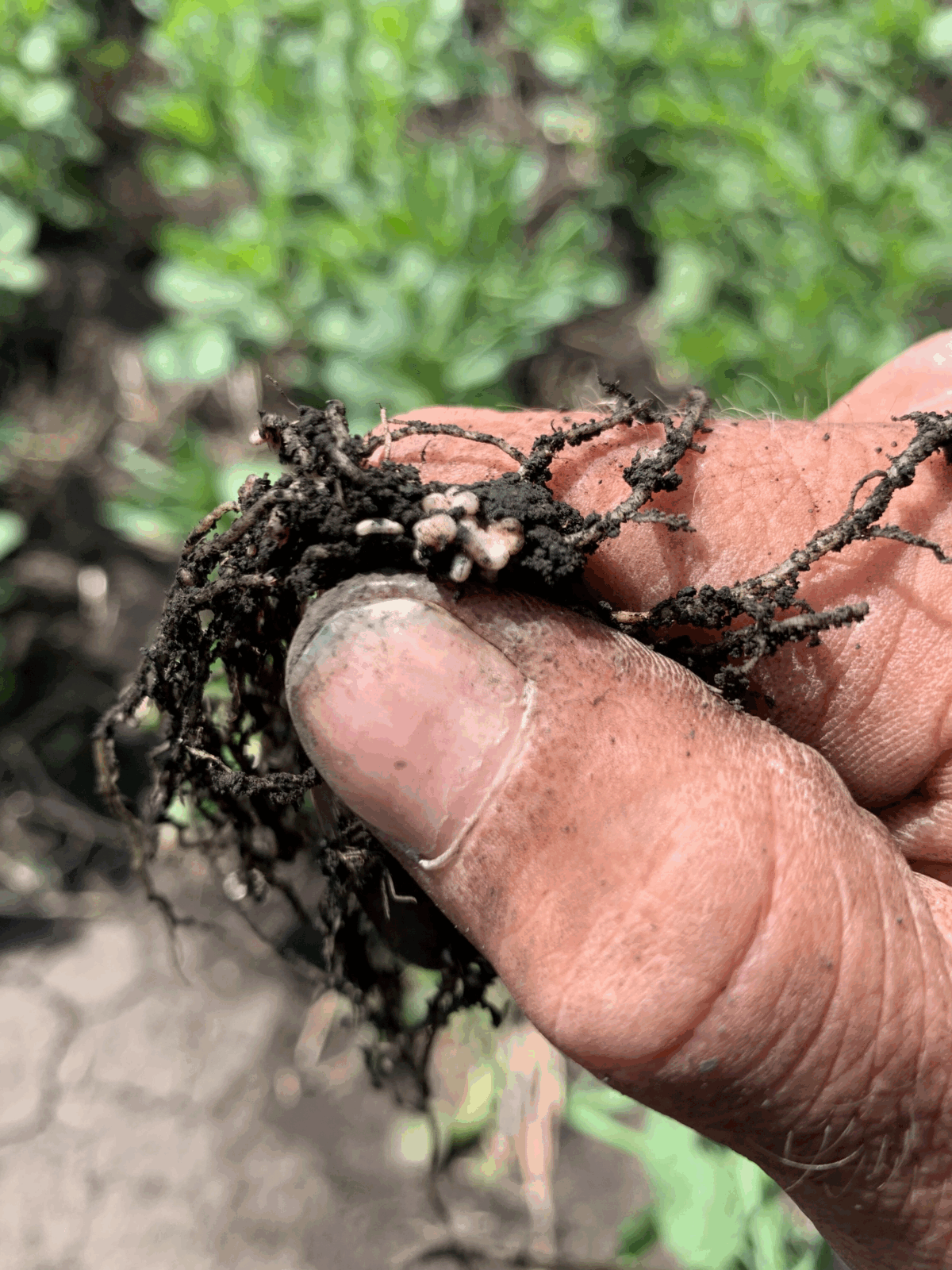
Growers can check for nodulation of their pulse crop by carefully digging up their plants (not pulling the plants up like a carrot) 4-5 weeks after seeding. If a peat or liquid formulation was applied directly to the seed, the nodules will form close to the crown and main tap root. A granular inoculant pattern has some nodules on the main tap root as well as scattered throughout the lateral roots.
Growers or agronomists wanting to do more rigorous nodule assessment can find a guide at https://www.saskatchewan.ca/business/agriculture-natural-resources-and-industry/agribusiness-farmers-and-ranchers/crops-and-irrigation/soils-fertility-and-nutrients/nodulation-and-nitrogen-fixation-field-assessment-guide .