Contact

Update on impact of rail disruptions to supply chain

(Daily updates will be available on the Alberta Pulse Growers website.)

Pulse Canada and the CSCA are partners of the Ag Transport Coalition (ATC)*, which tracks performance of the Canadian railway network for the movement of grain. The following is an excerpt of a report that has been created to provide stakeholders with insight on the performance of the Canadian rail system as it attempts to recover from a series of physical network disruptions in the months of January and February 2020.

The railway performance data reported reflects the performance of rail shipments specifically for grain shippers participating in the Ag Transport Coalition’s railway performance measurement program – estimated to encompass approximately 90‐95% of western Canadian originated grain shipments by rail. The ATC produces a Daily Network Status Report, which includes information and data on the status of the rail network as of midnight the previous day, and a Weekly Railway Performance Report, which provides detailed metrics on rail network performance for the week and the current grain year across a range of key indicators.

Loads on Wheels

· Traffic levels declined slightly on a system basis yesterday reflecting an increase on CN and a slight decline on CP.

· The increase on CN reflects increases in the eastern Canada and Vancouver corridors offset by lower volumes in the Prince Rupert corridor.

· CP reflects the inverse of this, with declines overnight in both of these corridors.

Loads Not Moving

· Loads sitting idle for more than 48 hours dipped slightly overnight reflecting reduced counts on CP offset to some extent by higher counts on CN.

· Last week CN saw the average daily count of idle cars increase for the first time in six weeks; CP counts continued their downward trend however after having reduced counts to the lowest level in more than 6 weeks in the early part of last week, CP saw counts more than double to more than 1,000 cars at the tail end of last week.

Port Unloads

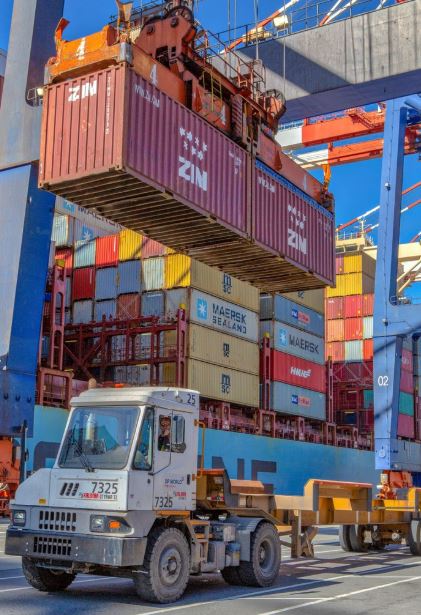
· West coast port unloads declined yesterday – not uncharacteristic of Sunday unloads ‐ reflecting lower unloads at both Vancouver and Prince Rupert.

· Vessel line ups were unchanged overnight but finished out last week at the lowest levels seen in six weeks reflecting improvements at both ports.

· With no scheduled arrivals at Prince Rupert over the next two weeks and despite lower traffic volumes destined to the Port, it is expected that further improvement in this area is realistic; Vancouver on the other hand has 14 vessels scheduled for arrival over the next two weeks which when combined with essentially flat volumes en route to the Port will present challenges in achieving meaningful reductions in this areas.

For more information, go to www.agtransportcoalition.com

* The Ag Transportation Coalition is comprised of the Canadian Canola Growers Association (CCGA), Alberta Wheat Commission (AWC), Pulse Canada, Manitoba Pulse Growers Association (MPGA), Western Grain Elevator Association (WGEA), Saskatchewan Wheat Development Commission, Inland Terminal Association of Canada (ITAC) and the Canadian Special Crops Association (CSCA).

POSTPONED – Phytophthora Root Rot Webinar

Please watch for more information on a new date and time. Sorry for the inconvenience.

Join Dr. Debra McLaren, Crop Production Pathologist, Brandon Research and Development Centre with Agriculture and Agri-Food Canada, as she discusses Phytophthora sojae and how it affects soybeans. Attendees will hear more about Phytophthora sojae in Canadian soybean fields, types of host resistance, pathotype diversity, best management practices, and more. This webinar is co-hosted by Alberta Pulse Growers, Saskatchewan Pulse Growers, Manitoba Pulse & Soybean Growers, and is funded through AAFC’s AgriScience Clusters Program.

Register here.

**Continuing education credits for CCA and CCSC members are available.

Wireworms – We’re Just Seeing the Tip of the Iceberg 

By Neil Whatley, Alberta Agriculture & Forestry

As damage to field crops is poised to escalate, consider proactively finding a wireworm control solution for your area by submitting samples to a member of Canada’s wireworm research team.

Lindane (e.g. Vitavax Dual, etc.) insecticide applied for several decades to crops on the Canadian Prairies kept wireworm numbers low. Since the ban of this organochlorine pesticide in 2004, wireworm damage in field crops is rebounding. Some entomology researcher scientists say we’re just seeing the tip of the iceberg.

Varying from region to region, around 30 different pest wireworm species exhibit diverse behaviours and lifecycles, making a single control measure improbable. An individual region may contain more than one wireworm species.

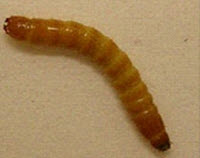
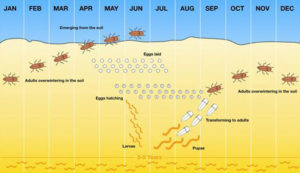
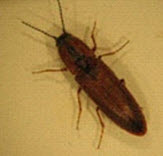
Depending on the species, the worm-like larvae can feed on plant roots and germinating seeds for up to 3 to 5 years before developing into the adult click beetle stage. While current insecticidal seed treatments may repel wireworms for a growing season, their populations continue to increase so that these treatment measures begin to fail. Even these insecticides may be phased out. Clearly, an integrated management method that also applies non-pesticide approaches will be required for optimal wireworm management.

Due to their preference to eat annual or perennial grasses, wireworm populations can build up in fields that have extended periods of cereal crops or pasture. Pulses, oilseeds, potatoes and sugar beets are susceptible to wireworm damage when grown in rotation with cereals. Crops grown in recently broken sod are especially vulnerable. Non-farmed areas like grassy ditches and undisturbed field borders also harbour wireworms and click beetles.

Agriculture and Agri-Food Canada’s (AAFC) wireworm research team is identifying wireworm species and researching new control measures. An integrated management approach includes improved understanding of the contribution of beneficial insects as well as realizing how wireworm communities are affected by various agronomic techniques, including crop rotations. The research team needs to know which specific wireworm species dominates in your farming region so the correct control option(s) can be applied as the problem worsens.

Dr. Haley Catton, cereal crop entomologist of AAFC Lethbridge, is the Prairie representative on this team. The team is asking for producers to submit wireworm species from their fields. Catton and colleagues are writing a wireworm field guide for Alberta, expected to be released later this year.

Early spring, prior to seeding, is the best time to bait and capture wireworms. Due to a greater amount of soil moisture, wireworms migrate upwards near to the soil surface to ultimately come in contact with the rooting zones of plants in the early spring, when the soil temperature rises above 5⁰ C.

Baiting can be as simple as burying a cup of a cereal-based product like flour, bran or wheat seeds to a depth of four to six inches into the soil at marked locations. While wireworms are attracted to the carbon dioxide emitted by germinating plants in the spring, the bait material attracts the worms by mimicking this process prior to plant germination.

Dig up the baits 10 to 14 days later, collecting wireworms and some field soil (not too wet). Sort through the sample and pick out as many wireworms as possible, place in a small vial of rubbing alcohol as preservative.  There may be more than one species present, so collect as many wireworms as possible. Mail your wireworm sample to:

Dr. Haley Catton
Agriculture and Agri-Food Canada
Lethbridge Research and Development Centre
5403 – 1 Ave S
Lethbridge, AB T1J 4B1

Include a brief description of when and where the sample was collected (nearest town or address), information about the crop rotation in the sampled field over the past four years, name and telephone number. Once the species are identified, producers will be contacted with the results.


Pulse grading resources from Making the Grade 2020

This week’s Making the Grade was once again a sold out event. This workshop brings keen and interested farmers, grain buyers, agronomists and others in the industry together to learn about grading of wheat, barley, canola and pulse crops. This year, APG’s Nevin Rosaasen along with Tyler Schmidt from Cotecna took participants through grading of peas, faba beans and red lentils. The following are helpful resources for past participants and those interested in knowing more on grading pulses. Other links include disease, root rots, pea leaf weevil and storage info. Any further questions can be directed to nrosaasen@albertapulse.com.

Official Canada Grain Commission grading for peas – https://www.grainscanada.gc.ca/en/grain-quality/official-grain-grading-guide/16-peas/16-peas-2018-en.pdf

Lentils – https://www.grainscanada.gc.ca/en/grain-quality/official-grain-grading-guide/18-lentils/18-lentils-2018-en.pdf

Faba beans – https://www.grainscanada.gc.ca/en/grain-quality/official-grain-grading-guide/21-fababeans/grading-factors.html

All crops available here: https://www.grainscanada.gc.ca/en/grain-quality/official-grain-grading-guide/

Aphanomyces and Root Rot guide – https://albertapulse.com/wp-content/uploads/2019/05/Root-Rot-Update-1.pdf

Aschochyta scorecard – https://albertapulse.com/wp-content/uploads/2018/06/Ascochyta.pdf

Pea Leaf Weevil survey maps available here: https://albertapulse.com/2019/12/new-pea-leaf-weevil-maps-for-alberta/

Storage of peas and lentils – Improved management of stored pulse crops final report  https://albertapulse.com/wp-content/uploads/2019/09/Final-Research-Update.pdf

Complete a survey to help promote benefits of Canadian pulses – Closing date extended!

Canadian pea and lentil growers are needed to help in promoting the environmental benefit of Canadian pulses. Complete a survey on your production methods here by Feb. 21 for a chance to win a $1,000 Amazon gift card: .

Pulse Canada is developing a complete inventory of data for Canadian pea and lentil production to produce national-level life cycle assessments of Canadian pea and lentil production, which will outline the environmental impacts of these two production systems.

The objectives of the project are to:

  1. Develop representative life cycle inventories for Canadian peas and lentils suitable for incorporation into public LCA databases; and
  2. Develop ISO-compliant life cycle analyses of Canadian pea and lentil production.

This data could be used by food manufacturers and ingredient companies to conduct environmental assessments of pulse ingredients in their products. The data collected is expected to be published by the fall of 2020.

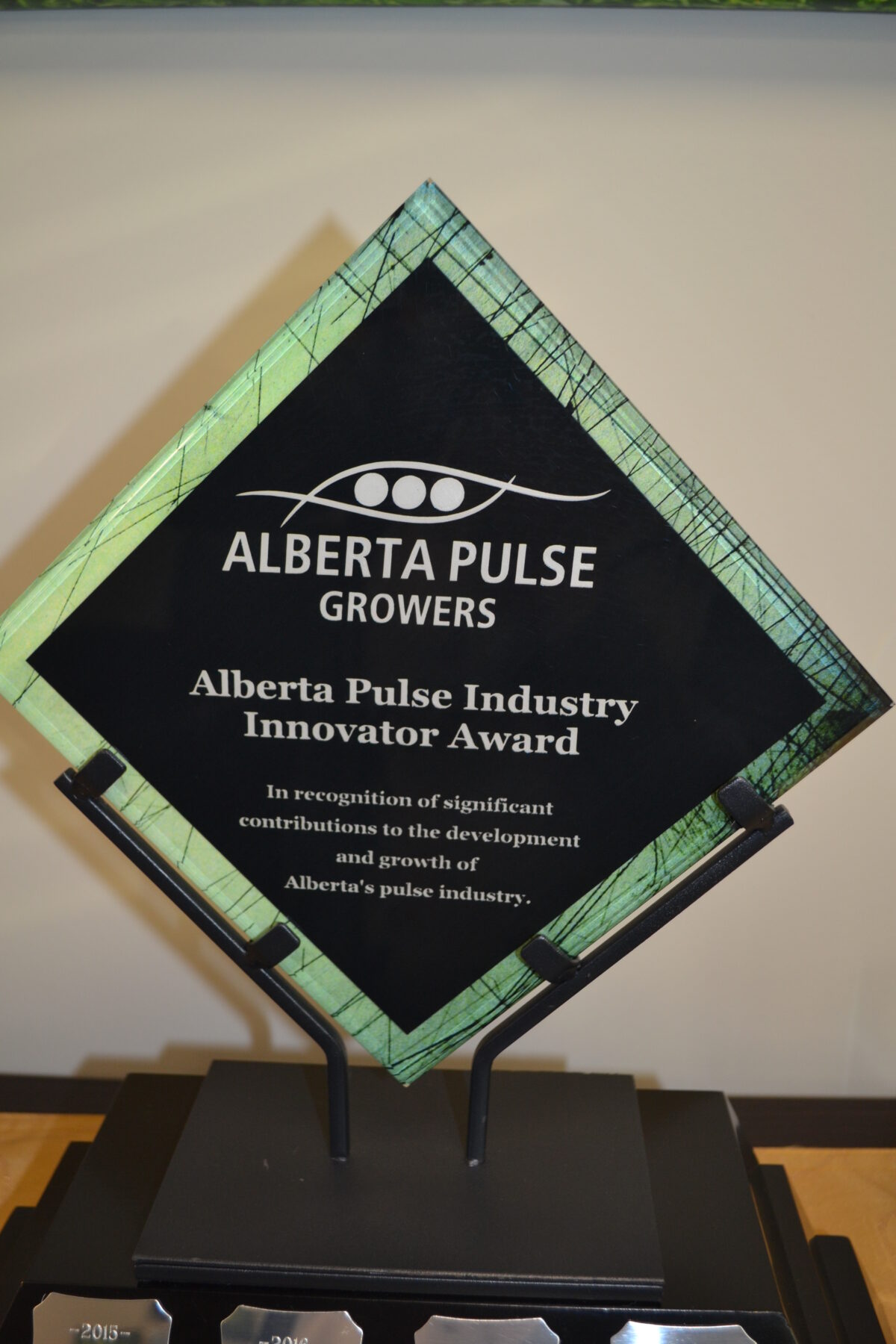
Provincial Pulse Unit Head Mark Olson honoured with 2020 Alberta Pulse Industry Innovator Award

The Alberta Pulse Growers (APG) selected Mark Olson, who continues to be instrumental in building Alberta’s pulse industry, as the winner of the sixth annual Alberta Pulse Industry Innovator Award.

“Mark Olson has had a positive influence on pulse production for more than 30 years in Alberta,” said APG Chair Don Shepert. “He has participated in nearly every aspect of production, extension, innovation, processing and marketing of pulses in Alberta. He continues to research and experiment with new pulse crops that could be added to Alberta crop rotations and further build Alberta’s pulse industry.”

Each year, APG recognizes a person or organization whose progressive thinking and tireless efforts helped build Alberta’s pulse industry into the flourishing sector that it is today.

“It’s really a genuine honour,” Olson said on learning he had been selected to receive this year’s award. “Focusing on pulses throughout my career has been easy because it is a positive crop in so many ways.  These crops fix their nitrogen from the air reducing fertilizer costs and carbon footprint, are high in protein and nutrient dense, the growers I’ve worked with are optimistic and innovative, and best of all the crops put dollars in the pockets of growers making for more sustainable cropping systems.”

Raised on a mixed farm near Stony Plain (west of Edmonton), Olson earned a Bachelor of Science in Agriculture and Masters of Agriculture degree from the University of Alberta. He began working with Alberta Agriculture and Rural Development as a summer technician for special crops at the Crop Diversification Centre South, and then as an assistant district agriculturist in Barrhead and district agriculturist in Sangudo. Olson went on to specialize in pulses and special crops in many positions in several different areas of the province before and after gaining extensive expertise in direct seeding systems during a secondment to the Alberta Reduced Tillage Initiative. In 2011, he was asked to head up the Alberta pulse program within the Crop Research and Extension Division of Alberta Agriculture and Forestry (AF).

In addition to field pea, faba bean, lentil, dry bean and chickpea, Olson and his colleagues began agronomic research and value-added development (fractionation) work on a series of pulse crops never grown before in Alberta, and some that were never grown before in Western Canada, including lupin, mung bean, and winter varieties of pea, lentil, and faba bean.

“I am excited by innovation and the challenge of proving something can be done rather than being dismissive,” he explained. “I was often told that can’t possibly work or that crop can’t grow here, but I truly believe it is the understanding or level of knowledge we have at the time that is the problem. The number of crops that fall into the pulse category make it a very intellectually stimulating area to work in. The farmers that grow pulse crops are leading edge, knowledgeable individuals for whom I have the utmost respect.”

Olson said he has seen Alberta’s small pulse industry of the 1980s grow to include millions of acres and be worth a billion dollars, if one takes into account annual farm gate receipts and the downstream economic benefits.

He said the biggest success story of all the pulses he helped to establish in Alberta is obviously field pea, which is the most widely adapted and grown.

“Although, Saskatchewan has larger pulse acres and gets the majority of credit when it comes to anything pulse related, it was Alberta folks that brought the dry pea we grow today to Western Canada,” he recalled. “Prior to the mid-1980s, very little field pea was grown in Alberta or Western Canada and a large portion of what was grown was processing pea.”

He explained that the dry field pea varieties being bred at the time (i.e. Century, Trapper, Triumph, Tara) were long vined (greater than two metres in length), normal leaf type with poor standability (especially in wet harvest seasons).

“Harry Arnot (Columbia Seeds), Joe St. Denis (grower at Morinville), as well as Blair Roth, Bob Park and Ken Lopetinsky from Alberta Agriculture facilitated the importation of European field pea genetics from companies such as Booker Seeds in the United Kingdom and Cebeco (now Limagrain) in the Netherlands,” Olson recollected. “As well, Alberta Agriculture’s Field Crops Branch in Lacombe assisted in several large screening trials. These first lines were short vine, semi-leafless, and in the case of the Radley green pea also had excellent bleaching resistance. It was the introduction of the semi-leafless characteristic, where tendrils replace the leaves, that was instrumental in providing a crop where the canopy knitted together resulting in better standability and as a result an easier harvest.”

Olson earned many accolades over the course of his career so far, including multiple Alberta Agriculture Teamwork Recognition Awards, Alberta Agriculture Performance Excellence Awards, and Premier’s Awards of Excellence.

“For the research and demonstration work on farm looking at pulse crops and later direct seeding in APG’s Zones 2 and 3 we used whatever equipment the farmer had to seed, spray and harvest trials, which was a great learning experience as young agrologist,” he noted. “AF brought the labour, seed, inoculant, seed treatment and made up plot plans for large size replicated field trials. I really got to know the cooperator-farmers well and learned a whole lot about the slightly different ways of growing pulse crops in a successful way, but I could see what was common (or the absolute musts) between the systems if you were going to have any success. About 15 years into my career, a lot of that information and knowledge was captured in the Pulse Crop in Alberta manual which I co-authored and it won the American Society of Agronomy award that year for best publication.”

The AF Pulse Crops Unit Head has presented his research and participated in trade activities around the world including China, Portugal, Turkey, India and United Arab Emirates.

Olson expects the future of Alberta’s pulse industry to include more new pulses to be grown by Alberta farmers and more fractionation, which builds on the work done by Alberta Agriculture that was “ahead of its time” in the early 2000s.

“I foresee the demand for the plant protein industry to continue which will mean even more pulse acres,” he said. “I can see faba bean acres increasing as companies start to fractionate more than just field pea. I think this is also true for lupin. This is not the Australian lupin that many farmers think of, but European plant materials and we are seeing some high yielding varieties with good adaptation to Alberta. There really needs to be some strong market development in conjunction with fine-tuning of the agronomy of the crop.”

Alberta Pulse Growers celebrated its 25th year as a commission by launching the Alberta Pulse Industry Innovator Award and presenting the organization’s founding president, Lud Prudek, with the first annual award in 2015. Since that time, the award has been presented to esteemed pulse researcher Ken Lopetinsky, life-long pulse supporter Blair Roth, Dr. Hans-Henning Muendel who developed numerous bean cultivars, and Kirsty Ross (Piquette) who was instrumental in building the field pea industry in northeastern Alberta.

TEAM ALBERTA NOTICE OF FARMER LED RESEARCH CONSULTATIONS

Team Alberta urges all farmers and ranchers in Alberta to take part in this government process to decide the future of agricultural research in Alberta. We highly recommend that all farmers provide the government with their views about how research will help their operations grow in the future.

Provide your input on the future of agricultural research in Alberta by January 31, 2020.

Get to one of these meetings and provide your views online here:

Farmer-led research engagement

Public engagement sessions will also be held throughout January. Register for a session below:

Lethbridge, January 13, 10 to 2 pm

Grande Prairie, January 17, 2 to 4 pm

Vermilion, January 21, 9 to 11 am

Camrose, January 21, 2:30 to 4:30 pm

Olds, January 23, 2 to 4 pm

Calgary, January 24, 10 am to 12 pm

Attend the meeting near you to have your say!

Read the pdf that includes a backgrounder here.