Pulse Canada 25-26 Annual Report


Explore the Pulse Canada annual report here.

Western Canadian Weather Roller Coaster Adds Uncertainty
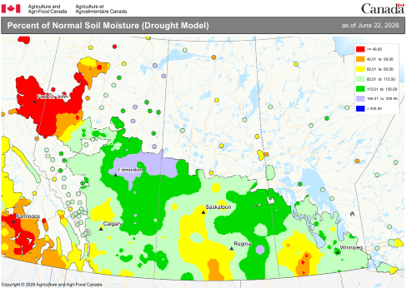
It’s not even the end of June, but the weather in western Canada has already experienced more twists and turns in 2026 than in recent memory, with the biggest changes occurring in the western prairies. It was only a month ago that soil moisture maps for Alberta looked mostly orange and red and there were widespread concerns about possible drought. Now, the moisture maps for Alberta are mainly green and blue, a very quick turnaround.
Various reports from numerous locations show a wide range of crop conditions as of late June. We’re hearing that large parts of Alberta, mostly in central and southern regions, are looking quite positive. Other areas, particularly in the western and northern Peace River region, are still dry. At the other end of the spectrum, reports from northeast and northwest Alberta are telling us about standing water and flooded crops. Other parts of the prairies are experiencing very variable conditions, from “great” to “ugly”.
Most often in western Canada, the biggest problems facing the crop are caused by dry conditions but so far in 2026, the opposite is true. And with more rain on the way, areas that are already too wet won’t be seeing any relief and it may get worse. Which brings us to pulse crops.
Excess moisture is a big problem for all crops, reducing yields and lowering quality, but pulses are even more susceptible to wet conditions and high humidity. Root rot and other diseases flourish under these conditions and have been serious issues in the past, taking their toll on pea, lentil and chickpea crops.
Of course, it’s too soon to make any reliable crop forecasts, either in terms of acreage or yields. StatsCan will release its updated acreage estimates at the end of June, based on a farmer survey, and there could be a few surprises in those numbers that affect crop size. Keep in mind though, planting delays in Saskatchewan and drowned-out low spots in Alberta will trim a few acres from the total. Yields are another question entirely. Last year’s exceptionally high yields will be difficult to repeat, especially if conditions remain wet.
This uncertainty about acres and yields could keep farmers on the marketing sidelines, especially those in areas where conditions are the wettest and the crop outlook is the diciest. Even though forward pricing is an effective risk management practice, holding back on further sales could be a solid marketing decision at this stage of the year. Besides the risk of lower production, historical patterns show that patience could be rewarded. Old-crop bids for yellow peas normally start declining in early June and new-crop bids turn down toward the end of the month. A similar pattern applies for green peas, red lentils and green lentils.
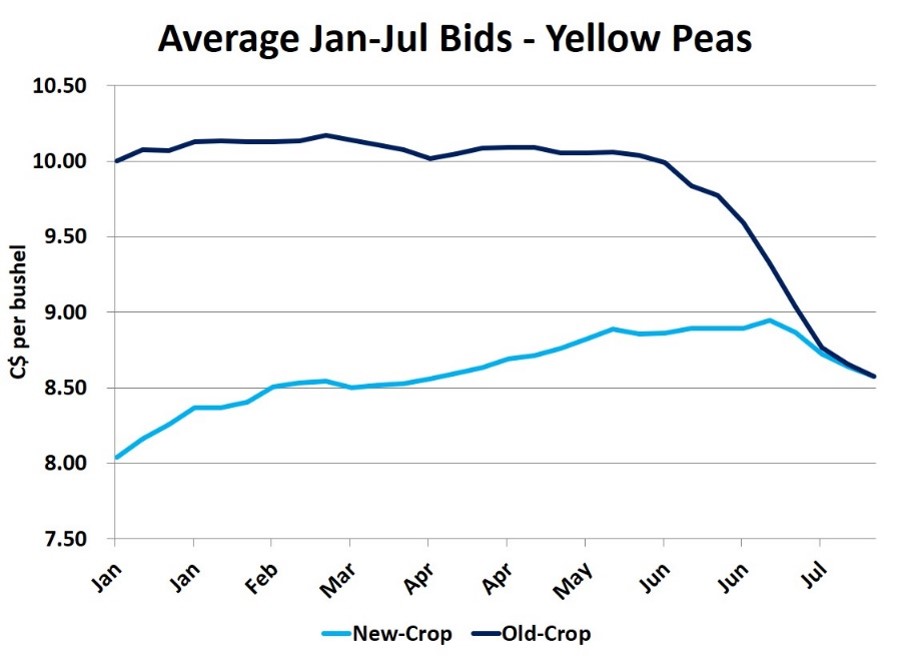
What this chart doesn’t show is that once the harvest is underway, pulse prices tend to start recovering. The size and speed of the rebound varies from year to year, depending on the outcome of Canadian crops, but also due to factors affecting demand. For 2026/27, the precarious situation in India could be the linchpin for pulse markets. With the uncertainties surrounding Canadian pulse crops, including the risk from excess moisture, and concerns about Indian pulse production, waiting on the sidelines to make sales for this year’s crop could turn into a wise choice.
Pulse Market Insight provides market commentary from Chuck Penner of LeftField Commodity Research to help with pulse marketing decisions.
Indian Monsoon Outcome Key for Pulse Outlooks
We think it’s important to not react too quickly to weather events, and particularly forecasts. For example, the crop outlook in western Canada has already made a number of sharp U-turns, and it’s only mid-June. As we get further into the growing season, outcomes will become more certain and the outlook will become clearer.
Even though we don’t want to bet too much on weather forecasts, there is a potential situation in India that certainly bears watching. Recently, the Indian Meteorology Department lowered its rain forecast for the southwest monsoon season to 90% of the long-term average, based on the potential for a large El Niño event. This was the lowest IMD monsoon forecast in at least 20 years. The actual monsoon performance doesn’t always line up with the IMD forecast, but the accuracy of its forecasts seems to be better in recent years.

While there’s plenty of uncertainty in the forecast, it’s worth noting that back in 2014/15 and 2015/16, when India went through two consecutive shortfalls, its pulse imports rose sharply. Large import volumes continued in the following two years and pulse production in Canada and elsewhere rose in response to the high prices. Eventually though, those large imports built up in Indian warehouses and the government imposed import restrictions which caused volumes (and prices) to drop sharply. That lasted until 2023/24, when monsoon rains were below average again and India’s government dropped its tariffs.
This brief history lesson suggests that if Indian monsoon rains are well below average in 2026/27, Indian import demand could rise considerably. Whether that includes a drop in import tariffs – currently 30% for peas and 10% for lentils – remains to be seen. To a large extent, tariff decisions depend on pulse prices within India. If prices rise in response to its smaller pulse crops, the Indian government could try to keep food prices under control by lowering tariffs and easing the way for imports.
If Indian monsoon rains are deficient, Canadian pulse prices could see some improvement. Looking back over the last 15 years, we see the response in Canadian pea and lentil bids in 2014/15 and 2015/16. Keep in mind, the Indian market was responding to two consecutive years of poor monsoon rains, not just one. Back then too, Canada dominated global pulse trade with a lot less competition from other pulse exporters, which added to the upside. After that though, the high prices caused pulse production to rise sharply in western Canada and other countries, which caused prices to cycle lower.
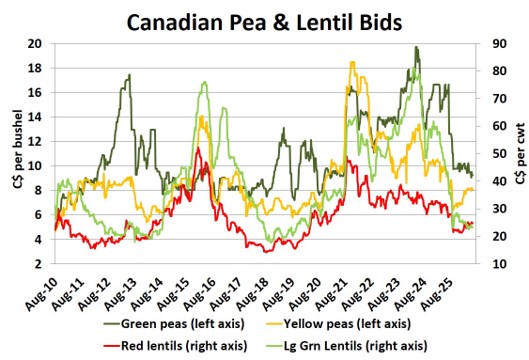
Of course, pulse prices are influenced by numerous factors, not just Indian trade. For example, the sharp rally in 2021/22 occurred when India was restricting pulse imports and was mostly driven by the drought in western Canada.
Overall, a shortfall in Indian monsoon rains should benefit Canadian pulse prices but in crop markets, there are no crystal balls and no sure things. While a marketing strategy for 2026/27 could include waiting to see how the Indian situation develops and delaying some sales until later in the year, it’s important (as always) not to put all the “marketing eggs” in one basket.
Pulse Market Insight provides market commentary from Chuck Penner of LeftField Commodity Research to help with pulse marketing decisions.
Alberta’s three largest crop commissions, Alberta Canola, Alberta Grains and Alberta Pulse Growers, have launched a new mobile app for Alberta’s Crop Protection Guide, better known as the Blue Book, giving farmers and agronomists convenient, on the go access to crop protection guidance.
Developed collaboratively by the three commissions, the Blue Book app is now available for download on Apple and Android devices. This launch follows feedback gathered in 2024, when producers and agronomists identified a growing need for a mobile-friendly version of the long-standing resource.
“This app is about putting practical, science-based information directly into the hands of farmers and agronomists when and where they need it,” said Alberta Grains Chair Scott Jespersen. “The Blue Book has been a trusted resource for decades and this next step ensures it continues to support informed decision-making on farms across Alberta.”
The Blue Book has supported Alberta farmers since 1977, offering guidance on pesticide application, product selection and farm safety. The new app builds on that foundation by improving accessibility while maintaining the reliability users expect.
“The Blue Book has evolved with the needs of farmers for nearly five decades, and this app is the next step in that evolution,” said Alberta Canola Chair Andre Harpe. “Moving to a digital format makes it even faster and easier for users to access important crop protection guidance in the field or on the go.”
At its core, the app features a comprehensive product database. It includes information on more than 700 registered crop protection products, including active ingredients, application details and direct links to product labels. Advanced search and filtering tools allow users to identify products based on pest, crop, product name or active ingredient.
Users can also compare products side by side to support decisions based on their cropping system and management goals. The app includes familiar Blue Book tools such as herbicide, fungicide, insecticide and seed treatment selector charts, along with guidance on product use and best management practices.
“Crop protection decisions are increasingly complex and timing is critical,” said Alberta Pulse Growers Chair Will Muller. “This app helps bring together the information farmers and agronomists need in one place so they can compare options and make confident, informed decisions for their operations.”
Designed for real-world farm conditions, the app includes offline functionality, ensuring access to critical information even in areas with limited connectivity.
The Blue Book is reviewed and updated annually with input from crop protection companies and industry experts, ensuring users have access to the most current information available. The app complements the print edition, which will continue to be produced and distributed.
The Blue Book app is available at both the Apple and Google Play App Stores for an annual subscription price of $20. More information can be found at albertabluebook.com.
Media Contacts:
Michelle Chunyua
Director of Communications
Alberta Canola
michelle@albertacanola.com
780-224-7970
Harley Groeneveld
Senior Manager, Communications & Marketing
Alberta Grains
hgroeneveld@albertagrains.com
403-371-2132
Rachel Peterson
Communications Manager
Alberta Pulse Growers
rpeterson@albertapulse.com
780-986-9398 ext. 108
APG’s Nodulation Scorecard calculator is now available on the app! Use this tool to estimate nodule health and nitrogen fixation potential for all pulse crops. This is the standard method used by pulse scientists and agronomists. Check out this valuable tool under Calculators on the APG app. Click here to download the app.
Better Outlook for 2026/27 Pea Demand
The Canadian pea market has been affected by import restrictions by its major customers for quite a few years. In fact, there hasn’t been a full marketing year that hasn’t seen some sort of Indian or Chinese trade barrier since 2016/17. While not all restrictions have gone away, prospects for 2026/27 are looking brighter and should mean better movement and prices.
The biggest impact should be seen in yellow peas. Back in November 2017, India imposed 50% import tariffs on Canadian yellow and green peas, as well as restrictions on the number of tonnes allowed into the country. For yellow peas, that lasted until December 2023 but has continued for greens. Once those restrictions were dropped, yellow peas were allowed into India with zero tariffs until November 2025, when 30% tariffs were reimposed. China had been importing Canadian peas without any restrictions until March 2025, when it imposed 100% tariffs. These tariffs lasted for a full year, and pea exports to China are just starting to show up again in the StatsCan trade data.
The combined effect of these Indian and Chinese restrictions is that since 2016/17, there hasn’t been a single complete marketing year without some sort of barrier to Canadian pea exports. For example, the 2025/26 marketing year included 30% Indian tariffs since November 2025 and 100% Chinese tariffs from August 2025 to February 2026. Fortunately, pea imports by other Asian countries such as Bangladesh and Pakistan helped fill in the demand gap.
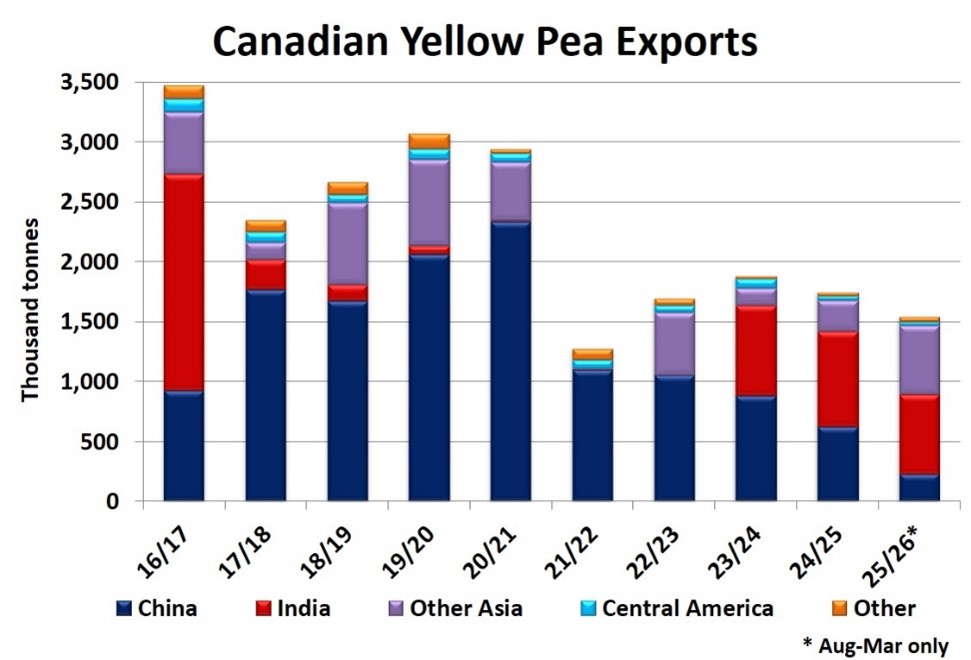
For 2026/27, the crop year will start with a brighter outlook. India still has its 30% import tariffs, although those aren’t high enough to stop trade entirely. And if, as some observers are forecasting, El Niño causes a shortfall in monsoon rains, India may need to lower those trade barriers later. More importantly, China will be back in the market for the full 2026/27 marketing year. With both of Canada’s two dominant buyers looking for yellow peas this fall and beyond, demand will be strong and will help draw down supplies to lower levels. All else equal, that should support prices.
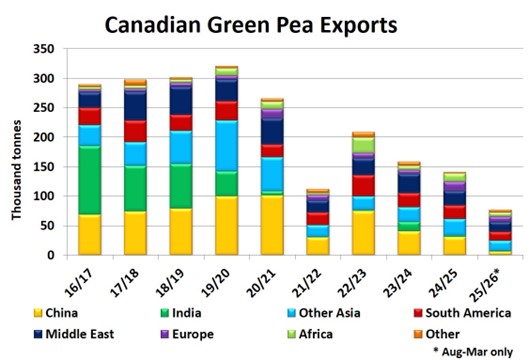
The situation for green peas won’t change as much. Canadian green pea exports are more broadly dispersed across more buyers, so India and China don’t dominate quite as much as in yellow peas. India still maintains 50% tariffs and volume restrictions on green pea imports, which has shut down trade. On a positive note, China will return as a buyer and should help with early-season movement. One note of caution though: the volume of Canadian green pea exports has been trending lower for several years. The situation in late 2024/25 and the first seven months of 2025/26 was affected by Chinese tariffs but the outlook is still a bit concerning.
Of course, a lot can change in 2026/27. Canadian pea production is very much an open question, as are crops in other competing exporters. The monsoon situation in India and the possible effect on its kharif and rabi crops is the other big variable that could cause big shifts on the demand side of the equation. For now, it looks like 2026/27 could turn into a more positive year for Canadian pea markets.
Pulse Market Insight provides market commentary from Chuck Penner of LeftField Commodity Research to help with pulse marketing decisions.
Third Quarter Scorecard Positive for Pulses
More acreage and very high yields meant much bigger Canadian pulse crops in 2025. Pea and lentil crops were each nearly 1.0 mln tonnes larger than 2024 and chickpea production was up by almost 200,000 tonnes. And for each crop, the carryover from 2024/25 into 2025/26 was also large, which added to the big supplies.
With pulse crops facing extremely heavy supplies, a serious increase in export volumes was needed in 2025/26 to keep markets from being pressured (even) lower. And early in the marketing year, prospects weren’t great. In fact, the most positive developments only started to show up in the third quarter of the 2025/26 marketing year. While that doesn’t leave a lot of time to “fix” the heavy supply situation, the outlook is certainly brighter than it was a few months ago.
Prospects were especially dim for peas earlier in 2025/26, with Chinese tariffs essentially shutting off that important outlet for Canadian peas. Indian demand was mediocre but other countries stepped up and kept pea exports flowing at a decent pace. Of course, the big pea supplies meant “decent” exports weren’t enough. Fortunately, China announced in January that it was dropping its tariffs, triggering a sharp improvement in exports by late February.

The chart above only shows bulk pea (mostly yellow) exports reported by the CGC but it clearly demonstrates how things have changed. As of week 39, the end of the third quarter, bulk pea exports reached 2.08 mln tonnes compared to 1.58 mln tonnes in 2024/25. Even if the pace moderates in the final quarter, Canadian exports will remain strong, the most since 2020/21. That means 2025/26 pea ending stocks will be large but not massive, which was certainly a concern earlier in the year.
The chart below shows the CGC data for bulk lentil exports, which would largely be red lentils. Exports were good through the first half of 2025/26, keeping pace with the previous year and well above average. That said, to offset the big increase in the 2025 crop, exports needed to be more than “good”; great exports where necessary. Fortunately, the pace of exports turned strongly higher starting in late February, in sharp contrast to the 2024/25 slowdown.
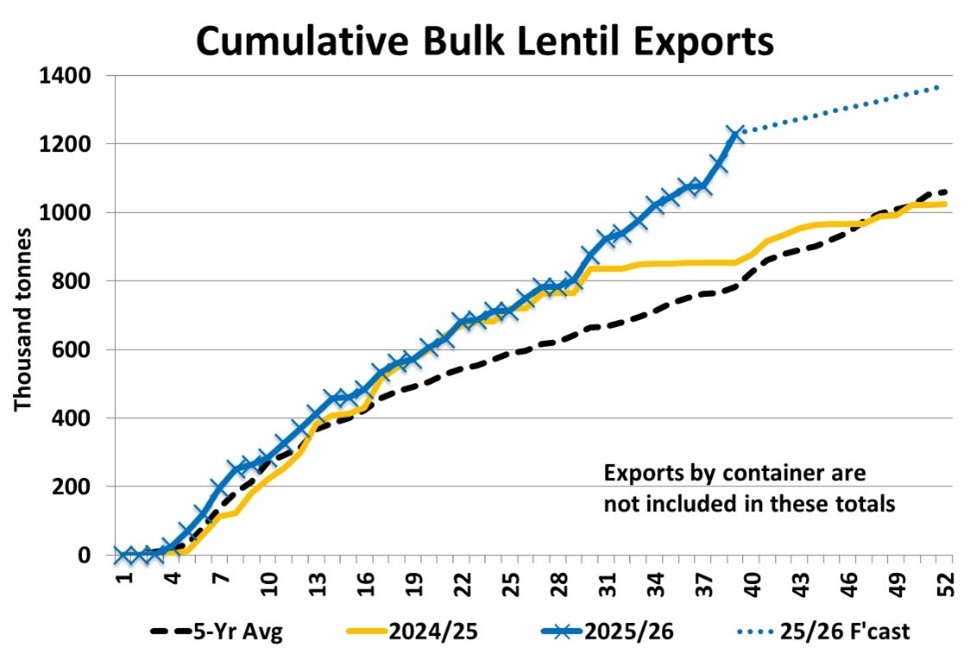
By the end of the third quarter of 2025/26, bulk lentil exports reached 1.23 mln tonnes versus the average of 0.78 mln tonnes. Even if exports slow in the fourth quarter, as they sometimes do, the full-year total should be the most since 2020/21. That’s good news for the red lentil market as those ending stocks will be reasonably large but not massive, and better than expected earlier this year. The CGC export numbers don’t reflect green lentil exports but the StatsCan data to the end of March shows above-average volumes of green lentil exports. Unfortunately, that pace isn’t nearly enough to draw down the huge stockpile of Canadian green lentils, so the heavy supplies will continue.
Among the pulses, chickpeas are showing the best export performance in 2025/26, with a record pace. The CGC doesn’t report chickpea exports, as those are all done by truck to the US or by container but StatsCan’s exports to the end of March are 168,000 tonnes, far ahead of the average of 121,000 tonnes. While that’s very positive, there are still lots of chickpeas, including low quality, still on farms. But the trend is in the right direction. That hasn’t been enough to lift chickpea prices but has at least kept him stable.
Pulse Market Insight provides market commentary from Chuck Penner of LeftField Commodity Research to help with pulse marketing decisions.
Supply Outlook and Carry-Over Stocks
It’s far too early to make solid predictions about the size of 2026 crops. Seeded area could have changed since StatsCan’s early forecasts. And of course, yields prior to planting are a complete unknown. At this stage in our 2026/27 production outlooks, we use an average yield as that would have the highest odds. Suffice to say, predictions in May about crop size are tentative at best.
While the upcoming crop forecasts are a bit “foggy”, one part of next year’s supply situation is a bit clearer. With the 2025/26 marketing year three-quarters complete, we’re getting a better idea of the tonnes that will be left at the end of the year and carried over into 2026/27. One thing that’s very apparent this year is that the situation is quite different for the individual classes within each pulse crop. Supplies of green lentils and green peas are very different than red lentils and yellow peas.
Overall, pea supplies at the end of 2025/26 will be quite comfortable, somewhere over 700,000 tonnes. That said, the good news is that we’ve trimmed this estimate a few times as export prospects improved, especially after China dropped its tariffs. On the surface, ending stocks of yellow peas look a lot larger than green peas as the absolute number of tonnes is almost twice as large.

The more important measure is the stocks/use (S/U) ratio, which looks at the number of tonnes left over, as a percent of usage (exports, feed, processing and seed). For yellow peas, the ending stocks of 470,000 tonnes represent only 15% of usage, not far off from the last few years. Even though green pea ending stocks are smaller at 250,000 tonnes, that works out to more than 40% of usage. For the 2026/27 outlook, this means the yellow pea carryover isn’t nearly as heavy, while the green pea market will be facing a relatively larger supply cushion.
It’s a similar situation for the Canadian lentil market, with very large supplies expected at the end of 2025/26. Exports have been strong so far this year, but not enough to match the increase in the record 2025 crop. There is a sizable difference between ending stocks for red and green lentils. Typically, red lentil stocks are much larger than greens but in 2025/26, that situation flipped around. Our forecast is that July 31 red lentil stocks will be 630,000 tonnes, with a stocks/use ratio of 35-40%. The green lentil crop in 2025 was more than double last year and even with solid exports, 850,000 tonnes will be left at the end of the year. The stocks/use ratio close to 100% means that there will almost be enough green lentils carried over to meet all of next year’s demand. That’s very burdensome and means that drawing down those supplies will take some time.
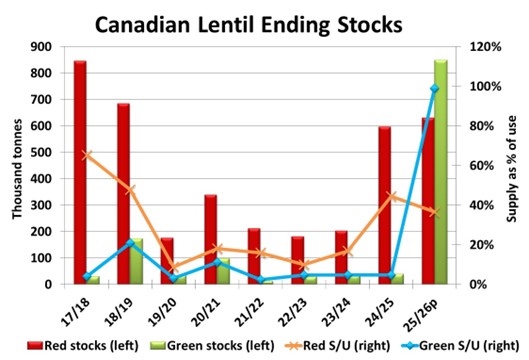
Not to be left out, ending stocks of Canadian chickpeas will also be very large, even though 2025/26 exports are running at a record pace. The 260,000 tonnes we’re expecting will be left at the end of this marketing year is close to the old highs of five or so years ago, although we’ve heard that a sizable portion this year are poor quality. The stocks/use ratio close to 75% is also quite large but may not feel quite as heavy as a few years ago, when stocks/use was well over 100%.

The large supplies for most pulses have implications for the possible impact of lower (or higher) production in 2026. If there is a problem with yields in 2026, those pulses with very large old-crop carryover, like green lentils and green peas, will see less of a price response. And if crops perform well again next year, the lows in those markets will be extended. On the other hand, there’s a smaller cushion for yellow peas and red lentils, and a production issue would generate a larger price response.
Pulse Market Insight provides market commentary from Chuck Penner of LeftField Commodity Research to help with pulse marketing decisions.
A new economic analysis finds a single week of rail and port disruptions during peak export season costs Canada’s grain sector up to $540 million, largely in unrecoverable export sales.
The analysis, commissioned by the Agriculture Transport Coalition, examined the economic impact of labour disruptions across rail and port operations during peak grain export periods and found that losses compound rapidly and fall disproportionately on farmers and exporters, with missed sales that cannot be recovered once shipments are delayed.
The coalition released the findings today as part of Too Much on the Line, a national campaign calling on the federal government to reform Canada’s labour relations framework and reduce the risk of future supply chain shutdowns.
The coalition is encouraging Canadians to visit KeepGrainMoving.ca and send a letter to their Member of Parliament, adding that participation in the federal consultation process is critical to ensuring government decisions reflect the economic realities of Canada’s grain supply chain.
“Every time grain stops moving, the consequences are immediate and unrecoverable,” said Bruce Burrows, executive director of Grain Growers of Canada. “Missed sales, broken contracts, and a reputation as a reliable supplier that takes years to rebuild. Canada cannot keep accepting this as the cost of doing business. There is simply too much on the line.”
The grain sector is uniquely exposed. Canada exports over 70 per cent of its grain production, with 94 per cent moving by rail. The analysis found that even the threat of disruption triggers losses, with up to $112 million in missed sales occurring before a work stoppage begins.
The findings come against the backdrop of the unprecedented dual railway stoppage in 2024, which brought grain shipments to a halt and cost the sector millions of dollars per day. Repeated disruptions have raised questions about Canada’s reliability as a global supplier at a time when agricultural exports are central to economic resilience.
With federal consultations on the labour relations framework now underway, the coalition is calling for two targeted recommendations:
• Ensure good-faith bargaining by appointing a Special Mediator to oversee collective bargaining, manage timelines, and ensure progress
• Resolve disputes before they escalate by providing the Minister with authority to consider economic harm and refer disputes to binding arbitration when necessary
“Canada’s customers expect reliability, and repeated disruptions put that at risk,” said Greg
Northey, vice president of corporate affairs with Pulse Canada. “With so much on the line, this is a critical moment to ensure the right policy framework is in place.”
The coalition said it will continue to engage with government and stakeholders throughout the consultation process, with a focus on advancing solutions that protect Canada’s reputation, support farmers, and strengthen long-term competitiveness.
For media inquiries, please contact:
Hana Sabah
hana@graingrowers.ca | (514) 834-8841
Seasonal Tipping Points Approaching
Performance in pulse markets has been very mixed this year, with some notable shifts recently. Prices for yellow peas and red lentils have shown some decent gains over the past couple of months. Others like green peas and green lentils are looking weaker, while kabuli chickpeas are steady.
When viewing the latest trends in these crops, especially the positive ones, it’s natural to expect (or hope) they’ll continue. As the old saying goes, “the trend is your friend”. There are solid fundamental reasons, particularly stronger export demand, behind the improvements in yellow pea and red lentil prices. And yet, these markets won’t keep climbing indefinitely. Prices trend higher, until they stop.
Fortunately, history provides a timeline of when that turn lower will happen. The most consistent part of seasonal price behaviour is the decline that happens virtually every summer. Even in 2021/22, with a severe drought underway, prices started to dip in summer before rallying.
While every year is a bit different, the main reasons behind the summer downturn are straightforward. Once the seed is in the ground, buyers back off from the market as they wait for the upcoming crop, even if it’s expected to be a bit smaller. At the same time, more farmers look at emptying bins and finishing old-crop sales. Overall, market activity slows ahead of the slug of harvest deliveries. The chart for yellow peas shows the seasonal index starting to decline a couple of months before harvest and hitting a bottom when off-the-combine deliveries peak.

Even though there can be a bit of “wiggle room” on the exact timing, this price behaviour is very consistent and predictable. In fact, it’s basically inevitable with the rare exception of a crop failure on the order of 2021/22. And yet, the price drop that happens every summer still seems to catch some people off guard, making them wonder what’s wrong with the market.
The chart above shows that for yellow peas, there isn’t an obvious spring peak in prices; it’s more of a “plateau”. That said, the drop-off in early summer is clear-cut, which starts around mid-May and accelerates lower by mid-June. For red lentils, there’s a more obvious peak in the seasonal index which also occurs in mid-May before turning steadily lower and bottoming out in mid-September. For red lentils however, the seasonal pattern shows there’s not as much of a postharvest recovery.
The seasonal index for all crops is at its most predictable at this time of year and can provide guidance for timing of remaining old-crop sales. The chart below shows how and when red lentil prices will change, assuming they’ll follow the seasonal timing. As of mid-April, the average bid in western Canada was just over 25 cents per pound. On average (the red line), seasonal behaviour indicates a small increase is likely four weeks out (mid-May). At eight weeks from now (mid-June), prices will be past the seasonal peak but won’t have dropped much yet. At twelve weeks out (mid-July) though, the seasonal pattern will have turned lower.

Of course, not every year follows the average tendency exactly. The blue (maximum) line on the chart shows the best price performance for the next 12 weeks, over the last 15 years. It’s worth noting that even in the most bullish year, prices still turned down by mid-July. There’s also a worst-case outcome, when red lentil prices started declining earlier than usual and dropped sharply over the following 12 weeks.
While each crop and each year is slightly different, the seasonal declines in summer are very clear and consistent market signals. Unless there’s a reason to hold the crop through the summer lows and into the next marketing year, this price behaviour is a strong incentive to make sales in the next few weeks.
Pulse Market Insight provides market commentary from Chuck Penner of LeftField Commodity Research to help with pulse marketing decisions.