Contact

Pulse Market Insight #298

Third Quarter Scorecard Positive for Pulses

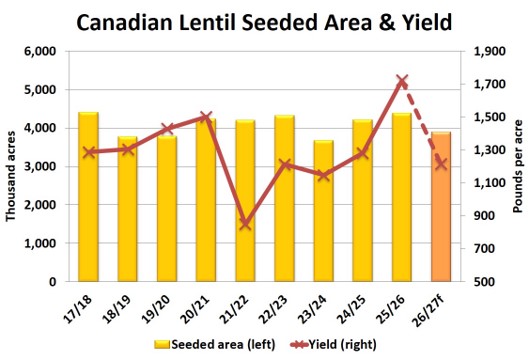
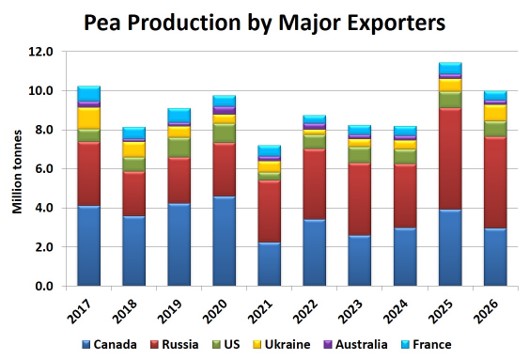
More acreage and very high yields meant much bigger Canadian pulse crops in 2025. Pea and lentil crops were each nearly 1.0 mln tonnes larger than 2024 and chickpea production was up by almost 200,000 tonnes. And for each crop, the carryover from 2024/25 into 2025/26 was also large, which added to the big supplies.

With pulse crops facing extremely heavy supplies, a serious increase in export volumes was needed in 2025/26 to keep markets from being pressured (even) lower. And early in the marketing year, prospects weren’t great. In fact, the most positive developments only started to show up in the third quarter of the 2025/26 marketing year. While that doesn’t leave a lot of time to “fix” the heavy supply situation, the outlook is certainly brighter than it was a few months ago.

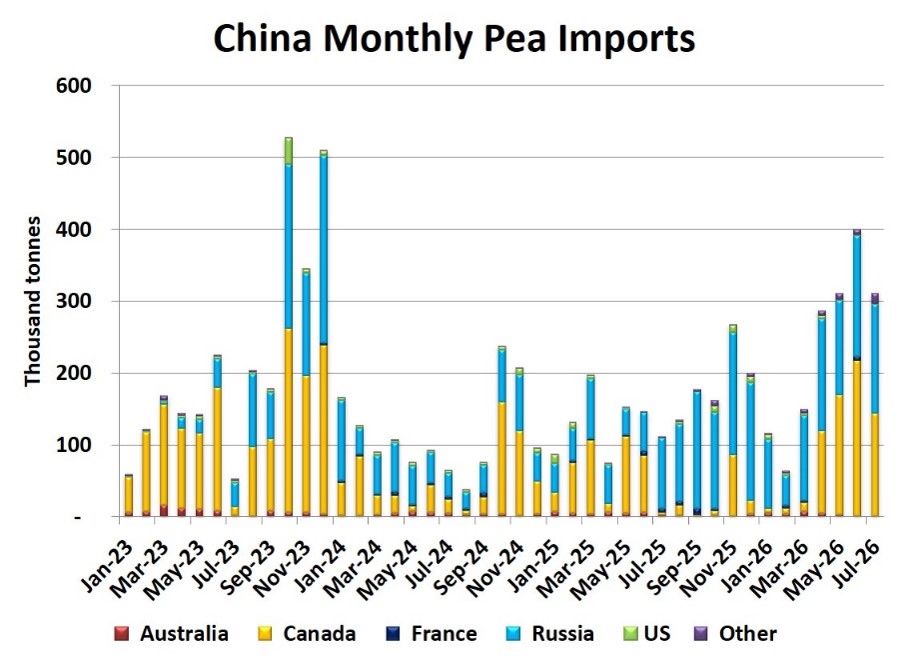
Prospects were especially dim for peas earlier in 2025/26, with Chinese tariffs essentially shutting off that important outlet for Canadian peas. Indian demand was mediocre but other countries stepped up and kept pea exports flowing at a decent pace. Of course, the big pea supplies meant “decent” exports weren’t enough. Fortunately, China announced in January that it was dropping its tariffs, triggering a sharp improvement in exports by late February.

The chart above only shows bulk pea (mostly yellow) exports reported by the CGC but it clearly demonstrates how things have changed. As of week 39, the end of the third quarter, bulk pea exports reached 2.08 mln tonnes compared to 1.58 mln tonnes in 2024/25. Even if the pace moderates in the final quarter, Canadian exports will remain strong, the most since 2020/21. That means 2025/26 pea ending stocks will be large but not massive, which was certainly a concern earlier in the year.

The chart below shows the CGC data for bulk lentil exports, which would largely be red lentils. Exports were good through the first half of 2025/26, keeping pace with the previous year and well above average. That said, to offset the big increase in the 2025 crop, exports needed to be more than “good”; great exports where necessary. Fortunately, the pace of exports turned strongly higher starting in late February, in sharp contrast to the 2024/25 slowdown.

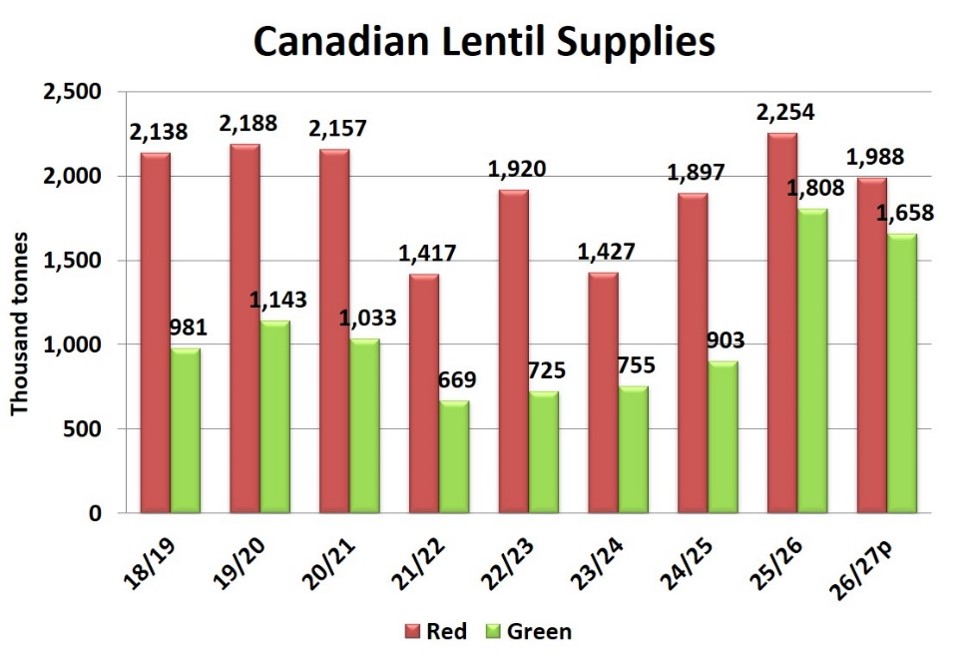
By the end of the third quarter of 2025/26, bulk lentil exports reached 1.23 mln tonnes versus the average of 0.78 mln tonnes. Even if exports slow in the fourth quarter, as they sometimes do, the full-year total should be the most since 2020/21. That’s good news for the red lentil market as those ending stocks will be reasonably large but not massive, and better than expected earlier this year. The CGC export numbers don’t reflect green lentil exports but the StatsCan data to the end of March shows above-average volumes of green lentil exports. Unfortunately, that pace isn’t nearly enough to draw down the huge stockpile of Canadian green lentils, so the heavy supplies will continue.

Among the pulses, chickpeas are showing the best export performance in 2025/26, with a record pace. The CGC doesn’t report chickpea exports, as those are all done by truck to the US or by container but StatsCan’s exports to the end of March are 168,000 tonnes, far ahead of the average of 121,000 tonnes. While that’s very positive, there are still lots of chickpeas, including low quality, still on farms. But the trend is in the right direction. That hasn’t been enough to lift chickpea prices but has at least kept him stable.

Pulse Market Insight provides market commentary from Chuck Penner of LeftField Commodity Research to help with pulse marketing decisions.

Pulse Market Insight #297

Supply Outlook and Carry-Over Stocks

It’s far too early to make solid predictions about the size of 2026 crops. Seeded area could have changed since StatsCan’s early forecasts. And of course, yields prior to planting are a complete unknown. At this stage in our 2026/27 production outlooks, we use an average yield as that would have the highest odds. Suffice to say, predictions in May about crop size are tentative at best.

While the upcoming crop forecasts are a bit “foggy”, one part of next year’s supply situation is a bit clearer. With the 2025/26 marketing year three-quarters complete, we’re getting a better idea of the tonnes that will be left at the end of the year and carried over into 2026/27. One thing that’s very apparent this year is that the situation is quite different for the individual classes within each pulse crop. Supplies of green lentils and green peas are very different than red lentils and yellow peas.

Overall, pea supplies at the end of 2025/26 will be quite comfortable, somewhere over 700,000 tonnes. That said, the good news is that we’ve trimmed this estimate a few times as export prospects improved, especially after China dropped its tariffs. On the surface, ending stocks of yellow peas look a lot larger than green peas as the absolute number of tonnes is almost twice as large.

The more important measure is the stocks/use (S/U) ratio, which looks at the number of tonnes left over, as a percent of usage (exports, feed, processing and seed). For yellow peas, the ending stocks of 470,000 tonnes represent only 15% of usage, not far off from the last few years. Even though green pea ending stocks are smaller at 250,000 tonnes, that works out to more than 40% of usage. For the 2026/27 outlook, this means the yellow pea carryover isn’t nearly as heavy, while the green pea market will be facing a relatively larger supply cushion.

It’s a similar situation for the Canadian lentil market, with very large supplies expected at the end of 2025/26. Exports have been strong so far this year, but not enough to match the increase in the record 2025 crop. There is a sizable difference between ending stocks for red and green lentils. Typically, red lentil stocks are much larger than greens but in 2025/26, that situation flipped around. Our forecast is that July 31 red lentil stocks will be 630,000 tonnes, with a stocks/use ratio of 35-40%. The green lentil crop in 2025 was more than double last year and even with solid exports, 850,000 tonnes will be left at the end of the year. The stocks/use ratio close to 100% means that there will almost be enough green lentils carried over to meet all of next year’s demand. That’s very burdensome and means that drawing down those supplies will take some time.

Not to be left out, ending stocks of Canadian chickpeas will also be very large, even though 2025/26 exports are running at a record pace. The 260,000 tonnes we’re expecting will be left at the end of this marketing year is close to the old highs of five or so years ago, although we’ve heard that a sizable portion this year are poor quality. The stocks/use ratio close to 75% is also quite large but may not feel quite as heavy as a few years ago, when stocks/use was well over 100%.

The large supplies for most pulses have implications for the possible impact of lower (or higher) production in 2026. If there is a problem with yields in 2026, those pulses with very large old-crop carryover, like green lentils and green peas, will see less of a price response. And if crops perform well again next year, the lows in those markets will be extended. On the other hand, there’s a smaller cushion for yellow peas and red lentils, and a production issue would generate a larger price response.

Pulse Market Insight provides market commentary from Chuck Penner of LeftField Commodity Research to help with pulse marketing decisions.
“Too Much on the Line” campaign launched as new study reveals the cost of supply chain disruptions

A new economic analysis finds a single week of rail and port disruptions during peak export season costs Canada’s grain sector up to $540 million, largely in unrecoverable export sales.

The analysis, commissioned by the Agriculture Transport Coalition, examined the economic impact of labour disruptions across rail and port operations during peak grain export periods and found that losses compound rapidly and fall disproportionately on farmers and exporters, with missed sales that cannot be recovered once shipments are delayed.

The coalition released the findings today as part of Too Much on the Line, a national campaign calling on the federal government to reform Canada’s labour relations framework and reduce the risk of future supply chain shutdowns.

The coalition is encouraging Canadians to visit KeepGrainMoving.ca and send a letter to their Member of Parliament, adding that participation in the federal consultation process is critical to ensuring government decisions reflect the economic realities of Canada’s grain supply chain.

“Every time grain stops moving, the consequences are immediate and unrecoverable,” said Bruce Burrows, executive director of Grain Growers of Canada. “Missed sales, broken contracts, and a reputation as a reliable supplier that takes years to rebuild. Canada cannot keep accepting this as the cost of doing business. There is simply too much on the line.”

The grain sector is uniquely exposed. Canada exports over 70 per cent of its grain production, with 94 per cent moving by rail. The analysis found that even the threat of disruption triggers losses, with up to $112 million in missed sales occurring before a work stoppage begins.

The findings come against the backdrop of the unprecedented dual railway stoppage in 2024, which brought grain shipments to a halt and cost the sector millions of dollars per day. Repeated disruptions have raised questions about Canada’s reliability as a global supplier at a time when agricultural exports are central to economic resilience.

With federal consultations on the labour relations framework now underway, the coalition is calling for two targeted recommendations:
• Ensure good-faith bargaining by appointing a Special Mediator to oversee collective bargaining, manage timelines, and ensure progress
• Resolve disputes before they escalate by providing the Minister with authority to consider economic harm and refer disputes to binding arbitration when necessary

“Canada’s customers expect reliability, and repeated disruptions put that at risk,” said Greg
Northey, vice president of corporate affairs with Pulse Canada. “With so much on the line, this is a critical moment to ensure the right policy framework is in place.”

The coalition said it will continue to engage with government and stakeholders throughout the consultation process, with a focus on advancing solutions that protect Canada’s reputation, support farmers, and strengthen long-term competitiveness.

For media inquiries, please contact:
Hana Sabah
hana@graingrowers.ca | (514) 834-8841

Pulse Market Insight #296

Seasonal Tipping Points Approaching

Performance in pulse markets has been very mixed this year, with some notable shifts recently. Prices for yellow peas and red lentils have shown some decent gains over the past couple of months. Others like green peas and green lentils are looking weaker, while kabuli chickpeas are steady.

When viewing the latest trends in these crops, especially the positive ones, it’s natural to expect (or hope) they’ll continue. As the old saying goes, “the trend is your friend”. There are solid fundamental reasons, particularly stronger export demand, behind the improvements in yellow pea and red lentil prices. And yet, these markets won’t keep climbing indefinitely. Prices trend higher, until they stop.

Fortunately, history provides a timeline of when that turn lower will happen. The most consistent part of seasonal price behaviour is the decline that happens virtually every summer. Even in 2021/22, with a severe drought underway, prices started to dip in summer before rallying.

While every year is a bit different, the main reasons behind the summer downturn are straightforward. Once the seed is in the ground, buyers back off from the market as they wait for the upcoming crop, even if it’s expected to be a bit smaller. At the same time, more farmers look at emptying bins and finishing old-crop sales. Overall, market activity slows ahead of the slug of harvest deliveries. The chart for yellow peas shows the seasonal index starting to decline a couple of months before harvest and hitting a bottom when off-the-combine deliveries peak.

Even though there can be a bit of “wiggle room” on the exact timing, this price behaviour is very consistent and predictable. In fact, it’s basically inevitable with the rare exception of a crop failure on the order of 2021/22. And yet, the price drop that happens every summer still seems to catch some people off guard, making them wonder what’s wrong with the market.

The chart above shows that for yellow peas, there isn’t an obvious spring peak in prices; it’s more of a “plateau”. That said, the drop-off in early summer is clear-cut, which starts around mid-May and accelerates lower by mid-June. For red lentils, there’s a more obvious peak in the seasonal index which also occurs in mid-May before turning steadily lower and bottoming out in mid-September. For red lentils however, the seasonal pattern shows there’s not as much of a postharvest recovery.

The seasonal index for all crops is at its most predictable at this time of year and can provide guidance for timing of remaining old-crop sales. The chart below shows how and when red lentil prices will change, assuming they’ll follow the seasonal timing. As of mid-April, the average bid in western Canada was just over 25 cents per pound. On average (the red line), seasonal behaviour indicates a small increase is likely four weeks out (mid-May). At eight weeks from now (mid-June), prices will be past the seasonal peak but won’t have dropped much yet. At twelve weeks out (mid-July) though, the seasonal pattern will have turned lower.

Of course, not every year follows the average tendency exactly. The blue (maximum) line on the chart shows the best price performance for the next 12 weeks, over the last 15 years. It’s worth noting that even in the most bullish year, prices still turned down by mid-July. There’s also a worst-case outcome, when red lentil prices started declining earlier than usual and dropped sharply over the following 12 weeks.

While each crop and each year is slightly different, the seasonal declines in summer are very clear and consistent market signals. Unless there’s a reason to hold the crop through the summer lows and into the next marketing year, this price behaviour is a strong incentive to make sales in the next few weeks.

Pulse Market Insight provides market commentary from Chuck Penner of LeftField Commodity Research to help with pulse marketing decisions.

Pulse Market Insight #295

Are US Acreage Changes a Signal for Canada?

A few weeks ago, StatsCan released its seeding intentions estimates for 2026, but these were the results from a very early farmer survey. This raised lots of questions about whether farmers have changed some planting decisions since then. This past week, the USDA issued its own set of 2026 acreage forecasts, but these survey results were more current by a couple of months.

Farmers on both sides of the border generally see the same kind of price signals and cropping practices aren’t all that different. As a result, we wonder whether the more recent USDA estimates could provide a few fresh clues about acreage changes in western Canada.

In its estimates, the USDA is forecasting seeded area of peas at 1.17 mln acres, almost identical to 2025, and this would be the second highest total ever. This is a bit surprising, given that US pea exports have lagged in 2025/26 and prices there haven’t benefited from Chinese buying, like Canadian peas have.

Earlier, StatsCan forecast a 12% decline in Canadian pea acreage but again, this was based on a farmer survey conducted before China dropped its import tariffs. It’s quite possible that the Canadian acreage number will be revised higher and if it matches the 2025 total, the 2026/27 supply outlook could be more comfortable than expected earlier.

The USDA reported a much larger change for 2026 lentil acres, with a 22% drop in seeded area at 832,000 acres. That shouldn’t be all that surprising as 2025 acreage was a near record and a return to more typical levels could be expected. More importantly, a large portion of US lentils are green varieties (mainly medium greens), and those prices have seen large price declines, discouraging more acres.

In western Canada, StatsCan estimated a more moderate 5.5% decline in lentil acreage. But looking beneath the surface, seeded area of green lentils will almost certainly drop more sharply, which could mirror the US declines. At the same time, red lentil acreage in western Canada will likely see an increase.

Seeded area of chickpeas in the US is forecast to drop by 7% in 2026. That’s the opposite direction from StatsCan’s estimate of a 6% increase. If 2026 chickpea acreage remains fairly steady on both sides of the border, that wouldn’t be too surprising. That said, these changes are relatively minor and we don’t want to read too much into them, especially since both the USDA and StatsCan have made sizable revisions to their chickpea estimates in recent years.

The USDA pulse estimate that could be the strongest clue about Canadian acreage is for dry beans, which are forecast to decline 10% from last year. StatsCan’s dry bean acreage estimates were incomplete for several provinces, and those gaps made it difficult to get a good handle on Canadian acreage. If seeded area on both sides of the border declines by 10%, lower North American supplies could make the 2026/27 market a bit more interesting.

Of course, these are only acreage numbers. The main ingredient in the supply outlook is yield. At this point, we think in terms of average yields, and there’s no way to make an accurate forecast until well into the growing season.

Pulse Market Insight provides market commentary from Chuck Penner of LeftField Commodity Research to help with pulse marketing decisions.

Alberta crop & livestock producers welcome emergency authorization of strychnine

Alberta crop and livestock producer organizations are welcoming the Government of Alberta’s success in securing an emergency use registration of strychnine to help manage Richardson Ground Squirrels.

This authorization provides an important and immediate tool for producers facing increasing infestations that threaten pasture, rangeland, and cropland across the province. Left unmanaged, ground squirrels can cause significant economic damage and undermine the productivity of farms and ranches that rural communities depend on.

With no viable, scalable alternatives currently available, this authorization is critical for producers dealing with widespread infestations. Strychnine remains the only proven tool that can be effectively deployed at the scale required in severe situations.

This outcome reflects sustained advocacy from Alberta’s agricultural sector and strong leadership from the provincial government. The efforts of Minister of Agriculture and Irrigation RJ Sigurdson, alongside the engagement of Premier Danielle Smith with federal counterparts, following earlier challenges in securing approval, were key to achieving this result.

We recognize the persistence required to secure this authorization and appreciate the Government of Alberta’s commitment to supporting producers and rural communities.

While this emergency registration provides needed short-term relief, producers note it is one tool within a broader approach to pest management.

Alberta’s producer organizations remain committed to working with all levels of government to ensure producers have access to effective, science-based tools to protect their operations now and into the future.

Alberta Beef Producers, Alberta-British Columbia Seed Growers, Alberta Canola, Alberta Grains, Alberta Pulse Growers, Alberta Sugar Beet Growers, Potato Growers of Alberta


Dry Bean Breeder Dr. Parthiba Balasubramanian honoured with 12th Annual Alberta Pulse Industry Innovator Award

Alberta Pulse Growers (APG) selected Dr. Parthiba Balasubramanian, who continues to develop dry bean cultivars with useful traits for farmers, as the winner of the 12th annual Alberta Pulse Industry Innovator Award.

“Each year, APG recognizes a person or organization whose progressive thinking and tireless efforts helped build Alberta’s pulse industry into the flourishing sector that it is today,” said APG Chair Will Muller. “Parthiba has been responsible for developing dry bean cultivars with traits appreciated by growers in Southern Alberta, including myself.”

Alberta pulse farmers and distinguished guests were on hand to celebrate Balasubramanian and his achievements at an award lunch during recent APG Joint Director-Advisor meetings in Calgary.

Farmers recognize Balasubramanian’s research contributions that have demonstrated success and advanced the growth of pulses in their businesses. The strength, consistency and performance of the dry bean cultivars developed by his program regularly provided, and continue to provide, excellent returns to the farm gate.

“Parthiba’s traditional scientific breeding techniques and strong attention to traits combine high yield with early maturity, lodging resistance, and enhanced resistance to white mould and bacterial diseases,” Muller explained. “This is in addition to improved seed quality such as size, shape, colour and colour retention traits for commercial production under irrigated conditions in Alberta and Saskatchewan which are held in high regard by pulse farmers.”

Balasubramanian was nominated for the award by APG’s Zone 1, which is comprised of pulse farmers in the Southern Alberta region with the climate to grow dry beans. Fellow scientists celebrated Balasubramanian’s accomplishments in a video that was shown during the ceremony and is available on the APG YouTube channel.

I am truly humbled to receive this award,” said Balasubramanian, who is based at the Agriculture and Agri-Food Canada (AAFC) Lethbridge Research and Development Centre. “I accept this award on behalf of the team members who have been part of the dry bean breeding program in Lethbridge in the past and in the present. It is their hard work, dedication and work ethic that has made the accomplishments of the program possible. We have been very fortunate to receive funding from various organizations, and it is because of the funding that we have been able to do the things we do in the breeding program.”

The Alberta Pulse Growers Commission represents 5,400 growers of field pea, dry bean, lentil, chickpea, faba bean, lupin and soybean in Alberta. Our vision is to have pulses on every farm, on every plate.

For more information, please contact:
Rachel Peterson, Communications Manager
Phone: 780-986-9398 ext. 108
rpeterson@albertapulse.com
www.albertapulse.com

Pulse Market Insight #294

Mid-Season Checkup

It’s already well past the halfway point of the 2025/26 marketing year but some of the performance measures, particularly exports, are only available for January. This export data gives us a bit of an indication of how things performed through the first half of the year and admittedly, are backward looking. Since then too, some significant changes have occurred in pulse markets, particularly for peas. There are also a few risks remaining in the market that could impact the last few months of 2025/26. Still, it’s worth reviewing how the first half of the year could impact the remainder of 2025/26.

Pea exports in the first half of 2025/26 have been disappointing, but that’s not surprising. With a few small exceptions, China has been absent as a buyer, and monthly totals have mostly been below average. Canadian exports to India have been sporadic, well below year-ago levels. The main bright spot has been a near doubling in exports to other Asian countries, particularly Bangladesh.

Overall, Canadian pea exports for the first six months of 2025/26 were 1.32 mln tonnes, the slowest pace since 2021/22 and well below the 5-year average of 1.55 mln tonnes. But there is good news early in the second half of the marketing year. The CGC weekly data is more current and shows a sharp increase in February exports, which we’re forecasting at 375,000 tonnes with solid performance again in March. This reflects the return of China as a customer due to the removal of import tariffs, effective March 1. While it’s not clear how the last few months will turn out, our full-year export forecast is now 2.7 mln tonnes, which would end up the highest since 2020/21.

Canadian lentil exports dipped in January but the first-half total of 1.19 mln tonnes was still slightly ahead of average at 1.11 mln tonnes. India was the largest destination but exports to Türkiye were also very strong due to its crop failure in 2025. We expect this strong Turkish demand will continue into the second half.

While the first half export pace has been solid, the CGC data shows lentil exports (similar to peas) are also seeing an uptick in the second half. While first-half lentil exports in 2025/26 were trailing last year, CGC exports (which don’t capture container exports) have pulled ahead in the last few weeks. There are also signs in the CGC’s delivery and shipment data that these export volumes will remain strong for at least the medium-term. Our full-year export forecast for 2025/26 is 2.25 mln tonnes, more than 400,000 tonnes above the previous year.

So far in 2025/26, Canadian chickpea exports are performing very well. Over the first six months, 116,200 tonnes were exported, a record pace and well above the 5-year average of 83,000 tonnes. Canadian chickpeas are competitively priced and solid exports are expected to continue, especially since volumes tend to be higher in the second half of the year. That said, Canadian supplies are still large enough to easily supply this demand.

Dry bean exports are also running at a record pace so far in 2025/26. Over the first half, 209,800 tonnes were exported compared to the 5-year average of 187,300 tonnes. As dry bean supplies are drawn down later in the year, exports could be limited, but the full-year total will be very positive.

Pulse Market Insight provides market commentary from Chuck Penner of LeftField Commodity Research to help with pulse marketing decisions.
Qualified Alberta Pulse Growers Eligible for 30.3% Tax Credit for Investing in Research

The Alberta Pulse Growers Commission (APG) has confirmed that 30.3% of eligible producers’ 2025 check-off payment is eligible for the Scientific Research & Experimental Development (SR&ED) tax credit for their investment in APG-funded research and development projects.

Producers are eligible to claim up to a maximum of 15% for non-incorporated farm operations and up to a maximum of 35% for incorporated operations of the determined 30.3%.

Producers who have paid check-off this past year and have not asked for refunds are eligible claimants for this year’s credits.

For more detailed information about the SR&ED Tax Credit, APG advises you to contact an accountant or the Canada Revenue Agency. For a history of SR&ED with Alberta Pulse Growers visit https://albertapulse.com/research-tax-credit/ . Information about APG research investments in 2024-25 is available at https://albertapulse.com/resource-library/ .

The federal SR&ED tax program is administered by the Canada Revenue Agency (CRA) and encourages businesses to invest in and perform research and development in Canada.

The SR&ED Tax Credit application forms for individual producers and Canadian controlled private corporations can be downloaded directly from the CRA website at https://www.canada.ca/en/revenue-agency/services/scientific-research-experimental-development-tax-incentive-program.html .

The Alberta Pulse Growers Commission represents 5,400 growers of field pea, dry bean, lentil, chickpea, faba bean, lupin and soybean in Alberta. Our vision is to have pulses on every farm, on every plate.

For more information, please contact:
Rachel Peterson, Communications Manager
Phone: 780-986-9398 ext. 108
rpeterson@albertapulse.com

Pulse Market Insight #293

StatsCan Pulse Acreage Numbers (Mostly) Not Surprising

The first official forecasts of 2026 seeded area were recently issued by StatsCan, with some “interesting” estimates for a few crops. For pulse crops though, most of the acreage numbers weren’t really out of line with expectations.

It’s important to note that even though StatsCan’s estimates were issued in early March, they were based on a farmer survey that occurred between mid-December and mid-January. Since that survey, there have been sizable market developments that could influence acreage decisions. That said, crop rotations are largely fixed and a portion of the acreage was already decided back in December. But there is still room for some late tweaking around the margins.

The most noteworthy event was the announcement by the Chinese government to scale back or eliminate import tariffs on canola seed, canola meal and peas, which injected more optimism into those markets. This development added some support for prices which could, in turn, shift a few more acres in that direction. Prices for other crops like barley, wheat and red lentils are moving higher seasonally, which could also make those look a bit more attractive.

For the most part though, StatsCan’s estimates a pulse crop acreage seem to be within reason. Seeded area of peas was reported at 3.08 mln acres, 12% less than last year and in line with the average trade guess. Both yellow and green pea prices are lower than a year ago, but the decline is sharper for green peas, which could discourage a few more of those acres. But as mentioned above, more certainty with respect to exports to China could bring a few more peas, particularly yellows, back into rotations.

Fewer acres of peas along with a return to an average yield would mean the 2026 crop could shrink by over a million tonnes. This should help ease the heavy supply situation to some degree but wouldn’t make things “tight”. The old-crop carryover from 2025/26 is expected to be historically large and offset much of a reduction in the 2026 crop.

StatsCan also showed a decline in 2026 lentil acreage, although not to the same extent as peas. Seeded area was reported at 4.14 mln acres, 5.5% lower than last year but above the average trade guess of 3.9 mln acres. This reduction would be fairly modest and leave lentil acreage in line with the 5-year average. While StatsCan doesn’t provide a breakdown by type in this report, we would expect a shift to red lentils, back to a more typical two-thirds share of acreage. This would mean a larger cut in green lentil acres, which the market definitely needs.

Just like peas, fewer lentil acres and a drop back to the average yield would mean a large decline in the size of the 2026 crop, a step in the right direction for a heavily-supplied market. That said, most of that production loss would be offset by the large old-crop carryover from 2025/26, with an emphasis on green lentil supplies.

Chickpeas are the exception in StatsCan’s lower estimates of pulse acreage. Seeded area is forecast at 575,000 acres, 6% more than last year. Even with more acres, a drop back to the average yield would mean a noticeably smaller crop in 2026. But the recurring theme of heavy supplies will also limit the impact of a smaller chickpea crop, with the very large old-crop carryover from 2025/26 resulting in even larger supplies next year. Export demand has been strong for chickpeas, but that may not be enough to keep supplies from feeling heavy again in 2026/27.

StatsCan’s estimate of dry bean acres was a bit puzzling, showing a 31% drop at 295,000 acres. That would be the lowest total since 2015. While prices for pinto and black beans are currently low, we’re skeptical that seeded area will decline that much, partly because StatsCan’s coverage of dry beans has been “patchy” in the past. Seeded area will likely be lower, but not by that much.

Pulse Market Insight provides market commentary from Chuck Penner of LeftField Commodity Research to help with pulse marketing decisions.