Contact

Dry Bean

Diseases

Foliar Diseases
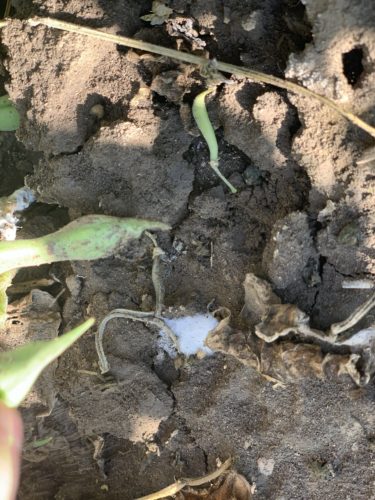
White Mould (Sclerotinia rot)

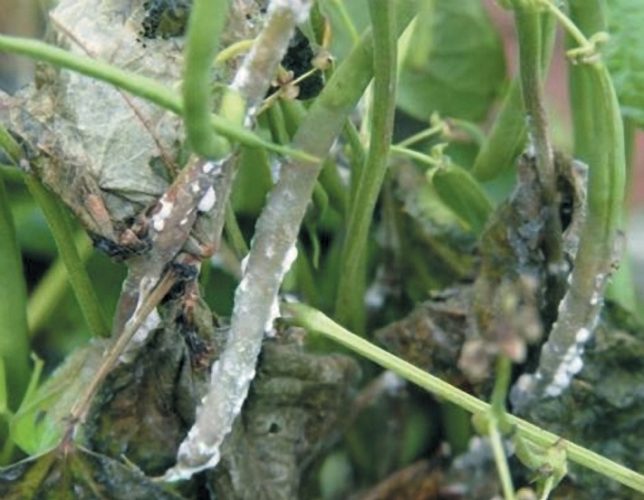
Dry Bean White Mould

White Mould on Dry Bean, Photo Credit: Howard F. Schwartz, Colorado State University, Bugwood.org

CAUSED BY
  • Often called White Mould or Pod Rot, Sclerotinia rot is caused by Sclerotinia sclerotiorum (Lib.) de Bary.
  • White Mould occurs in all dry bean growing areas of western Canada. The critical infection period is during the flowering stage.
  • While White Mould is of minor importance in most pulse crops, it can cause severe losses in bean, where the infection can spread quickly. Sclerotinia overwinters in infected crop debris and soil.
  • Favours cool temperatures; high humidity, and dense canopies.
  • When the dry bean is harvested, sclerotia are either harvested with the seed or fall to the ground with the vines. It overwinters as black, hard resting bodies (sclerotia) in the soil, apart from the host.
  • Only sclerotia in the top 6 cm of soil can produce apothecia. Sclerotia buried deeper remain dormant and can survive in the soil for five to seven years, until conditions for apothecia formation are favourable.
SYMPTOMS
  • The first sign of White Mould is the appearance of a light brown, water-soaked discolouration on the stem, leaves, or pods and a cottony threadlike growth in the collar region, if the temperature and humidity levels remain high.
  • A water-soaked area appears that spreads both upwards and downwards. Dark brown spots then develop on the stem, and the entire plant eventually turns brown.
  • The growth and spread of infection is very rapid under favourable conditions, and whole plants may be killed in just a few days after symptoms are first observed (plant tissue invaded by the fungus becomes soft and slimy).
  • Affected plants often appear wilted and ripen prematurely due to rotting stems; lodging is common in affected areas.
  • Stems, when split open, exhibit characteristic white fungus growth – numerous sclerotia may be present in the pith. Affected plants yield poorly and often die prematurely.
  • Under favourable conditions during the growing season, Sclerotinia may germinate to produce mushroom-like structures that, in turn, produce spores – the spores are readily air-borne and may cause direct plant infection (generally, this mode of infection is more common than direct attack from mycelium in the soil).
PREVENTION AND CONTROL
  • Bury all crop residues.
  • In bean, avoid irrigating after the rows close over, and use wider row spacing and decreased seeding rates.
  • Sclerotia can persist in the soil for many years, so rotate with cereals and grasses – allow at least four years between susceptible crops such as legumes, canola, mustard and sunflower.
  • Fungicide use for control of Sclerotinia stem rot in the majority of pulse crops is not cost-effective because, once the canopy closes, the fungicides cannot reach their target.
  • In bean, a timely application of any of the available registered fungicides can help control the disease. Fungicide applications are most critical when target yields are high, when vine growth is heavy, and when moist weather occurs during flowering.
  • Heads Up® Plant Protectant has been approved for treatment of White Mould on dried beans.
IMPACT
  • While White Mould is of minor importance in most pulse crops, it can cause severe losses in bean, where the infection can spread quickly.
  • If infection occurs late in the growing season, there may be little effect on yield, however, the buildup of sclerotia in a field may have a negative impact on subsequent broadleaf crops. 

CAUSED BY

  • Often called White Mould or Pod Rot, Sclerotinia rot is caused by Sclerotinia sclerotiorum (Lib.) de Bary.
  • White Mould occurs in all dry bean growing areas of western Canada. The critical infection period is during the flowering stage.
  • While White Mould is of minor importance in most pulse crops, it can cause severe losses in bean, where the infection can spread quickly. Sclerotinia overwinters in infected crop debris and soil.
  • Favours cool temperatures; high humidity, and dense canopies.
  • When the dry bean is harvested, sclerotia are either harvested with the seed or fall to the ground with the vines. It overwinters as black, hard resting bodies (sclerotia) in the soil, apart from the host.
  • Only sclerotia in the top 6 cm of soil can produce apothecia. Sclerotia buried deeper remain dormant and can survive in the soil for five to seven years, until conditions for apothecia formation are favourable.

SYMPTOMS

  • The first sign of White Mould is the appearance of a light brown, water-soaked discolouration on the stem, leaves, or pods and a cottony threadlike growth in the collar region, if the temperature and humidity levels remain high.
  • A water-soaked area appears that spreads both upwards and downwards. Dark brown spots then develop on the stem, and the entire plant eventually turns brown.
  • The growth and spread of infection is very rapid under favourable conditions, and whole plants may be killed in just a few days after symptoms are first observed (plant tissue invaded by the fungus becomes soft and slimy).
  • Affected plants often appear wilted and ripen prematurely due to rotting stems; lodging is common in affected areas.
  • Stems, when split open, exhibit characteristic white fungus growth – numerous sclerotia may be present in the pith. Affected plants yield poorly and often die prematurely.
  • Under favourable conditions during the growing season, Sclerotinia may germinate to produce mushroom-like structures that, in turn, produce spores – the spores are readily air-borne and may cause direct plant infection (generally, this mode of infection is more common than direct attack from mycelium in the soil).

PREVENTION AND CONTROL

  • Bury all crop residues.
  • In bean, avoid irrigating after the rows close over, and use wider row spacing and decreased seeding rates.
  • Sclerotia can persist in the soil for many years, so rotate with cereals and grasses – allow at least four years between susceptible crops such as legumes, canola, mustard and sunflower.
  • Fungicide use for control of Sclerotinia stem rot in the majority of pulse crops is not cost-effective because, once the canopy closes, the fungicides cannot reach their target.
  • In bean, a timely application of any of the available registered fungicides can help control the disease. Fungicide applications are most critical when target yields are high, when vine growth is heavy, and when moist weather occurs during flowering.
  • Heads Up® Plant Protectant has been approved for treatment of White Mould on dried beans.

IMPACT

  • While White Mould is of minor importance in most pulse crops, it can cause severe losses in bean, where the infection can spread quickly.
  • If infection occurs late in the growing season, there may be little effect on yield, however, the buildup of sclerotia in a field may have a negative impact on subsequent broadleaf crops. 

Common Blight and Halo Blight

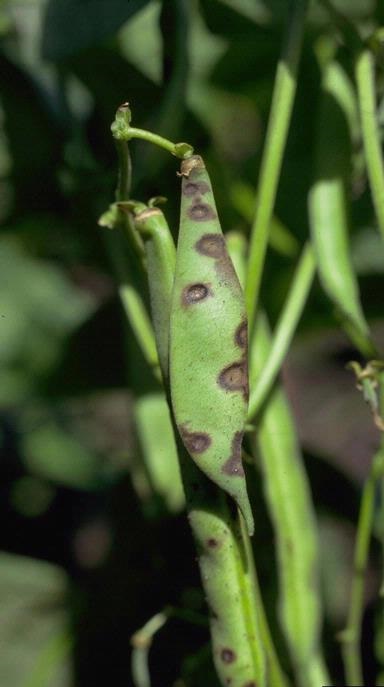
Halo Blight on Dry Bean pod, Photo Credit: Howard F. Schwartz, Colorado State University, Bugwood.org
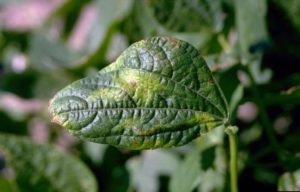
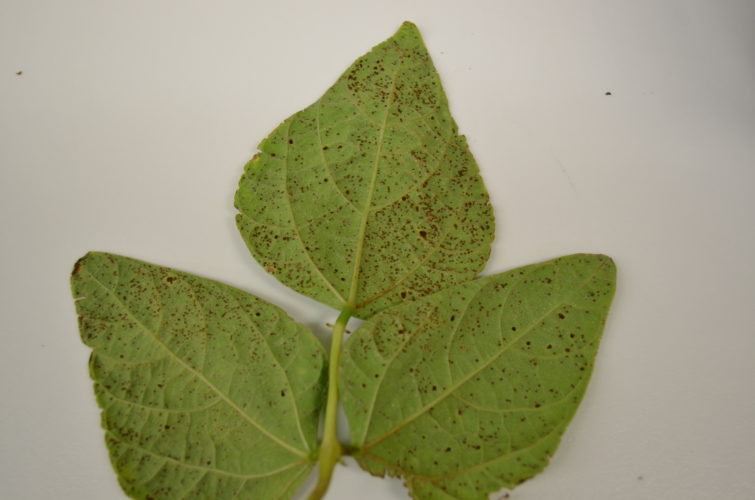
Halo Blight on Dry Bean leaf, Photo Credit: Howard F. Schwartz, Colorado State University, Bugwood.org

CAUSED BY
  • Common Blight is caused by (Xanthomonas campestris pu phaseoli) and Halo Blight is caused by (Pseudomonas syringae pv. Phaseolicola).
  • Blights are most prevalent in wet, windy weather and can be spread by rain splash.
  • Damaged or cut tissue is particularly susceptible to infection.
SYMPTOMS
  • Blight diseases cause leaf lesions, defoliation, pod lesions and shrunken, discoloured seed.
  • The most prevalent blight is Common Blight
    • large irregular shaped lesions are surrounded by a distinct yellow zone;
    • veins near the lesion are darkened;
    • infected pods will develop greasy-appearing spots surrounded by a chlorotic halo; and
    • lesions exude yellow ooze when wet
  • Halo Blight is less prevalent, and Pinto, Great Northern and Red Mexican varieties have some resistance
  • Halo Blight first appears as small water-soaked spots.  These spots soon die, leaving chocolate brown lesions.
  • During cool weather, the lesions are surrounded by light green halos up to 1/2 in. (1.3 cm) in diameter.
  • The bacteria can cause pod lesions, and these exude a white/cream ooze when wet.
  • All bacterial diseases are spread by rain splash, and water aids bacteria penetration into leaf pores and wounds
  • These pathogens are seed-borne but can survive in non-decomposed bean trash for at least one year.
PREVENTION AND CONTROL
  • Both blights are seed-borne and soil residue borne, so using disease free seed is very important.
  • Bury bean trash and use a three-year (or longer) crop rotation.
  • Avoid cultivation when bean plants are wet.
  • Copper fungicides can help control blights in-season, but are ineffective when wet weather favours the development of the disease.
IMPACT
  •  Common Blight and Halo Blight are in the top three diseases in Alberta impacting dry beans.

CAUSED BY

  • Common Blight is caused by (Xanthomonas campestris pu phaseoli) and Halo Blight is caused by (Pseudomonas syringae pv. Phaseolicola).
  • Blights are most prevalent in wet, windy weather and can be spread by rain splash.
  • Damaged or cut tissue is particularly susceptible to infection.

SYMPTOMS

  • Blight diseases cause leaf lesions, defoliation, pod lesions and shrunken, discoloured seed.
  • The most prevalent blight is Common Blight

o   large irregular shaped lesions are surrounded by a distinct yellow zone;

   veins near the lesion are darkened;

   infected pods will develop greasy-appearing spots surrounded by a chlorotic halo; and

   lesions exude yellow ooze when wet

  • Halo Blight is less prevalent, and Pinto, Great Northern and Red Mexican varieties have some resistance
  • Halo Blight first appears as small water-soaked spots.  These spots soon die, leaving chocolate brown lesions.
  • During cool weather, the lesions are surrounded by light green halos up to 1/2 in. (1.3 cm) in diameter.
  • The bacteria can cause pod lesions, and these exude a white/cream ooze when wet.
  • All bacterial diseases are spread by rain splash, and water aids bacteria penetration into leaf pores and wounds
  • These pathogens are seed-borne but can survive in non-decomposed bean trash for at least one year.

PREVENTION AND CONTROL

  • Both blights are seed-borne and soil residue borne, so using disease free seed is very important.
  • Bury bean trash and use a three-year (or longer) crop rotation.
  • Avoid cultivation when bean plants are wet.
  • Copper fungicides can help control blights in-season, but are ineffective when wet weather favours the development of the disease.

IMPACT

  •  Common Blight and Halo Blight are in the top three diseases in Alberta impacting dry beans.

Less Common Foliar Diseases in Alberta Include Anthracnose and Rust

Anthracnose

Anthracnose on Dry Beans Pod, Photo Credit: Howard F. Schwartz, Colorado State University, Bugwood org

CAUSED BY
  • Caused by Colletotrichum lindemuthianum on bean.
  • Anthracnose can be seed- or soil-borne. Spores can survive on stubble from two to four years.
  • Anthracnose favours warm temperatures, high humidity, recurrent rains (spores are spread by splashing rain), and dense canopies.
SYMPTOMS
  • Anthracnose first appears as grey to cream-coloured spots on leaves and tan to brown lesions on stems. The entire lower stem may become covered in lesions, giving it a brown, rough appearance.
  • Pod lesions are circular and sunken with reddish-brown margins and reddish centres; close examination of pod lesions often reveals fruiting bodies with orange-pink spores.
  • Leaf and stipule lesions are oval, with brown margins and greyish centres, and stem lesions are elongate, appearing as a copperish colour when moist and greyish when dry.
  • Severely diseased plants have an overall reddish-brown appearance, and die back of leaves can occur.
PREVENTION AND CONTROL
  • Apply various registered fungicides prior to flowering, and repeat if conditions for disease development are favourable.
  • Seed treatments can be used for seed-borne infections of this disease. On beans, resistant cultivars are available
IMPACT
  • Anthracnose is not common in Alberta.

CAUSED BY

  • Caused by Colletotrichum lindemuthianum on bean.
  • Anthracnose can be seed- or soil-borne. Spores can survive on stubble from two to four years.
  • Anthracnose favours warm temperatures, high humidity, recurrent rains (spores are spread by splashing rain), and dense canopies.

SYMPTOMS

  • Anthracnose first appears as grey to cream-coloured spots on leaves and tan to brown lesions on stems. The entire lower stem may become covered in lesions, giving it a brown, rough appearance.
  • Pod lesions are circular and sunken with reddish-brown margins and reddish centres; close examination of pod lesions often reveals fruiting bodies with orange-pink spores.
  • Leaf and stipule lesions are oval, with brown margins and greyish centres, and stem lesions are elongate, appearing as a copperish colour when moist and greyish when dry.
  • Severely diseased plants have an overall reddish-brown appearance, and die back of leaves can occur.

PREVENTION AND CONTROL

  • Apply various registered fungicides prior to flowering, and repeat if conditions for disease development are favourable.
  • Seed treatments can be used for seed-borne infections of this disease. On beans, resistant cultivars are available

IMPACT

  • Anthracnose is not common in Alberta.

Rust

Bean Rust Underside Telia (black) and Uredinia(rust)

Bean Rust Teliospores

CAUSED BY
  • Rust is caused by Uromyces appendiculatus.
  • Rust occasionally occurs in Alberta and is found primarily in pinto bean, and tends to infest late-maturing crops.
  • Infection may occur at any time and spread very quickly.
  • Rust fungus can survive on infected bean crop residue and is also spread by wind-borne spores (rust fungus is not transmitted as a seed-borne disease).
  • Rust favors frequent heavy dews, moderate to warm temperatures, and dense canopies.
  • Factors that may affect disease development include close proximity to a field that had rust the previous.
SYMPTOMS
  • Rust first appears as small, white spots on the lower surface of the leaves – these spots break open within a few days to expose rust-coloured fungus spores on both upper and lower leaf surfaces.
  • Small (1/16 inch) cinnamon-brown pustules that may have a yellow halo. Pustules turn black at end of growing season.
  • Severely infected leaves turn yellow, then brown and soon die (pods and stems may also be attacked).
PREVENTION AND CONTROL
  • Follow a crop rotation that allows a minimum of three years between bean crops.
  • Fungicides applied after detection may be economically viable.
  • After harvest, turn under all bean residue as completely as possible.
IMPACT
  • Rust is not a common disease to Alberta.

CAUSED BY

  • Rust is caused by Uromyces appendiculatus.
  • Rust occasionally occurs in Alberta and is found primarily in pinto bean, and tends to infest late-maturing crops.
  • Infection may occur at any time and spread very quickly.
  • Rust fungus can survive on infected bean crop residue and is also spread by wind-borne spores (rust fungus is not transmitted as a seed-borne disease).
  • Rust favors frequent heavy dews, moderate to warm temperatures, and dense canopies.
  • Factors that may affect disease development include close proximity to a field that had rust the previous.

SYMPTOMS

  • Rust first appears as small, white spots on the lower surface of the leaves – these spots break open within a few days to expose rust-coloured fungus spores on both upper and lower leaf surfaces.
  • Small (1/16 inch) cinnamon-brown pustules that may have a yellow halo. Pustules turn black at end of growing season.
  • Severely infected leaves turn yellow, then brown and soon die (pods and stems may also be attacked).

PREVENTION AND CONTROL

  • Follow a crop rotation that allows a minimum of three years between bean crops.
  • Fungicides applied after detection may be economically viable.
  • After harvest, turn under all bean residue as completely as possible.

IMPACT

  • Rust is not a common disease to Alberta.

Other Causes:

These aren’t considered to be a disease, but can be confused with diseases.

Dry bean showing wind damage

Sunscald and Bronzing

CAUSED BY
  • Dry beans are susceptible to damage from sunscald and ozone damage, which results in bronzing. Sunscald is caused by intense concentration of the sun’s heat on plant tissue. It can affect leaves, stems, or pods and most often is found on the lush new growth.
  • When there are humid, warm, cloudy days followed by bright sun, leaves are most susceptible to damage.
  • Bronzing occurs when leaves are exposed to ozone. Ozone exposure is related to pollution and lightning events. Similar conditions that favour damage from sunscald also favour damage from higher concentrations of ozone.
SYMPTOMS
  • Sunscald affected leaves look brown and scorched or show white discolouration. The leaf tissue will die and crumble, leaving ragged edges on the leaves.
  • Leaves affected by Bronzing will exhibit small reddish brown flecking on upper surfaces and some pods may show flecking as well.
PREVENTION AND CONTROL
  • Some varieties are more sensitive to ozone damage, with black varieties in particular more likely to be damaged.
IMPACT
  • Both conditions are not considered to affect yield.

CAUSED BY

  • Dry beans are susceptible to damage from sunscald and ozone damage, which results in bronzing. Sunscald is caused by intense concentration of the sun’s heat on plant tissue. It can affect leaves, stems, or pods and most often is found on the lush new growth.
  • When there are humid, warm, cloudy days followed by bright sun, leaves are most susceptible to damage.
  • Bronzing occurs when leaves are exposed to ozone. Ozone exposure is related to pollution and lightning events. Similar conditions that favour damage from sunscald also favour damage from higher concentrations of ozone.

SYMPTOMS

  • Sunscald affected leaves look brown and scorched or show white discolouration. The leaf tissue will die and crumble, leaving ragged edges on the leaves.
  • Leaves affected by Bronzing will exhibit small reddish brown flecking on upper surfaces and some pods may show flecking as well.

PREVENTION AND CONTROL

  • Some varieties are more sensitive to ozone damage, with black varieties in particular more likely to be damaged.

IMPACT

  • Both conditions are not considered to affect yield.

Special thanks to Saskatchewan Pulse Growers and Manitoba Pulse and Soybean Growers.