| CAUSED BY |
- This disease complex is caused by three fungi:
- Mycosphaerella pinodes (Berk & Blox.) (the perfect stage of Ascochyta pinodes), which causes blight;
- Ascochyta pisi Lib., which causes leaf and pod spot; and
- Phoma medicaginis var. pinodella (Jones), which causes root rot.
- The three species often occur together and can be difficult to tell apart. These pathogens can be seed, stubble or soil-borne.
- Seed-borne infection by M. pinodes is considered to be the primary source of infection in virgin pea fields.
- P. medicaginis var. pinodella and M. pinodes are both quite persistent, surviving on pea straw fragments and in the soil.
- When moisture and temperature conditions are favourable, residual pycnidia from M. pinodes mature, new pycnidia develop and pycnidiospores are released. These can infect healthy plants by rain splash (ascospores are also produced and can be carried by wind for a kilometre or more).
- A. pisi, on the other hand, competes very poorly with other microflora in the soil and overwinters very poorly – the main source of infection is from seed-borne spores.
|
| Symptoms |
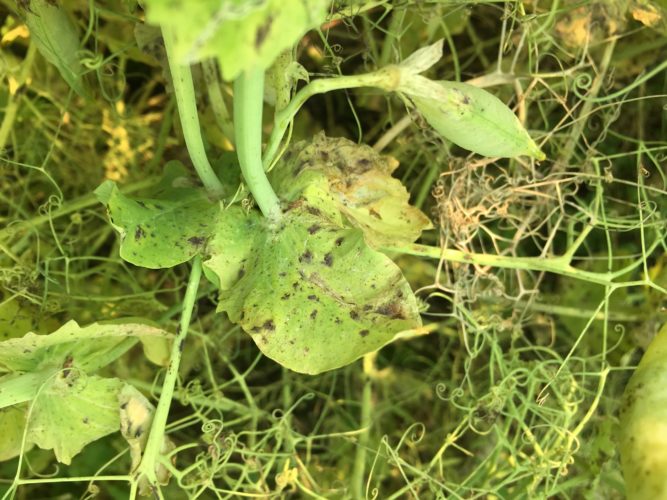
- A. pisi lesions are partially sunken, tan coloured and surrounded by a well-defined dark brown margin:
- circular lesions are found on pods and leaves while lesions on stems are more elongated;
- numerous pycnidia are usually found in the lesions; and
- lesions of A. pisi are rarely found on any plant parts below the soil line.
- If lesions on leaves, stems and pods are widespread and severe, M. pinodes is the cause.
- If lesions are severe on roots, P. medicaginis var. pinodella is the cause.
- M. pinodes produces small, brown to purplish, irregular flecks without definite margins, initially appearing on pods, leaves, stems and the cotyledonary area – these lesions enlarge if weather conditions are favourable (15˚ to 18˚C and high humidity).
- Dark brown to black specks (pycnidia) are eventually produced and form a distinct concentric tan and brown ring pattern as the lesions enlarge – this is often more pronounced on leaves and pods than on other plant parts.
- Lesions developing on stems tend to form long, wide purple to bluish-black streaks that eventually coalesce and may completely girdle the stems, pod attachments or tendrils – these streaks are more common near the nodes and on the lower portion of the stem.
- Early pod infection can lead to seed infection, which may show no visible symptoms if infection is light, to varying degrees of shrinkage and discolouration if severe.
- Under drier conditions, the concentric ring pattern of the symptoms is less pronounced and may show up only as a uniform yellowing of lower leaves – if the blossom becomes infected, girdling of the sepal often occurs, leading to pod drop or distortion.
|
| PREVENTION AND CONTROL |
- Have a four to five-year rotation between pea crops.
- Have pea seed examined for Ascochyta presence by an accredited seed lab. Use only pathogen-free seed – if pathogen-free seed cannot be found, use seed with as low a level of Ascochyta as possible, and have the seed treated.
- Avoid seeding next to any previous year’s pea fields since spores can spread by wind.
- Bury all crop residue, to prevent the fungus being spread by wind and rain.
- For further advice in managing Ascochyta, please refer to resource below.
|
| IMPACT |
- M. pinodes is the most common on field pea in Western Canada – average yield losses run to 10%, but losses of up to 80% have been reported.
- For most pea varieties, expect a 5% to 6% yield reduction for every 10% of the stem area affected.
|
| RESOURCES |
- Managing Ascochyta (Mycosphaerella) Blight in Field Pea.
|