| CROP MATURITY |
- Depending on type and variety, seeding date and seasonal moisture, field pea crops require a growing season of approximately 90 to 105 days.
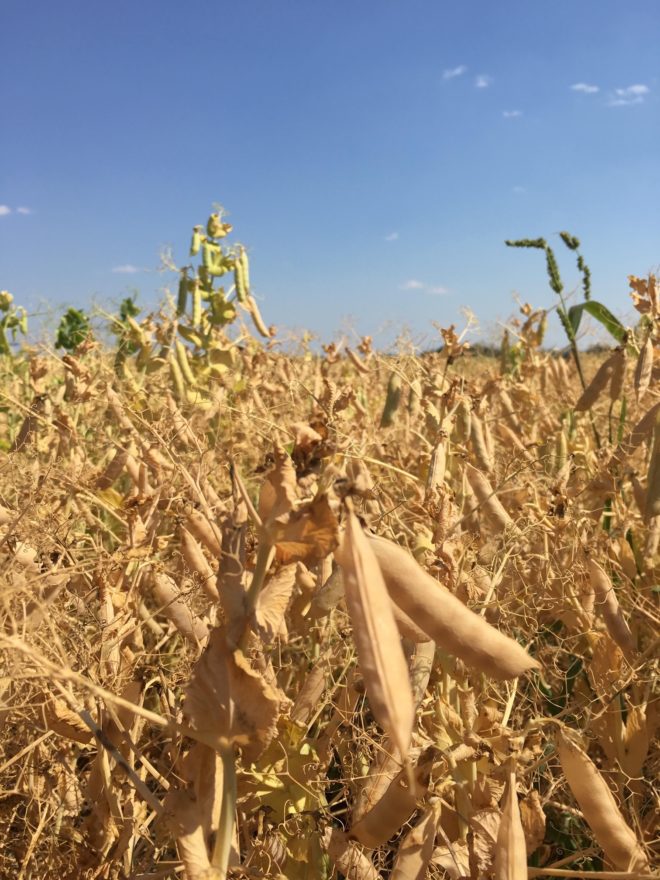
- Field pea plants mature from the bottom to the top, and are near maturity when the bottom 30% of pods are ripe, the middle 40% of pods and vines are yellow-coloured, and the upper 30% pods are turning yellow. This is the stage to swath or desiccate if either of these harvest methods is chosen.
- Seeds in bottom pods will be very firm and require some force to dent the seed coat with a fingernail.
- Seeds from middle pods will flatten somewhat with pressure between the thumb and finger, and the seed coat will dent with a little fingernail pressure.
- Seeds from the uppermost pods will be fairly soft and, with a little pressure, will split into two cotyledons.
- Pea crops can also be left to straight cut without desiccation.
- Pea crops are mature when seeds in the bottom pods are detached and loose in the pods and when the upper pods are turning yellow. Once the crop is mature it can dry down very quickly if the weather is warm and dry.
|
| SEED MOISTURE CONTENT |
- Seed moisture content of physiologically mature pea will decrease quickly if weather conditions are warm and dry and if humidity is low.
- Drought stress in the crop will also result in rapid drydown.
- Desiccation or swathing can start when seed moisture content has reached approximately 25% to 30%.
- Drydown of the sprayed crop between 16% to 18% seed moisture normally takes 5 to 7 days, depending on weather.
- If the crop is to be straight combined, you can begin when seed moisture content has reached approximately 18% to 20%, provided the straw is dry enough to feed through the combine.
- Once the crop is combined, a short time in an aeration bin may be required if the grain is not at storable 16% or if the seed is warm. Aeration of straight-harvested pea is generally required to condition the grain for longer storage.
|
| FIELD MONITORING |
- Pre-harvest field monitoring will help determine which harvest system to consider, if more than one is available, and will greatly assist in determining when to begin harvest operations.
- Monitoring pea fields means checking plants in numerous locations for uniformity of stages of maturity.
- Most fields will not be 100% uniform in topography – there could be greener conditions in lower, wetter areas and further advanced plants on higher areas.
- A decision to begin harvest will hinge on a majority of the field meeting certain criteria. Do not sacrifice the quantity and quality of your crop waiting for smaller greener areas to reach the proper stage to start harvest.
- Harvesting too early will result in immature seeds – this is especially important with yellow cotyledon varieties because immature yellow-green seeds will result in downgrading.
- Harvesting too late when the pods are dry and brittle may result in shatter losses and will increase the risk of poorer quality seed due to adverse weather. For green pea varieties, harvesting even several days later may result in excess bleach.
- The decision to start the harvest process will depend on three factors:
- crop maturity (stage of uniformity – how variable is the crop’s maturity?)
- seed moisture content
- presence of weed growth.
- Other considerations may include weather patterns, and marketing considerations (for human consumption, livestock feed or seed).
|
| PRESENCE OF WEED CONTROL |
- Waiting for green weed growth to drydown will jeopardize quality and yields.
- Swathed green weeds are unlikely to dry sufficiently in a few days, so combining will be delayed.
- Green weed material in a straight-cut operation will cause extra wetness in the threshing areas of the combine, resulting in moisture on the seed coat and dirt adhering to this moisture (earth tag). Grades will be lowered because of earth tag (see Grading Section).
|
| PRE-HARVEST AIDS (GLYPHOSATE) |
- Various chemical harvest management tools are available to aid in the preparation for combining. It’s important to select the right product for right crop and the intended outcome.
- Crop desiccation and dry down and pre-harvest perennial weed products are not the same. Make sure to select the right product, follow label directions, and timing of application. Harvest aid products vary in speed of activity, efficacy, and pre-harvest intervals.
- Apply glyphosate for pre-harvest weed control and not for desiccation. See Desiccation information further below.
- Pre-harvest glyphosate must only be applied when the grain moisture content is less than 30% in the least mature part of the field to prevent unacceptable residues in the harvested grains.
- To determine if the field pea crop is at less than 30% seed moisture:
- The bottom pods are ripe and dry with seeds detached from the pods.
- 80% of plants are yellow to brown in colour.
- Top pods are wrinkled and the seed is firm.
- The top of the plant may have a slight green colour.
- This treatment will provide some crop dry down, but this benefit may be inconsistent and is unlikely to occur under cool, wet conditions.
- The crop and in-crop weeds must have enough green material remaining at application time for the herbicide to be effective.
- Glyphosate is not registered for pea crops destined for planting seed because irregular germination and seedling development can occur.
- Applying glyphosate too early can reduce yield and seed size, and late-season application may result in levels of glyphosate in the seed that exceed maximum allowable levels.
- Growers must take appropriate risk mitigation steps to ensure product residues remain below maximum residue limits (MRLs) set by regulatory agencies.
- Prior to applying glyphosate, check with potential buyers. Some companies are NOT accepting peas where glyphosate was used pre-harvest as weed control.
|
| KEEP IT CLEAN |
- Certain crop protection products can restrict the marketing options for your pulse crop. Before you make your crop management plans, talk to your grain buyer and read the Keep it Clean Pulse Maximum Residue Limits Advisory for a list of products of concern for this year, and the steps you can take to mitigate risk.
- More than 85% of Canada’s pulse production is exported to feed the world. Market access is important to the Canadian pulse industry, and growers play a key role in keeping the doors open.
Source: For the latest “Keep it Clean” updates, visit Keep it Clean main website. |