Contact

Qualified Alberta Pulse Growers Eligible for 30.3% Tax Credit for Investing in Research

The Alberta Pulse Growers Commission (APG) has confirmed that 30.3% of eligible producers’ 2025 check-off payment is eligible for the Scientific Research & Experimental Development (SR&ED) tax credit for their investment in APG-funded research and development projects.

Producers are eligible to claim up to a maximum of 15% for non-incorporated farm operations and up to a maximum of 35% for incorporated operations of the determined 30.3%.

Producers who have paid check-off this past year and have not asked for refunds are eligible claimants for this year’s credits.

For more detailed information about the SR&ED Tax Credit, APG advises you to contact an accountant or the Canada Revenue Agency. For a history of SR&ED with Alberta Pulse Growers visit https://albertapulse.com/research-tax-credit/ . Information about APG research investments in 2024-25 is available at https://albertapulse.com/resource-library/ .

The federal SR&ED tax program is administered by the Canada Revenue Agency (CRA) and encourages businesses to invest in and perform research and development in Canada.

The SR&ED Tax Credit application forms for individual producers and Canadian controlled private corporations can be downloaded directly from the CRA website at https://www.canada.ca/en/revenue-agency/services/scientific-research-experimental-development-tax-incentive-program.html .

The Alberta Pulse Growers Commission represents 5,400 growers of field pea, dry bean, lentil, chickpea, faba bean, lupin and soybean in Alberta. Our vision is to have pulses on every farm, on every plate.

For more information, please contact:
Rachel Peterson, Communications Manager
Phone: 780-986-9398 ext. 108
rpeterson@albertapulse.com

APG Launches New Website with Enhanced Features

Alberta Pulse Growers (APG) unveiled its new website today at albertapulse.com. This enhanced resource makes it easy for Alberta pulse farmers to find useful information about growing and marketing pulses, and for consumers to learn how best to eat more pulses.

The APG website is the heart of all APG communications. It is divided into main sections of About Us, Growing Pulses, Eating Pulses, Marketing Pulses, and News & Events, as well as adding Advocacy as a major component to reflect APG’s increased activity in this area.

“When producers look for information, they need it fast and they need to be able to depend on it to be accurate,” said APG Chair Will Muller. “APG’s new website is a reliable source of information that farmers can access from out in the field, or just about anywhere. The new site also provides an opportunity for consumers to learn more about how peas, beans, lentils, chickpeas and other pulses are sustainably produced by Alberta farmers.”

Common questions are answered in the About Us section to save time and reduce frustration, while other topics are also easily found via dropdown menus. New and enhanced features include an event “add to calendar” button, contact forms, simplified dealer list, and a new Research resource library section. The Eating Pulses section is tailored to be a consumer hub for pulse information and recipes, including online ordering of recipe resources for teachers and health professionals, and an email newsletter.

“We are very proud of the resources available through APG for growers and consumers,” Muller added. “This website makes use of the latest technology to put up-to-date, reliable pulse information at the fingertips of visitors when they need it in keeping with APG’s vision of pulses on every farm, on every plate.”

APG is committed to providing the best information in an attractive and responsive format to promote the benefits of including pulses in a sustainable crop rotation and in a healthy diet through research and marketing initiatives to increase the sustainability and profitability of pulse production in Alberta. The Alberta Pulse Growers Commission represents 5,400 growers of field pea, dry bean, lentil, chickpea, faba bean, lupin and soybean in Alberta.

For more information, please contact:
Rachel Peterson, Communications Manager
Phone: 780-986-9398 ext. 108
rpeterson@albertapulse.com

U of C Call for Farmer Views on Carbon Markets

Centring Farmers and Ranchers Views on Carbon Markets

University of Calgary researchers are conducting a social science research study examining how greenhouse gas reduction initiatives, carbon sequestration efforts, carbon offset projects, and other climate-focused programs are being introduced within Alberta’s agricultural and livestock sectors.

They are seeking participation from farmers and ranchers who can share their experiences, perspectives, and insights on carbon offset or mitigation programs—whether you have taken part in these initiatives or have been affected by them in any way. Your contributions will help improve understanding of how climate-related policies and programs are shaping agricultural practice, and how they are experienced by farming and ranching communities in Alberta.

If you are an Albertan Rancher or Farmer, and are interested in participating, please fill out this survey:

https://iheid.qualtrics.com/jfe/form/SV_bdbfVzFFt72S9Se

This study is supported by a research grant from the Swiss National Science Foundation.

Pulse Market Insight #268

India Situation Update

This is the time of year that we look more closely at the situation with Indian pulse crops, as the rabi season is when Indian farmers plant chickpeas, lentils and peas, the crops we’re more concerned about in Canada. Normally, the focus is on acreage and crop prospects. While those are still important, the added layer of government policy has become a key feature in the outlook. But let’s start with crop production.

This year, Indian farmers started the planting season on a strong note, with pulse acreage running ahead of average. There are some questions about the Indian reports, but they show very small gains later in the season, with total pulse acreage currently 11% less than last year and 12% below the 5-year average. According to these reports, Indian farmers have planted 24.4 mln acres of chickpeas (6% less than last year), 4.3 mln acres of lentils (down 11%) and 2.2 mln acres of peas (12% less).

Of course, acreage is only one part of the production equation. Across much of India, satellite vegetation maps show crop conditions are better than average, with the early harvest scheduled to begin in a few weeks. Keep in mind, conditions were very positive last year; comparing the vegetation maps against last year shows key growing areas in north-central India this year in worse shape. These two comparisons suggest 2025 yield potential could be better than average but less than the 2024 harvest.

This brings us to the other main topic in the outlook, Indian government policy. With acreage and crop prospects smaller than last year, it’s possible the Indian government will decide to keep import tariffs off for peas, lentils and chickpeas. This would help keep food prices low for Indian consumers but wouldn’t make farmers very happy.

The current situation is that import tariffs are set at zero for peas, lentils and chickpeas. The deadline for peas has been extended several times and the latest deadline is February 28, unless it’s extended again. For lentils and chickpeas, the deadlines are March 31 and those can also be extended.

Because the government’s goal for the zero tariffs has been to keep food costs down, prices for the various pulses can be a clue about possible changes in policy. For peas, prices have been dropping ever since the tariffs were zeroed out in late 2023 and have continued to decline steadily as imports from Canada, Russia and elsewhere flowed into India. With Indian pea prices now at the lowest point in years and the harvest soon to arrive, it may encourage the government to impose import tariffs again to protect its farmers.

Desi chickpea prices rose sharply last year in response to a smaller 2024 Indian harvest but have now given back all of those gains. The latest steep declines are showing up as the big Australian crop is now arriving in India and boosting supplies in the country. This could allow the government to reimpose tariffs on desi chickpeas at the end of March. And as yellow peas are a substitute for desi chickpeas, the lower chickpea prices could also support the return of tariffs on peas after February 28.

The situation for lentil tariffs seems a bit clearer. Prices in India are holding steady, in line with the government’s Minimum Support Price and are also helped by the drop in Australia’s recent harvest. The steady prices suggest there’s less chance of tariffs being reimposed on lentils at the end of March.

Crop markets are full of uncertainty and the situation in India is no exception. We are used to the ups and downs in prices that are caused by smaller or larger crops. With the Indian crop getting closer to harvest, that uncertainty is starting to fade. But the unpredictability of government policy remains just as large as ever.

Pulse Market Insight provides market commentary from Chuck Penner of LeftField Commodity Research to help with pulse marketing decisions.

Qualified Alberta Pulse Growers Eligible for 17.5% Tax Credit for Investing in Research

The Alberta Pulse Growers Commission has confirmed that 17.5% of eligible producers’ 2024 check-off payment is eligible for the Scientific Research & Experimental Development (SR&ED) tax credit for their investment in APG-funded research and development projects.

Producers who have paid check-off this past year and have not asked for refunds are eligible claimants for this year’s credits.

For more detailed information about the SR&ED Tax Credit, APG advises you to contact an accountant or the Canada Revenue Agency. For a history of SR&ED with Alberta Pulse Growers visit https://albertapulse.com/growing-pulses/sred-tax-credit/ . A summary of APG research investments in 2023-24 is available at https://albertapulse.com/growing-pulses/research/ .

The federal SR&ED tax program is administered by the Canada Revenue Agency (CRA) and encourages businesses to invest in and perform research and development in Canada.

The SR&ED Tax Credit application forms for individual producers and Canadian controlled private corporations can be downloaded directly from the CRA website at https://www.canada.ca/en/revenue-agency/services/scientific-research-experimental-development-tax-incentive-program.html .

The Alberta Pulse Growers Commission represents 5,400 growers of field pea, dry bean, lentil, chickpea, faba bean and soybean in Alberta. Our vision is to have pulses on every farm, on every plate.

For more information, please contact:
Rachel Peterson, Communications Manager
Phone: 780-986-9398 ext. 108
rpeterson@albertapulse.com
www.albertapulse.com

Pulse Market Insight #265

Tariff Exposure for Pulse Crops

There’s a lot of concern about possible import tariffs by the US and their impact on Canadian agriculture. Of course, there’s no shortage of opinions about whether (or how) across-the-board tariffs would actually occur under the new Trump administration. Various scenarios are possible; the situation could be resolved and tariffs could be avoided altogether, only certain products might face tariffs or the percentage could be lower than the initial 25% number that’s been announced.

Despite the uncertainty, it’s still worth knowing a bit more about Canada-US pulse trade and how serious the issue could be for those crops. The answer (as it often tends to be) is, it depends. The importance of the US as a destination varies considerably by crop.

Canada’s pea exports are dominated by China and India. Over the past five years, exports to the US have averaged 200,000 tonnes, only 7% of Canadian exports. The US imports small amounts of yellow, green and split peas from Canada but the largest category, over 80% of the total in the last two years, is peas to be used as planting seed. This indicates that pedigreed seed growers would face the largest threat while other trade would see much less impact.

For lentils, the US is an even smaller trade partner with Canada. In most years, the US accounts for less than 5% of Canadian lentil exports, averaging less than 75,000 tonnes over the past five years. Just like peas, the category of “lentil seeds used for sowing” usually accounts for the largest part of the trade. As a result, US tariffs on Canadian lentils would mostly affect the pedigreed seed industry and would impact growers in the US as much as in Canada.

When it comes to chickpeas, disruption in Canada-US trade would have a larger impact. Over the past five years, the US has accounted for roughly a quarter of exports and is the largest single destination for Canadian chickpeas. While chickpeas as planting seed are a sizable part of the trade, two thirds to three quarters of the chickpeas shipped to the US are not used as seed and are destined for food and petfood sectors. Any blockage to trade would have a sizable impact on industry on both sides of the border.

Canadian dry bean exports also rely heavily on the US, which is the largest single destination and has accounted for an average of 30% of Canadian exports in recent years. Like the other pulses, planting seed is a large part of the trade, accounting for close to 60% of Canadian exports to the US in most years. Black and pinto bean exports were also a good portion of the trade. Of course, the North American dry bean market could also be affected by disruptions in US-Mexico trade, potentially shifting more Mexican business toward Canada.

There’s still a lot of uncertainty in this outlook and it’s possible that tariffs can be avoided. That would be the best case, as trade disruptions are especially damaging to a country like Canada, which depends heavily on exports. If tariffs do occur, the impact on pulse crops would be mixed, with certain sectors and segments affected more than others.

Pulse Market Insight provides market commentary from Chuck Penner of LeftField Commodity Research to help with pulse marketing decisions.
Mental Health Matters Video

Plant 24 is a marathon not a sprint, so take care of yourself! APG Research & Extension Manager Dr. Jenn Walker reminds farmers of key everyday actions to promote mental health in this quick video.


Pulse Market Insight #252

Waiting Out the Seasonals

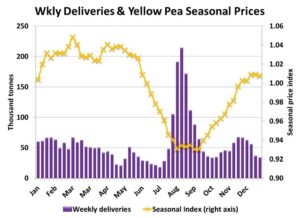
Crop prices tend to behave in certain ways at certain times of the year. That makes sense since crop production happens at specific times of the year and supply levels change according to those seasons. The seasons affect both farmers’ selling behaviour and buyers’ activity. No surprise there.

Seasonal price tendencies are often reliable, although prices in a given year can deviate from the pattern due to unusual circumstances like crop failures and shocks in export demand (either good or bad). The most certain part of the pattern is that prices bottom out in the fall. Again, that’s hardly a surprise. Farmer deliveries spike at harvest time while export shipments are also picking up. Even in the 2021 drought year when crop conditions headed south, pea prices bottomed out in the summer. That said, it was a few weeks earlier than usual and didn’t last long.

While the seasonal bottom is not news, the weeks on either side of the lows can be instructive. It doesn’t happen every year, but prices for yellow peas tend to start heading lower in mid-June (late May for green peas). Even though supplies are at their lowest levels all year, buyers are already waiting for the next harvest in a few weeks. Some farmers might also be cleaning out their bins, especially if the crop in the field is looking good.

In 2023/24, yellow pea bids made solid gains in late spring, mainly due to the return of Indian demand along with shrinking Canadian supplies. Even so, it’s unlikely that prices can avoid the downward pull of the seasonals for much longer. This year’s very tight supplies could limit how far yellow pea prices will decline but the outlook for the 2024 crop (either good or bad) another key factor.

Once the harvest lows are over, prices will turn higher. The inevitable question of “how far” is the big unknown. Of course, the main factor is the size of the crop, not just in Canada but in other exporting countries. It’s far too early to have a firm handle on this year’s yields and crop size in western Canada and elsewhere. In the case of yellow peas, Russia has become the biggest competitor and crop estimates there have been slipping recently due to drought and frost. For green peas, the US is a sizable exporter and the crop there is looking positive.

Export demand is the other factor that determines how fast and far prices come off the harvest lows. For yellow peas, 2024/25 is the first year in a long while with two large buyers, India and China. Even so, there are large questions about both countries. India cut its import tariffs to 0% but for now, that’s only until the end of October. Chinese pea imports have been quieter recently and it’s not clear how long that will last. And in both countries, Russia is a larger competitor despite downgrades to its 2024 crop.

Even though markets are unpredictable, the harvest lows are as close to certain as possible. When making marketing decisions around those lows, it’s important to recognize the patterns. When prices start to drop in summer, that doesn’t have to mean the market is bearish and that farmers should bail out. They may just need to be patient, since the market is just doing what it normally does. Likewise, the postharvest rally isn’t necessarily a sign that the outlook is outright bullish and will keep going higher through the rest of the year. Rather it’s often just the typical recovery as the supply and demand return to a more stable balance.

Pulse Market Insight provides market commentary from Chuck Penner of LeftField Commodity Research to help with pulse marketing decisions.

Combine Loss Calculator Now Available on APG’s App!

APG’s Combine Loss Calculator is now available on the app! Use this tool to estimate current losses and optimize combine settings for pulses and other crops to minimize grain loss through the combine. Check out this valuable tool under Calculators on the APG app. Click here to download the app.

Pre-Harvest Intervals

By Sheri Strydhorst, PhD, PAg – Sheri’s Ag Consulting Inc.

Understanding and complying with Pre-Harvest Intervals (PHIs) are critical for safe pulse crop production. 

WHO? All pulse growers who use pesticides. It is particularly important for pulse growers who need to spray herbicides, fungicides or insecticides later in the growing season.

WHAT? The PHI is the MINIMUM amount of time between applying a pesticide and swathing or harvesting the crop.

WHEN? The PHI for many pulse fungicides is 14 to 30 days. For example, if a pulse crop is intended to be swathed or harvested on August 15th, you cannot spray certain fungicides later than July 16th or August 1st, depending on the product. The PHI for harvest aids is 2 to 10 days and the PHI for insecticides ranges from 1 to 30 days.

WHY? Compliance with PHIs is a legal requirement to ensure that pesticide residues do not exceed the maximum residue limits (MRL), established by the Food and Drugs Act (FDA). If your pulse crop is found to have residue levels which exceed the MRLs, the grain could be seized, destroyed or forbidden for export.

HOW? PHI information is found on pesticide labels, the Keep it Clean website and in The Blue Book.

Learn more in the video below as Dr. Strydhorst discusses PHIs with APG’s Dr. Jenn Walker.