Contact

Pulse Market Insight #290

Good News for Pea Markets

The recent announcement that China will drop its import tariffs on Canadian peas was very welcome, although not a complete surprise. Typically, trade agreements are worked out ahead of the official trade mission, with politicians mainly there for the announcements and publicity. The odds were high that something positive was going to happen; it just wasn’t clear what or when.

A day or two before the announcement, we started hearing that some farmers with production contracts for maple and green peas were being called to start hauling. Clearly, buyers were already betting on a breakthrough for pea exports to China.

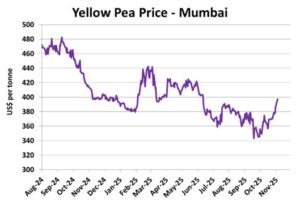
Those who might have expected a sharp spike in prices on the heels of this announcement are probably a bit disappointed by the size of the market’s reaction. Keep in mind, the scale of the chart below tends to downplay the latest changes. The response seems to vary between buyers; those with immediate sales to China showed larger gains.

We also noticed a larger response in maple pea bids than greens and yellows. In the past week, the average maple pea bid rose 75 cents per bushel, while the prairie-wide bid for greens was up 25 cents and yellows closer to 20 cents per bushel. It’s not that surprising that maple peas showed the biggest early reaction as it’s the market portion in which Canada and China are most interdependent.

Canadian export data this year is delayed more than usual but in the first quarter of 2025/26, exports of green and “other” (mostly maple) peas were only about half of the 5-year average, which reflects the impact of China’s import tariffs. At the same time, yellow pea exports were only 9% behind average, with India and Bangladesh picking up the slack. It’s also worth noting that Canada exported 77,000 tonnes of peas (mainly yellows) to China in October.

The drop in Chinese tariffs won’t take effect until March 1, but peas still need to be assembled for those shipments, in addition to the regular pea shipments to other destinations. These extra volumes should result in stronger bids as more peas need to be drawn into the export pipeline. That said, it won’t likely be a runaway rally, for a few reasons.

For one thing, farmers had contracted large volumes of green and maple peas last spring. Because there hasn’t been strong movement of those classes until now, these inventories are still waiting to enter the export channel before more uncontracted supplies are needed. That’s not so much the case for yellow peas, which have been moving to other destinations.

Secondly, the 2025/26 marketing year is already half over and the fall export surge is in the rearview mirror. China has been buying steady volumes of peas from other countries, including Russia, the US, Argentina and a few others. That’s not to say Chinese buyers are sitting on large supplies of peas. Inventory data shows stocks of peas (mainly yellows) in Chinese warehouses are currently at a multiyear low and will need to be replenished, indicating imports will need to pick up somewhat.

Upside potential could also be limited by large supplies of peas in Canada and other exporters, particularly Russia. Competition from Russian peas will act as a governor on prices in Canada, especially for yellow peas. And as bids start to firm up in western Canada, farmers will likely use the opportunity to empty a few bins, thus limiting the gains. Canadian pea supplies expanded by 1.1 mln tonnes in 2025/26 and even if exports to China reach 500,000 tonnes (versus 732,000 tonnes in 2024/25), inventories aren’t going to run low, by any means.

Even though the market response may not be huge and enthusiasm might need to be tempered, this trade agreement is still very good news. Compared to the gloomy outlook earlier, freer trade means more of the big 2025 crop will be able to find a home. More demand is always better than less.

Pulse Market Insight provides market commentary from Chuck Penner of LeftField Commodity Research to help with pulse marketing decisions.
Pulse Market Insight #289

Big Risks Dampen Price Signals for 2026 Crop

This is the time of year when new-crop bids for pulses usually start showing up, but not always. It’s not just the actual price that signals how urgently buyers are looking to lock in acres; the timing of new-crop bids is also an indicator.

For example, I recall years when new-crop bids for peas or lentils already started to show up in October, almost a year before the next crop is harvested. That happened when pea and lentil supplies were very short and importers wanted to ensure they would have access to next year’s crops.

In general though, the first new-crop bids are often seen in late December or early January. One rule of thumb some people use is the Saskatoon Crop Production Show in mid-January as the “real start” of the contracting season. But this year, it seems that new-crop bids are even scarcer than usual, with a few possible reasons.

The first is that overseas buyers aren’t very concerned about locking in next year’s supplies. Big 2025 pulse crops in Canada and elsewhere have created a general feeling of heaviness in the market, reducing the sense of urgency. This also means 2025/26 ending stocks will be historically large; in some cases, record high. This means that even if acres and production are reduced in 2026, next year’s supplies could remain comfortable.

In addition, pulse production has expanded in several other countries that have become larger export competitors with Canada. Importers have more options and aren’t as dependent on Canadian production as in the past. Thus, there’s less concern about having to “buy acres” in western Canada.

The added element this year is the ongoing risk of trade actions that could cause sharp changes in pulse markets. In the past 12 months, import tariffs were imposed on peas by Canada’s two largest customers with a large impact on prices. More Indian tariffs on lentil imports are possible in the coming months. Of course, reduced or eliminated tariffs are also a possibility, but the odds of that type of positive development are very hard to gauge. In any case, the risks of a large swing in the market could be discouraging traders from issuing new-crop bids.

At the very least, the extra caution would mean a larger than usual discount for new-crop bids. As a result, when new-crop prices are released, they won’t likely be very attractive to farmers. Not wanting to issue unappealing bids may also cause buyers to hold off. Weak prices also mean there won’t be a lot of forward contracting activity this spring.

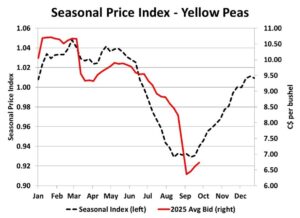
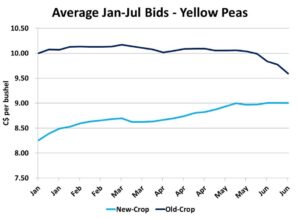
And in fact, it’s probably a good idea for farmers to be cautious about contracting the 2026 crop. Over the years, new-crop bids for most (but not all) crops tend to improve as the contracting season goes on. The chart above shows the average of old-crop and new-crop yellow pea bids from the last 10 years. Over that time, the most cautious new-crop bids have tended to occur early in the calendar year and improve as the season progresses. While it’s not a guarantee for 2026, it may not be a bad idea for farmers to remain patient.

Pulse Market Insight provides market commentary from Chuck Penner of LeftField Commodity Research to help with pulse marketing decisions.

Pulse Market Insight #288

Crop Prospects for 2026

This seems to be the time of year when there’s a flood of reports looking back at the past year or gazing ahead to the new year. While looking backward allows a person to gauge their grain marketing performance, hindsight generally doesn’t provide much help for making decisions about the upcoming year.

In fact, every marketing year is different. Making next year’s decisions based on last year’s successes or failures can be counterproductive. After all, acreage will shift and while there are always hopes for big yields, the odds of record output happening again in 2026 are very unlikely. In addition, global trade will also change (hopefully for the better) and affect next year’s market prospects.

This is also the time of year when we start thinking about farmers’ planting decisions for next spring. There are many factors going into those decisions, especially crop rotation considerations, but prices and profitability are also important. Typically, we use basic production costs and new-crop bids to compare gross margins for a number of crops. Of course, each farm’s farming practices and cost structure are different, so we use a set of generic production costs.

Often, new-crop bids are available for most crops by now, but this year’s heavy supplies seem to be decreasing buyers’ urgency for contracting tonnage for 2026/27, especially for special crops. This means we need to use our best “judgement” of where new-crop bids could show up.

This gross margin analysis isn’t the be-all and end-all of our acreage guesstimates though. We also spend time talking to people on the front lines to get farmer feedback and a few themes seem to be emerging for 2026. First, maintaining crop rotations is the most important driver and will limit the size of shifts in and out of various crops. At the same time though, on-farm inventories of some crops are much larger than others and could discourage acres of the “heaviest crops”.

One other theme we’ve been hearing frequently is that seeded area of pulses will be trimmed, with peas mentioned most often. Ending stocks for all pulses will be historically large in 2025/26, meaning there will still be plenty of bins full of peas, lentils and chickpeas at seeding time. For some farmers, 2026 is seen as an opportunity to give pulse rotations a rest. That said, there aren’t other crops that are “big winners” in the 2026 acreage derby, and that could limit some of the losses in pulse acreage.

Our guesstimates include seeded area of peas slipping just below 3.0 mln acres, down 16% from last year. If so, it could be the smallest acreage base of peas since 2011 and would likely include reductions for all classes.

For lentils, we’re also looking at a decline in seeded area although not quite as severe at 3.9 mln acres, 11% less than last year and the lowest since 2023. We expect most of that decline would occur in green lentils, with very large supplies hanging over the market.

Acreage of chickpeas is also expected to slip by 12% to 475,000 acres. Even though chickpea prices continue to weaken, we’re still looking at historically sizable acreage as farmers have been having success growing chickpeas in the last few years.

Prices of black and pinto beans are somewhat depressed and we’re expecting that will allow dry bean acreage to also decline, although not as much as the other pulses.

Of course, these numbers are what we call “guesstimates”, which are a combination of analysis, feedback and a bit of gut feel. And if conditions change, especially with respect to trade barriers, the acreage projections could look a whole lot different.

If acreage of pulses does decline in 2026, we see that as a healthy and positive step. As the old saying goes, “the best cure for low prices is low prices.” Lower production is the way that markets recover from periods of depressed prices, a basic law of supply and demand. And if farmers in other countries do the same, it sets the stage for a price recovery in 2026/27.

Pulse Market Insight provides market commentary from Chuck Penner of LeftField Commodity Research to help with pulse marketing decisions.

Pulse Market Insight #287

Big Crops But No Surprises From StatsCan

The long-awaited 2025 yield and production estimates from StatsCan were released this week but were a bit anticlimactic; anyone looking for a surprise in the numbers would have been disappointed. Yes, crops were certainly larger this year but that was already expected. During harvest, reports of very large yields kept coming in, well above StatsCan’s August and September numbers. As a result, this month’s higher yield estimates from StatsCan were anticipated. In fact, it would have been a shock if the yield numbers hadn’t changed.

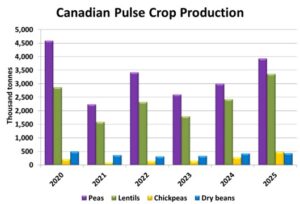
These latest estimates from StatsCan were based on a large farmer survey conducted in November and confirmed the positive harvest results. In fact, they may have understated the actual yields, as they sometimes do. The StatsCan numbers show the total 2025 pulse crop at 8.22 mln tonnes, a jump of more than 2 million tonnes from last year and the largest production since 2016/17. There were differences for each of the pulse crops though.

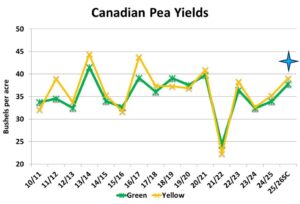
This year’s pea crop came in at 3.93 mln tonnes, up 31% from last year and 24% above the 5-year average. This increase from 3.00 mln tonnes in 2024 was the result of a 9% gain in seeded area and a 42.3 bu/acre yield, the highest since 2016/17. The StatsCan breakdown by type showed a larger percentage increase for green and “other” classes, up 38% and 44% respectively. The 185,000 tonnes of “other” peas (which include maples) was a record while green pea production of 582,000 tonnes was the most since 2020/21. Yellow pea production was up 29% at 3.17 mln tonnes, also the largest since 2020/21.

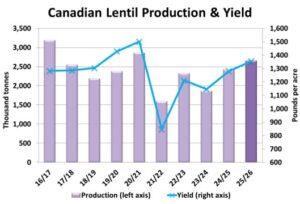
StatsCan reported 2025 lentil production at 3.36 mln tonnes, up 38% from last year and a new record. Seeded area was only 4% more than last year but the yield of 1,721 pounds (28.7 bushels) per acre was up 34% from last year and was the highest since 2013/14. StatsCan showed some very large differences between the various lentil classes, with red lentil production only up 1%, due to a drop in 2025 acreage. Meanwhile, both large green and small green lentil crops were new records, up 124% and 134% respectively while production of “other” lentils rose 186% from last year.

The sharpest increase in 2025 pulse production was seen in chickpeas, with StatsCan estimating the crop at 482,000 tonnes, 68% more than last year and 168% above the 5-year average. This record crop was the result of a combination of 13% more acres and a 50% jump in the 2025 yield at 1,970 pounds (32.8 bushels) per acre.

StatsCan revised dry bean acreage up considerably from its previous estimates but even so, the 2025 crop of 438,000 tonnes was only 3% more than last year. Because a sizable portion of the Canadian bean crop is grown in Ontario, where drought was an issue this year, the Canadian yield of 2,278 lb/acre was actually lower than last year and the limited the size of the 2025 crop.

These big 2025 pulse crops mean a large increase in exports will be needed to keep the market at least somewhat balanced. There have been some signs that lower prices are helping spur more demand, but export trade is facing headwinds due to increased competition and other challenges in the marketplace.

Pulse Market Insight provides market commentary from Chuck Penner of LeftField Commodity Research to help with pulse marketing decisions.
Pulse Market Insight #286

Another Headwind for Yellow Peas

The first quarter of the 2025/26 marketing year is now over and the pea market’s performance can be described as good, considering China’s 100% tariffs on Canadian pea imports, but not great. According to the CGC, farmers’ pea deliveries through 13 weeks were 1.13 mln tonnes, below the 5-year average of 1.21 mln and last year at 1.37 mln tonnes. Licensed pea exports totaled 865,000 tonnes, slightly above the 5-year average of 855,000, but trailing last year’s strong pace of 1.05 mln tonnes.

In a “normal” year, this movement of peas wouldn’t be a big concern but the 2025 pea crop is nearly a million tonnes larger than last year, including 700,000 tonnes more yellow peas. Canada needs to export more peas, not less, in 2025/26 to avoid a large buildup in ending stocks. Unfortunately, the Indian government’s recent announcement of a 30% import tariff on yellow peas (from all origins), effective November 1, won’t help the situation.

Several months ago, India announced the 0% import tariffs would remain in effect until March 31, 2026 but backtracked now in an effort to support domestic pea prices ahead of the rabi planting season. This wasn’t a total surprise, as pulse traders and farmers had been pressuring the government as pea prices in India continued to slide. The Indian government has a long history of using tariffs, tonnage limits and minimum support prices to influence prices.

These new 30% tariffs on yellow peas (green pea imports have been restricted for years) will have two effects on the Canadian market – export volumes and prices. Canada already exported a large amount of peas to India (and other destinations) this fall, helping offset the loss of China as a customer. Export volumes normally drop off after October, so these Indian tariffs starting in November will have less impact (at least for this year) than if they had happened a few months ago.

Some Indian traders have suggested Indian pea imports will actually increase because the tariff announcement has removed uncertainty from the marketplace. We have our doubts, but even if that’s the case, the tariffs will have a negative impact on Canadian yellow pea prices. It’s still early, but the tariffs had the desired effect on Indian pea prices, which are up US$30 per tonne since the announcement. That’s good, but it’s only a 7-8% increase, which is just a portion of the tariff, leaving 22-23% to be made up somewhere else.

Part of that “somewhere else” could come from thinner traders’ margins, but we expect the lion’s share will show up in lower bids to Canadian farmers. Yellow pea bids had been recovering recently from the harvest lows but right after India’s tariff announcement, some buyers dropped bids by 50-60 cents per bushel. Prices recovered fairly quickly from that initial reaction but only partially, with the average yellow pea bid in western Canada still down 18 cents per bushel or C$6.60 per tonne.

The bottom line is that while these tariffs won’t completely slam the door on yellow pea exports to India, volumes could suffer, especially if Russian traders are more willing to discount their peas to make a sale. For Canadian yellow peas, export sales will be done at reduced prices to absorb a portion of the tariffs and most of that will flow back as lower farmer bids. Another unwelcome challenge for 2025/26 pea markets.

Pulse Market Insight provides market commentary from Chuck Penner of LeftField Commodity Research to help with pulse marketing decisions.
Pulse Market Insight #285

Big Supplies Mean Patience and Modest Expectations Needed

Not everyone had impressive pulse yields this year but there were enough positive results that big crops and big supplies are a key feature in the 2025/26 outlook. According to StatsCan’s September estimates, total pulse production this summer was just over 7.2 mln tonnes, over a million tonnes more than last year and the most since 2020/21.

Other sources indicate yields were a lot bigger than StatsCan. Most feedback we received during harvest pointed to yields well above average and provincial crop reports seem to back up those claims. For example, pea yields reported by Alberta Ag and Sask Ag were both 6-7 bushels per acre higher than StatsCan’s estimates for those provinces. Likewise, the lentil yield from Sask Ag was 32.0 bu/acre versus StatsCan at 24.4.

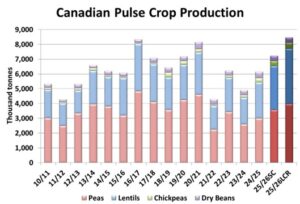
If we plug in these higher yield estimates, the 2025 pulse crop moves from “large” to “record large”, rivaling production of 2016/17. Not each crop would be a record in 2025. In fact, only lentils would be the largest crop ever but total pulse production would be just shy of 8.5 mln tonnes, up 2.3 mln tonnes (38%) from last year.

If demand is strong enough, big pulse crops don’t have to mean extremely low prices, but they certainly don’t help. And it would be nice if the regular laws of supply and demand wouldn’t apply this year, especially for those who didn’t get the big yields this summer, but they do.

Western Canadian bids for peas and lentils since 2010/11 are shown in the chart below. Prices don’t always respond directly to the size of the crop, at least not every year. For example, pulse prices generally strengthened in 2020/21 even though production was close to a new record. That said, the gains that year were fairly modest, especially compared to the spike caused by the drought in 2021/22.

Most times though, markets responded as expected with bigger production resulting in weaker prices. The large pulse crop in 2016/17 triggered a drop in prices, and the market (aside from green peas) took several years to recover.

Pulse prices this fall have reacted according to the laws of supply and demand, but this year’s declines seem to be much more severe. That’s especially the case for green peas and green lentils, which had been historically high and had further to fall.

If prices would reverse course and strengthen in the face of record supplies, demand would need to pick up in a big way, and soon. Unfortunately, the outlook for increased export business is cloudy, at best. Canadian peas are still facing 100% import tariffs from China and although trade talks are ongoing, the odds of a resolution are still fairly low. Another big concern is India, Canada’s other major pulse buyer. Rumours are still circulating about the potential for increased import tariffs but even if that doesn’t happen, Indian buying has been quiet.

In this type of environment with big crops and limited demand, it will take longer than usual to clear the market of the large supplies. This means a fair amount of patience will be needed and price expectations should be limited, looking for opportunities to make small gains during the year rather than waiting for a major rally.

Pulse Market Insight provides market commentary from Chuck Penner of LeftField Commodity Research to help with pulse marketing decisions.

Pulse Market Insight #284

Strong Start for Pulse Exports Needs to Continue

Pulse crops were among the best performers in a year of surprisingly good yields. In September, StatsCan raised its 2025 pea, lentil and chickpea yields compared to August. The provincial crop reports from Alberta and Sask Ag have also boosted yield estimates this fall, in some cases by a lot. According to StatsCan (so far), combined 2025 production of peas, lentils and chickpeas is roughly 6.9 mln tonnes, up 1.2 mln tonnes from last year. And using provincial crop report yields, the total 2025 crop could be closer to 7.9 mln tonnes. That’s a lot more pulses that need to be exported or processed within Canada.

We follow the weekly grain handling data from the Canadian Grain Commission for clues about the movement of crops through the export pipeline. Through the first few weeks of 2025/26, those signals have been mostly positive, but not spectacular. Keep in mind, not all movement is reported by the CGC; only bulk exports are shown, not container exports. Still, the year-to-year comparisons are useful.

As of shipping week eight, bulk pea exports were 626,000 tonnes, running ahead of last year at 599,000 and the 5-year average of 538,000 tonnes. We expect this strong start is largely driven by quick movement to India and other south Asian destinations. This is good news, especially with China’s 100% import tariffs still in place.

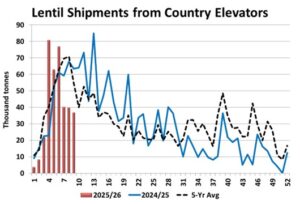
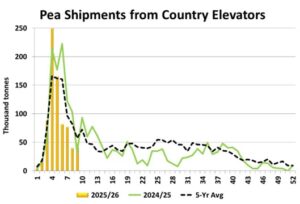
While the export numbers show what has already been moved outside our borders, two other CGC measures are leading indicators of whether that export pace will continue. Farmer deliveries are the earliest indication of how strongly peas are being pulled into the export pipeline. Farmer deliveries of peas always spike at harvest and at the start of 2025/26, those volumes were solid again. In more recent weeks though, pea deliveries dropped more sharply than usual. It’s a similar picture for shipments out of country elevators, which spiked earlier but have since dropped below average. Both indicators suggest a quieter-than-usual export movement ahead.

It’s a similar picture for lentils, with year-to-date bulk exports of 264,000 tonnes, ahead of last year at 181,000 and the 5-year average of 215,000 tonnes. A stronger-than-usual start is important for 2025/26, especially with a record lentil crop expected in Australia later this year.

Just like peas, farmer deliveries of lentils also tend to spike in the first few weeks of the marketing year, followed by a quick drop in volumes. Deliveries were impressive in late August and early September but in more recent weeks, have already dropped below average levels. Similarly, shipments of lentils out of country elevators were very strong a few weeks ago but seem to have run out of steam more recently. This is a caution that exports will be quieter than usual in the weeks ahead.

This year’s bigger pulse crops mean exports will need to increase in 2025/26 and a large portion of export programs are already set within the first 2-3 months of the marketing year. It’s always possible the export market could improve later in the year, especially if low prices spur more demand. For peas, a sizable pickup in exports would need China withdrawing its import tariffs. A poor Indian rabi pulse crop could also increase demand for Canadian lentils and peas. That said, there are no indications of either of these things happening.

There are also risks that demand could be reduced, particularly if the Indian government decides to raise or impose import tariffs on one or more pulses. This means a marketing plan for pulses in 2025/26 should include some optimism, but also a good dose of realism. A certain amount of patience wouldn’t hurt either.

Pulse Market Insight provides market commentary from Chuck Penner of LeftField Commodity Research to help with pulse marketing decisions.
Pulse Market Insight #283

Changes in 2025 Market Sentiment

Every marketing year is different, from both the supply and the demand sides of the equation. That said, ever since the 2021/22 drought year, pulse prices were mostly positive with supply and demand relatively well-balanced, although there were still regular ups and downs in the market. Pulse exports moved more-or-less freely and kept ending stocks in check.

It also helped (for prices) that in the last few years, yields of Canadian pulses have been below long-term averages. In the three years after 2021/22, pea yields have averaged 35.0 bu/acre, almost four bushels less than the average before 2021/22. Likewise for lentils, yields averaged 1,200 lb/acre since 2021/22 versus 1,360 lb/acre prior to the drought year. These mediocre yields kept supplies limited and prices supported.

In 2025/26 though, pulse crops avoided the high temperatures of the last few years. Even though rainfall was variable, this year’s moderate temperatures during flowering and filling resulted in much stronger yields, and will likely end up well above StatsCan’s latest estimates. For example, StatsCan reported the Alberta pea yield at 40 bu/acre, while the Alberta Ag crop report showed a yield seven bushels higher, with a similar difference in Saskatchewan estimates. Lentil and chickpea estimates showed the same type of yield response.

The combination of increased acres of peas, lentils and chickpeas along with yields at multiyear highs have resulted in much larger Canadian pulse supplies needing to be sold. Word-of-mouth reports have also told us that forward contracting this year was slower than usual, partly due to concerns about short crops in the last few years. That’s understandable, but it also leaves even larger volumes that need to be sold in season.

As this year’s pulse harvest progressed and the big yields became obvious to all, getting some of that crop sold took on more urgency. Prices were already declining through the summer but the increase in harvest selling triggered an even sharper downturn. It’s worth noting that this drop still fits the seasonal pattern for this time of year.

This year’s added urgency of selling off the combine exaggerated the move lower, but it also set the stage for a price rebound. It appears the heavy selling caused the price drop to be overdone. Once the rest of the crop was safely in the bin, bids already began to rebound, which also fits the seasonal pattern.

This bounce doesn’t mean there will be a sustained rally through the late fall and early winter. There’s no getting around that Canadian pulse supplies are very large. At the same time, the export market is facing challenges. Bigger crops are also reported in other exporters like Russia, Kazakhstan and Australia and competition will be more intense. Add to that, Chinese tariffs on imports are limiting demand for peas. There are also concerns that the Indian government could reinstate tariffs.

There is no doubt the pulse industry will face headwinds in 2025/26, which will limit how much prices can recover from the bottom. From a positive perspective though, the current low prices should also spur more demand from other sources. As the old saying goes, “the best cure for low prices is low prices.”

Pulse Market Insight provides market commentary from Chuck Penner of LeftField Commodity Research to help with pulse marketing decisions.

Pulse Market Insight #282

What Do the StatsCan Stocks Numbers Say?

This week, StatsCan released its estimates of crop stocks as of July 31. This was based on a farmer survey a couple of months earlier, so it is somewhat stale-dated. Despite its limitations, these numbers can be helpful in looking ahead to the new marketing year of 2025/26. The July 31 stocks are the carryover into the following year and, together with the incoming crop, determine the supply situation for 2025/26.

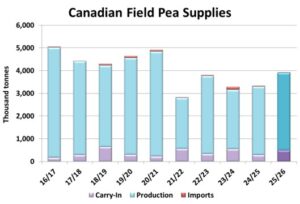
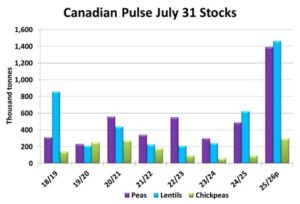
StatsCan reported July 31 stocks of peas at 489,000 tonnes, up nearly 200,000 tonnes from 2023/24 and about 100,000 tonnes above the 5-year average. Inventories would have been lower if China hadn’t imposed tariffs and is a mildly negative number (on its own). Together with StatsCan’s initial yield production estimate of 3.41 mln tonnes, total 2025/26 supplies would end up just shy of four million tonnes, nearly 600,000 tonnes more than last year.

From a longer term perspective, these supplies aren’t considered huge but must be viewed in light of the challenging export picture. There is considerable uncertainty in the export outlook with respect to both China and India and those outcomes could overshadow the Canadian supply situation. It’s also quite likely that later production estimates will be larger than these initial reports.

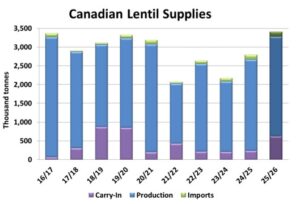
For lentils, StatsCan reported large 2024/25 ending stocks of 624,000 tonnes, up sharply from the previous year and the most since 2018/19. Based on production and exports in 2024/25, we expect most of those would be red lentils. At the same time, StatsCan’s initial estimate of the 2025 crop is also larger than last year and the combination of these two amounts would mean 3.4 mln tonnes of lentil supplies in 2025/26. That’s up 600,000 tonnes (22%) from last year and would be the largest on record.

These heavy supplies of Canadian lentils make the export prospects much more critical for the 2025/26 price outlook. It looks like exports could improve in the coming year, but they’ll need to pick up a lot to deal with the big supplies, which could get even bigger based on harvest results.

Chickpea exports were very positive in 2024/25 but StatsCan still reported an increase in July 31 stocks at 92,000 tonnes, up more than 50% from the previous year. StatsCan is also forecasting a sizable increase in the 2025 crop, which would push total supplies up to 440,000 tonnes, the most since 2020/21. That said, Canadian exports have been strong, helped by lower prices, and if that continues, these supplies won’t feel much heavier.

Keep in mind that these supply estimates are using StatsCan’s first production estimates issued in late August. Most observers (including us) expect the final production numbers will be higher, perhaps considerably larger. As a result, the supply estimates in the chart above should be considered the low watermark for the year.

Pulse Market Insight provides market commentary from Chuck Penner of LeftField Commodity Research to help with pulse marketing decisions.
Pulse Market Insight #281

First StatsCan Crop Estimates for 2025

This week, StatsCan issued its first yield and production estimates for 2025 crops. These numbers are based on computer models using satellite vegetation images which, in our view, have been getting better at estimating yields. That said, these first estimates were based on the situation at the end of July; weather and crop conditions have changed considerably since then, some worse but mostly better.

As combines got rolling this fall, one common theme we’ve been hearing from many parts of the prairies has been that yields are coming in better than expected. Rainfall was variable across the prairies but in all regions, 2025 was a much milder summer than the last 3-4 years when extended periods of extreme heat reduced yields. If these early positive results continue through the rest of harvest, we wouldn’t be surprised if these initial StatsCan numbers are the low-water mark for the season.

For peas, StatsCan reported a yield of 36.6 bu/acre, up from 34.8 bu/acre last year and about three bushels better than the 5-year average. This higher yield, along with a 9% increase in seeded area would result in a 2025 Canadian pea crop of 3.41 mln tonnes, 400,000 tonnes (14%) larger than last year and the biggest crop since 2022/23. Back in June, StatsCan’s acreage estimates showed yellow pea area expanded the least, with larger gains for green and especially “other” peas, which includes maples.

In a normal year, this size of production increase could be absorbed by the market without too much difficulty, but 2025/26 isn’t normal for peas. Import tariffs by China, Canada’s largest customer, will restrict export potential and it will be difficult to find a home for that lost tonnage in other countries. Ultimately, 2025/26 ending stocks could end up at historically high levels.

StatsCan reported positive yields for lentils in 2025. Its estimate of 1,355 pounds (22.6 bushels) per acre was the highest since 2020/21 and, based on early harvest results, could still be too low. The improved yield, along with a 4% increase in seeded area, would mean a lentil crop of 2.66 mln tonnes, 225,000 tonnes (9%) larger than last year. And with a larger old-crop carryover, 2025/26 supplies could be in record territory. Keep in mind that back in June, StatsCan reported large increases in green lentil acreage while seeded area of reds actually declined. This suggests a sizable shift in Canadian lentil supplies toward greens while red lentils don’t appear as burdensome.

The lentil export market isn’t facing hurdles as serious as those for peas, but there are issues. Back in March, India imposed 10% tariffs on lentil imports which hasn’t stopped trade but does require discounted prices. Even so, Canadian red lentil exports could expand in 2025/26. The greater concern could be dealing with the large supplies of green lentils, with global trade tending to be more-or-less static.

StatsCan was more cautious with its estimate of chickpea yields, reporting output at 1,289 pounds (21.5 bushels) per acre, the lowest yield since 2021/22. Even with a lower yield, the 13% increase in seeded area would mean a 2025 chickpea crop of 309,000 tonnes, 8% more than last year. If yields end up close to this initial StatsCan estimate, 2025/26 supplies won’t be huge but still quite comfortable. Canadian chickpea exports have been strong for the last year and performance could be strong again in 2025/26, keeping stocks from feeling too heavy.

The StatsCan production estimate for dry beans show 2025 production at 353,000 tonnes, down 16% from last year. This is mainly due to a yield of 2,160 lb/acre, the lowest since 2021/22. That said, there are sizable questions not only about its bean yield but also StatsCan’s seeded area estimate, which could be understated by nearly 50,000 acres.

As always, these estimates are subject to debate. The next StatsCan model-based estimates will be released in only a few weeks, based on August conditions. Yields and production numbers will see changes, quite likely higher. The “final” crop estimate will be released in early December based on a farmer survey, but even that is prone to questions and debate.

Pulse Market Insight provides market commentary from Chuck Penner of LeftField Commodity Research to help with pulse marketing decisions.