Contact

Pulse Market Insight #298

Third Quarter Scorecard Positive for Pulses

More acreage and very high yields meant much bigger Canadian pulse crops in 2025. Pea and lentil crops were each nearly 1.0 mln tonnes larger than 2024 and chickpea production was up by almost 200,000 tonnes. And for each crop, the carryover from 2024/25 into 2025/26 was also large, which added to the big supplies.

With pulse crops facing extremely heavy supplies, a serious increase in export volumes was needed in 2025/26 to keep markets from being pressured (even) lower. And early in the marketing year, prospects weren’t great. In fact, the most positive developments only started to show up in the third quarter of the 2025/26 marketing year. While that doesn’t leave a lot of time to “fix” the heavy supply situation, the outlook is certainly brighter than it was a few months ago.

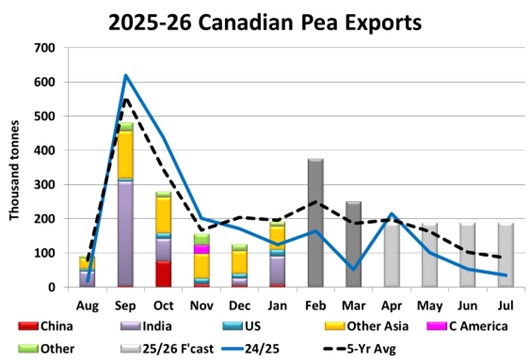
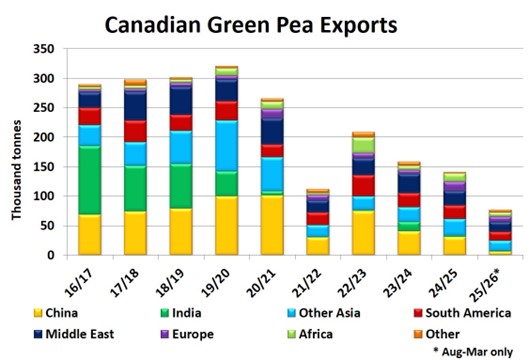
Prospects were especially dim for peas earlier in 2025/26, with Chinese tariffs essentially shutting off that important outlet for Canadian peas. Indian demand was mediocre but other countries stepped up and kept pea exports flowing at a decent pace. Of course, the big pea supplies meant “decent” exports weren’t enough. Fortunately, China announced in January that it was dropping its tariffs, triggering a sharp improvement in exports by late February.

The chart above only shows bulk pea (mostly yellow) exports reported by the CGC but it clearly demonstrates how things have changed. As of week 39, the end of the third quarter, bulk pea exports reached 2.08 mln tonnes compared to 1.58 mln tonnes in 2024/25. Even if the pace moderates in the final quarter, Canadian exports will remain strong, the most since 2020/21. That means 2025/26 pea ending stocks will be large but not massive, which was certainly a concern earlier in the year.

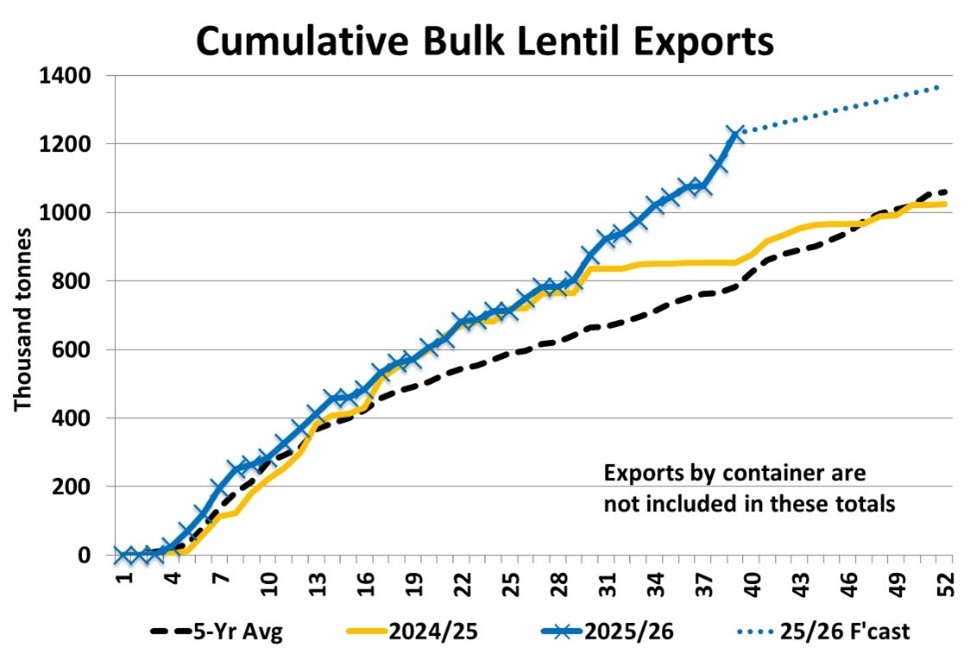
The chart below shows the CGC data for bulk lentil exports, which would largely be red lentils. Exports were good through the first half of 2025/26, keeping pace with the previous year and well above average. That said, to offset the big increase in the 2025 crop, exports needed to be more than “good”; great exports where necessary. Fortunately, the pace of exports turned strongly higher starting in late February, in sharp contrast to the 2024/25 slowdown.

By the end of the third quarter of 2025/26, bulk lentil exports reached 1.23 mln tonnes versus the average of 0.78 mln tonnes. Even if exports slow in the fourth quarter, as they sometimes do, the full-year total should be the most since 2020/21. That’s good news for the red lentil market as those ending stocks will be reasonably large but not massive, and better than expected earlier this year. The CGC export numbers don’t reflect green lentil exports but the StatsCan data to the end of March shows above-average volumes of green lentil exports. Unfortunately, that pace isn’t nearly enough to draw down the huge stockpile of Canadian green lentils, so the heavy supplies will continue.

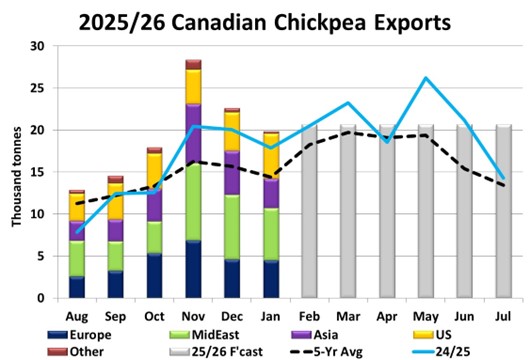
Among the pulses, chickpeas are showing the best export performance in 2025/26, with a record pace. The CGC doesn’t report chickpea exports, as those are all done by truck to the US or by container but StatsCan’s exports to the end of March are 168,000 tonnes, far ahead of the average of 121,000 tonnes. While that’s very positive, there are still lots of chickpeas, including low quality, still on farms. But the trend is in the right direction. That hasn’t been enough to lift chickpea prices but has at least kept him stable.

Pulse Market Insight provides market commentary from Chuck Penner of LeftField Commodity Research to help with pulse marketing decisions.
Pulse Market Insight #297

Supply Outlook and Carry-Over Stocks

It’s far too early to make solid predictions about the size of 2026 crops. Seeded area could have changed since StatsCan’s early forecasts. And of course, yields prior to planting are a complete unknown. At this stage in our 2026/27 production outlooks, we use an average yield as that would have the highest odds. Suffice to say, predictions in May about crop size are tentative at best.

While the upcoming crop forecasts are a bit “foggy”, one part of next year’s supply situation is a bit clearer. With the 2025/26 marketing year three-quarters complete, we’re getting a better idea of the tonnes that will be left at the end of the year and carried over into 2026/27. One thing that’s very apparent this year is that the situation is quite different for the individual classes within each pulse crop. Supplies of green lentils and green peas are very different than red lentils and yellow peas.

Overall, pea supplies at the end of 2025/26 will be quite comfortable, somewhere over 700,000 tonnes. That said, the good news is that we’ve trimmed this estimate a few times as export prospects improved, especially after China dropped its tariffs. On the surface, ending stocks of yellow peas look a lot larger than green peas as the absolute number of tonnes is almost twice as large.

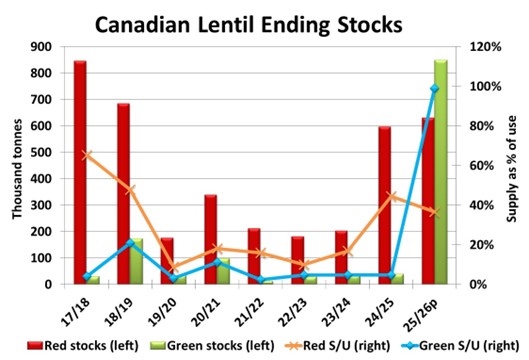
The more important measure is the stocks/use (S/U) ratio, which looks at the number of tonnes left over, as a percent of usage (exports, feed, processing and seed). For yellow peas, the ending stocks of 470,000 tonnes represent only 15% of usage, not far off from the last few years. Even though green pea ending stocks are smaller at 250,000 tonnes, that works out to more than 40% of usage. For the 2026/27 outlook, this means the yellow pea carryover isn’t nearly as heavy, while the green pea market will be facing a relatively larger supply cushion.

It’s a similar situation for the Canadian lentil market, with very large supplies expected at the end of 2025/26. Exports have been strong so far this year, but not enough to match the increase in the record 2025 crop. There is a sizable difference between ending stocks for red and green lentils. Typically, red lentil stocks are much larger than greens but in 2025/26, that situation flipped around. Our forecast is that July 31 red lentil stocks will be 630,000 tonnes, with a stocks/use ratio of 35-40%. The green lentil crop in 2025 was more than double last year and even with solid exports, 850,000 tonnes will be left at the end of the year. The stocks/use ratio close to 100% means that there will almost be enough green lentils carried over to meet all of next year’s demand. That’s very burdensome and means that drawing down those supplies will take some time.

Not to be left out, ending stocks of Canadian chickpeas will also be very large, even though 2025/26 exports are running at a record pace. The 260,000 tonnes we’re expecting will be left at the end of this marketing year is close to the old highs of five or so years ago, although we’ve heard that a sizable portion this year are poor quality. The stocks/use ratio close to 75% is also quite large but may not feel quite as heavy as a few years ago, when stocks/use was well over 100%.

The large supplies for most pulses have implications for the possible impact of lower (or higher) production in 2026. If there is a problem with yields in 2026, those pulses with very large old-crop carryover, like green lentils and green peas, will see less of a price response. And if crops perform well again next year, the lows in those markets will be extended. On the other hand, there’s a smaller cushion for yellow peas and red lentils, and a production issue would generate a larger price response.

Pulse Market Insight provides market commentary from Chuck Penner of LeftField Commodity Research to help with pulse marketing decisions.

Pulse Market Insight #296

Seasonal Tipping Points Approaching

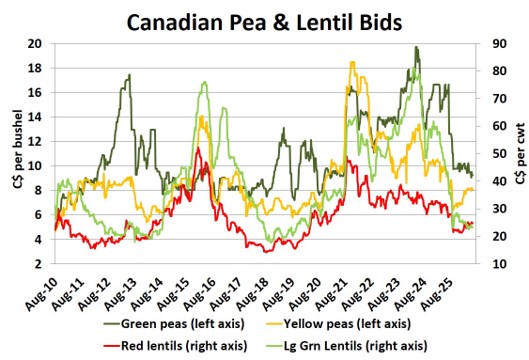
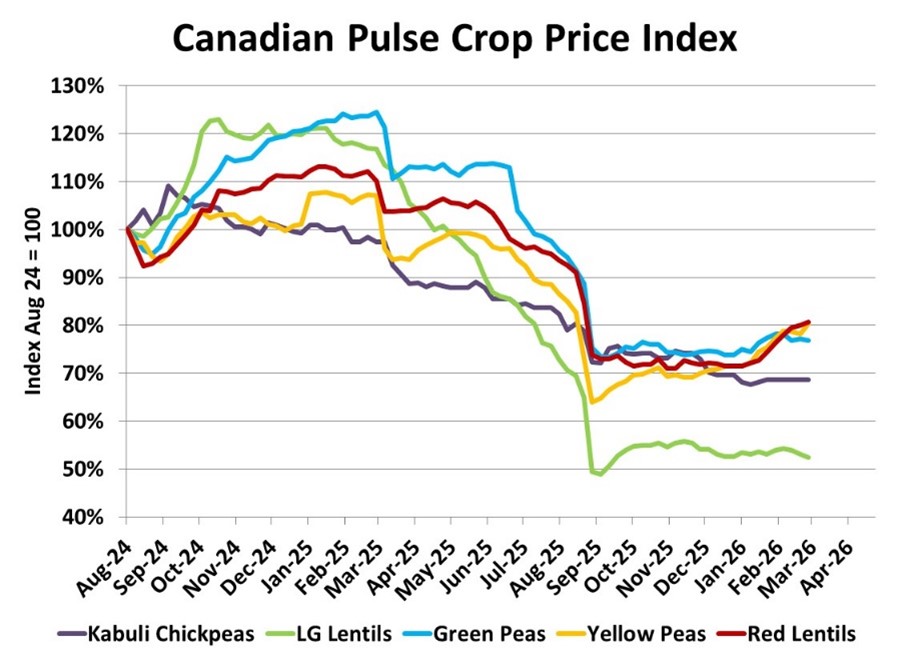
Performance in pulse markets has been very mixed this year, with some notable shifts recently. Prices for yellow peas and red lentils have shown some decent gains over the past couple of months. Others like green peas and green lentils are looking weaker, while kabuli chickpeas are steady.

When viewing the latest trends in these crops, especially the positive ones, it’s natural to expect (or hope) they’ll continue. As the old saying goes, “the trend is your friend”. There are solid fundamental reasons, particularly stronger export demand, behind the improvements in yellow pea and red lentil prices. And yet, these markets won’t keep climbing indefinitely. Prices trend higher, until they stop.

Fortunately, history provides a timeline of when that turn lower will happen. The most consistent part of seasonal price behaviour is the decline that happens virtually every summer. Even in 2021/22, with a severe drought underway, prices started to dip in summer before rallying.

While every year is a bit different, the main reasons behind the summer downturn are straightforward. Once the seed is in the ground, buyers back off from the market as they wait for the upcoming crop, even if it’s expected to be a bit smaller. At the same time, more farmers look at emptying bins and finishing old-crop sales. Overall, market activity slows ahead of the slug of harvest deliveries. The chart for yellow peas shows the seasonal index starting to decline a couple of months before harvest and hitting a bottom when off-the-combine deliveries peak.

Even though there can be a bit of “wiggle room” on the exact timing, this price behaviour is very consistent and predictable. In fact, it’s basically inevitable with the rare exception of a crop failure on the order of 2021/22. And yet, the price drop that happens every summer still seems to catch some people off guard, making them wonder what’s wrong with the market.

The chart above shows that for yellow peas, there isn’t an obvious spring peak in prices; it’s more of a “plateau”. That said, the drop-off in early summer is clear-cut, which starts around mid-May and accelerates lower by mid-June. For red lentils, there’s a more obvious peak in the seasonal index which also occurs in mid-May before turning steadily lower and bottoming out in mid-September. For red lentils however, the seasonal pattern shows there’s not as much of a postharvest recovery.

The seasonal index for all crops is at its most predictable at this time of year and can provide guidance for timing of remaining old-crop sales. The chart below shows how and when red lentil prices will change, assuming they’ll follow the seasonal timing. As of mid-April, the average bid in western Canada was just over 25 cents per pound. On average (the red line), seasonal behaviour indicates a small increase is likely four weeks out (mid-May). At eight weeks from now (mid-June), prices will be past the seasonal peak but won’t have dropped much yet. At twelve weeks out (mid-July) though, the seasonal pattern will have turned lower.

Of course, not every year follows the average tendency exactly. The blue (maximum) line on the chart shows the best price performance for the next 12 weeks, over the last 15 years. It’s worth noting that even in the most bullish year, prices still turned down by mid-July. There’s also a worst-case outcome, when red lentil prices started declining earlier than usual and dropped sharply over the following 12 weeks.

While each crop and each year is slightly different, the seasonal declines in summer are very clear and consistent market signals. Unless there’s a reason to hold the crop through the summer lows and into the next marketing year, this price behaviour is a strong incentive to make sales in the next few weeks.

Pulse Market Insight provides market commentary from Chuck Penner of LeftField Commodity Research to help with pulse marketing decisions.
Pulse Market Insight #295

Are US Acreage Changes a Signal for Canada?

A few weeks ago, StatsCan released its seeding intentions estimates for 2026, but these were the results from a very early farmer survey. This raised lots of questions about whether farmers have changed some planting decisions since then. This past week, the USDA issued its own set of 2026 acreage forecasts, but these survey results were more current by a couple of months.

Farmers on both sides of the border generally see the same kind of price signals and cropping practices aren’t all that different. As a result, we wonder whether the more recent USDA estimates could provide a few fresh clues about acreage changes in western Canada.

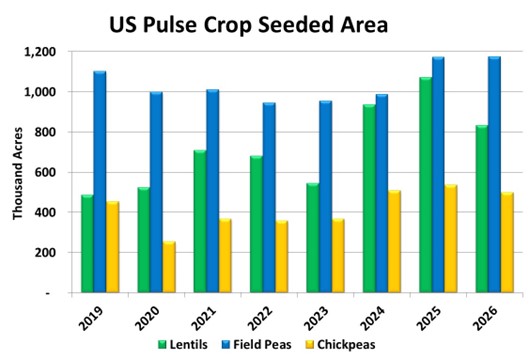
In its estimates, the USDA is forecasting seeded area of peas at 1.17 mln acres, almost identical to 2025, and this would be the second highest total ever. This is a bit surprising, given that US pea exports have lagged in 2025/26 and prices there haven’t benefited from Chinese buying, like Canadian peas have.

Earlier, StatsCan forecast a 12% decline in Canadian pea acreage but again, this was based on a farmer survey conducted before China dropped its import tariffs. It’s quite possible that the Canadian acreage number will be revised higher and if it matches the 2025 total, the 2026/27 supply outlook could be more comfortable than expected earlier.

The USDA reported a much larger change for 2026 lentil acres, with a 22% drop in seeded area at 832,000 acres. That shouldn’t be all that surprising as 2025 acreage was a near record and a return to more typical levels could be expected. More importantly, a large portion of US lentils are green varieties (mainly medium greens), and those prices have seen large price declines, discouraging more acres.

In western Canada, StatsCan estimated a more moderate 5.5% decline in lentil acreage. But looking beneath the surface, seeded area of green lentils will almost certainly drop more sharply, which could mirror the US declines. At the same time, red lentil acreage in western Canada will likely see an increase.

Seeded area of chickpeas in the US is forecast to drop by 7% in 2026. That’s the opposite direction from StatsCan’s estimate of a 6% increase. If 2026 chickpea acreage remains fairly steady on both sides of the border, that wouldn’t be too surprising. That said, these changes are relatively minor and we don’t want to read too much into them, especially since both the USDA and StatsCan have made sizable revisions to their chickpea estimates in recent years.

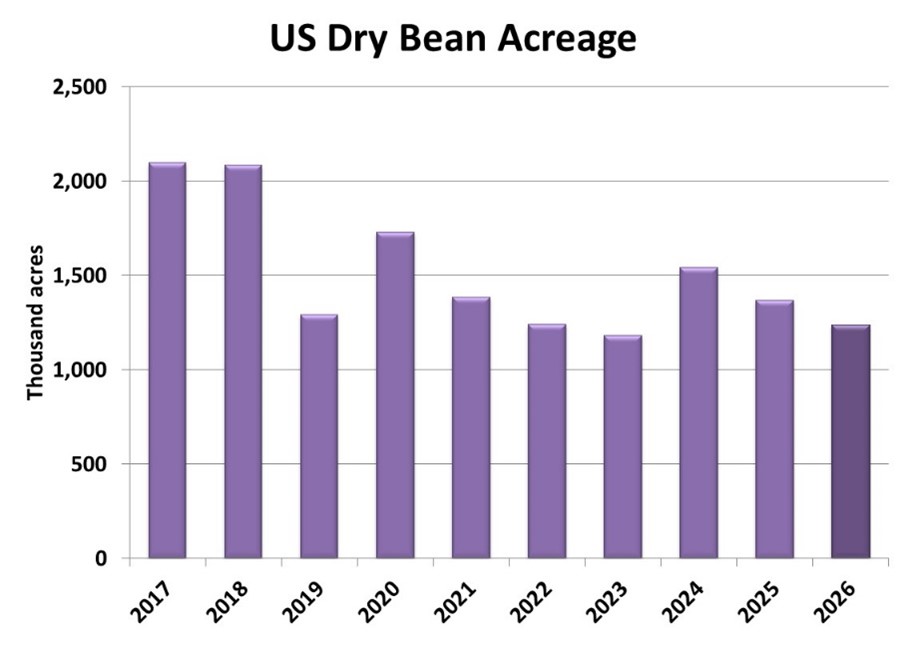
The USDA pulse estimate that could be the strongest clue about Canadian acreage is for dry beans, which are forecast to decline 10% from last year. StatsCan’s dry bean acreage estimates were incomplete for several provinces, and those gaps made it difficult to get a good handle on Canadian acreage. If seeded area on both sides of the border declines by 10%, lower North American supplies could make the 2026/27 market a bit more interesting.

Of course, these are only acreage numbers. The main ingredient in the supply outlook is yield. At this point, we think in terms of average yields, and there’s no way to make an accurate forecast until well into the growing season.

Pulse Market Insight provides market commentary from Chuck Penner of LeftField Commodity Research to help with pulse marketing decisions.

Pulse Market Insight #294

Mid-Season Checkup

It’s already well past the halfway point of the 2025/26 marketing year but some of the performance measures, particularly exports, are only available for January. This export data gives us a bit of an indication of how things performed through the first half of the year and admittedly, are backward looking. Since then too, some significant changes have occurred in pulse markets, particularly for peas. There are also a few risks remaining in the market that could impact the last few months of 2025/26. Still, it’s worth reviewing how the first half of the year could impact the remainder of 2025/26.

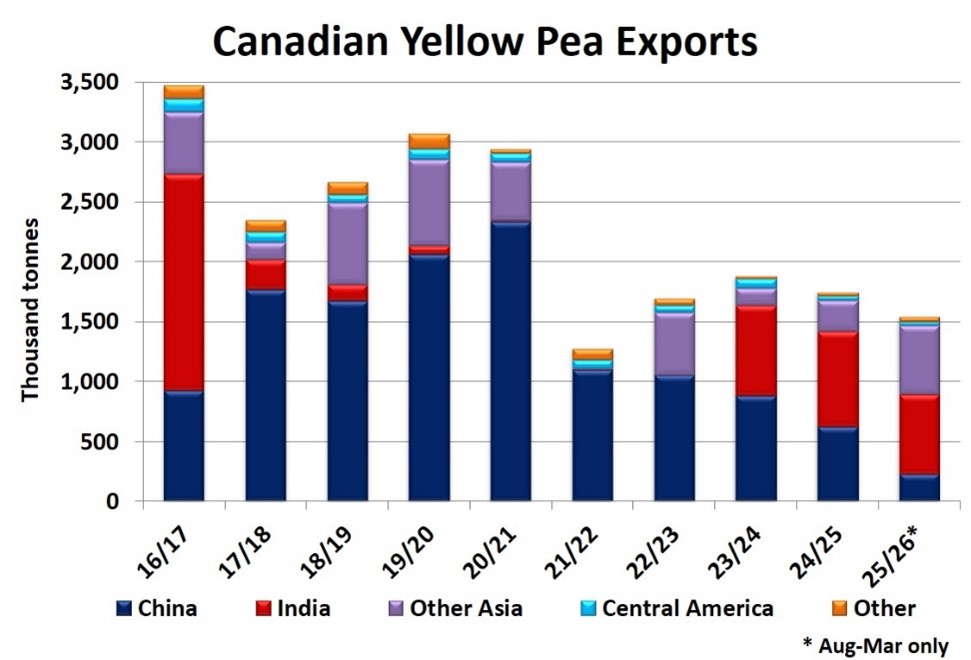
Pea exports in the first half of 2025/26 have been disappointing, but that’s not surprising. With a few small exceptions, China has been absent as a buyer, and monthly totals have mostly been below average. Canadian exports to India have been sporadic, well below year-ago levels. The main bright spot has been a near doubling in exports to other Asian countries, particularly Bangladesh.

Overall, Canadian pea exports for the first six months of 2025/26 were 1.32 mln tonnes, the slowest pace since 2021/22 and well below the 5-year average of 1.55 mln tonnes. But there is good news early in the second half of the marketing year. The CGC weekly data is more current and shows a sharp increase in February exports, which we’re forecasting at 375,000 tonnes with solid performance again in March. This reflects the return of China as a customer due to the removal of import tariffs, effective March 1. While it’s not clear how the last few months will turn out, our full-year export forecast is now 2.7 mln tonnes, which would end up the highest since 2020/21.

Canadian lentil exports dipped in January but the first-half total of 1.19 mln tonnes was still slightly ahead of average at 1.11 mln tonnes. India was the largest destination but exports to Türkiye were also very strong due to its crop failure in 2025. We expect this strong Turkish demand will continue into the second half.

While the first half export pace has been solid, the CGC data shows lentil exports (similar to peas) are also seeing an uptick in the second half. While first-half lentil exports in 2025/26 were trailing last year, CGC exports (which don’t capture container exports) have pulled ahead in the last few weeks. There are also signs in the CGC’s delivery and shipment data that these export volumes will remain strong for at least the medium-term. Our full-year export forecast for 2025/26 is 2.25 mln tonnes, more than 400,000 tonnes above the previous year.

So far in 2025/26, Canadian chickpea exports are performing very well. Over the first six months, 116,200 tonnes were exported, a record pace and well above the 5-year average of 83,000 tonnes. Canadian chickpeas are competitively priced and solid exports are expected to continue, especially since volumes tend to be higher in the second half of the year. That said, Canadian supplies are still large enough to easily supply this demand.

Dry bean exports are also running at a record pace so far in 2025/26. Over the first half, 209,800 tonnes were exported compared to the 5-year average of 187,300 tonnes. As dry bean supplies are drawn down later in the year, exports could be limited, but the full-year total will be very positive.

Pulse Market Insight provides market commentary from Chuck Penner of LeftField Commodity Research to help with pulse marketing decisions.
Pulse Market Insight #293

StatsCan Pulse Acreage Numbers (Mostly) Not Surprising

The first official forecasts of 2026 seeded area were recently issued by StatsCan, with some “interesting” estimates for a few crops. For pulse crops though, most of the acreage numbers weren’t really out of line with expectations.

It’s important to note that even though StatsCan’s estimates were issued in early March, they were based on a farmer survey that occurred between mid-December and mid-January. Since that survey, there have been sizable market developments that could influence acreage decisions. That said, crop rotations are largely fixed and a portion of the acreage was already decided back in December. But there is still room for some late tweaking around the margins.

The most noteworthy event was the announcement by the Chinese government to scale back or eliminate import tariffs on canola seed, canola meal and peas, which injected more optimism into those markets. This development added some support for prices which could, in turn, shift a few more acres in that direction. Prices for other crops like barley, wheat and red lentils are moving higher seasonally, which could also make those look a bit more attractive.

For the most part though, StatsCan’s estimates a pulse crop acreage seem to be within reason. Seeded area of peas was reported at 3.08 mln acres, 12% less than last year and in line with the average trade guess. Both yellow and green pea prices are lower than a year ago, but the decline is sharper for green peas, which could discourage a few more of those acres. But as mentioned above, more certainty with respect to exports to China could bring a few more peas, particularly yellows, back into rotations.

Fewer acres of peas along with a return to an average yield would mean the 2026 crop could shrink by over a million tonnes. This should help ease the heavy supply situation to some degree but wouldn’t make things “tight”. The old-crop carryover from 2025/26 is expected to be historically large and offset much of a reduction in the 2026 crop.

StatsCan also showed a decline in 2026 lentil acreage, although not to the same extent as peas. Seeded area was reported at 4.14 mln acres, 5.5% lower than last year but above the average trade guess of 3.9 mln acres. This reduction would be fairly modest and leave lentil acreage in line with the 5-year average. While StatsCan doesn’t provide a breakdown by type in this report, we would expect a shift to red lentils, back to a more typical two-thirds share of acreage. This would mean a larger cut in green lentil acres, which the market definitely needs.

Just like peas, fewer lentil acres and a drop back to the average yield would mean a large decline in the size of the 2026 crop, a step in the right direction for a heavily-supplied market. That said, most of that production loss would be offset by the large old-crop carryover from 2025/26, with an emphasis on green lentil supplies.

Chickpeas are the exception in StatsCan’s lower estimates of pulse acreage. Seeded area is forecast at 575,000 acres, 6% more than last year. Even with more acres, a drop back to the average yield would mean a noticeably smaller crop in 2026. But the recurring theme of heavy supplies will also limit the impact of a smaller chickpea crop, with the very large old-crop carryover from 2025/26 resulting in even larger supplies next year. Export demand has been strong for chickpeas, but that may not be enough to keep supplies from feeling heavy again in 2026/27.

StatsCan’s estimate of dry bean acres was a bit puzzling, showing a 31% drop at 295,000 acres. That would be the lowest total since 2015. While prices for pinto and black beans are currently low, we’re skeptical that seeded area will decline that much, partly because StatsCan’s coverage of dry beans has been “patchy” in the past. Seeded area will likely be lower, but not by that much.

Pulse Market Insight provides market commentary from Chuck Penner of LeftField Commodity Research to help with pulse marketing decisions.

Pulse Market Insight #292

Drawing Down Pulse Stocks Will Take Time

It’s no secret that Canadian pulse crops were big in 2025. While pulse yields didn’t set new records like a few other crops, the pea yield of 42.3 bu/acre was 7½ bushels more than the year before and 26% above the 5-year average. The 2025 lentil yield of 1,721 lb/acre was up 440 pounds from the previous year and 45% above average while the chickpea yield was 1,970 lb/acre, 650 pounds more than 2024 and a whopping 56% above the average.

For all three pulse crops, seeded area was higher in 2025 than 2024, compounding the big crop “problem”. While not everyone got the high yields, the big inventories in farmers’ bins are evidence of the heavy supply situation facing pulse markets in 2025/26. Total supplies of pulses (not including dry beans) in 2025/26 are a new record, just over 9.0 mln tonnes. That’s 2.6 mln tonnes (40%) more than a year ago.

It wasn’t just the big 2025 crops that caused the buildup in supplies; stocks at the end of 2024/25 were already feeling “comfortable” for all three pulse crops. When those stocks were carried over into 2025/26 and added to last year’s big production, supplies ballooned.

The feeling of “heaviness” in the market varies between pulses and even within pulse types. For example, production of green and maple peas expanded more than yellows in 2025 and those two classes are looking a bit more burdensome than yellows. The green lentil crop, especially small greens, grew a lot more than reds, creating more of a “problem” with green lentils.

On the plus side, pulse exports in 2025/26 have been showing some positive signs. Pea exports are starting to pick up again now that the Chinese government has announced a drop in tariffs. Movement of lentils has been positive all year, with more signs of fresh demand in the last few weeks. And chickpea exports have picked up considerably this year, with volumes in November the highest in years.

Of course, stronger export demand is stimulated by low prices, which is part of normal market behaviour. When supplies are heavy and prices are low, demand tends to pick up and eventually draw down those heavy supplies. That isn’t always a quick process though.

One way to measure the heaviness of supplies is the stocks-to-use ratio. This is calculated by dividing the July 31 ending stocks of a crop by the amount of total usage (exports and domestic consumption). The higher the percentage, the heavier a crop’s supplies are, relatively speaking.

When we look at peas for example, the 5-year average stocks-to-use ratio is 14% and in 2024/25, that moved up to 17%. The big jump in 2025/26 was mainly caused by the much larger crop. Our forecast for 2026/27 includes a drop in pea acreage and a return to average yields but even then, the 2026/27 stocks-to-use ratio only declines to 24%, still on the comfortable side.

For lentils, the stocks-to-use ratio was already signaling heavier supplies in 2024/25, well above the 5-year average but in 2025/26, that spiked to 63%. Next year, even with a forecast of fewer acres and average yields together with solid exports, the stocks-to-use ratio will remain elevated.

The stocks-to-use ratio for chickpeas dropped in 2024/25 but shot higher in 2025/26. And the situation may not improve in 2026/27, even if yields drop back to average and acres slip a bit. Those heavy stocks carried over from 2025/26 will keep next year’s supplies very heavy.

That’s not to say the large supplies won’t allow prices to improve at all. We’ve already seen some gains in pea prices (even before China’s reentry into the market) and red lentil bids are starting to edge higher as well. Rather, the heaviness will limit the potential gains that tend to show up seasonally (for some crops) in spring as well as price potential in 2026/27.

Pulse Market Insight provides market commentary from Chuck Penner of LeftField Commodity Research to help with pulse marketing decisions.

Pulse Market Insight #291

Chinese Pea Demand is Positive but Not the Cure-All

No question, the news that China is dropping its 100% import tariff on Canadian peas is positive for the market. At a time of year when pea exports are normally slowing, renewed shipments to China will keep peas flowing into the system, which will keep prices supported.

Early in 2026, average western Canadian bids for both yellow and green peas are up roughly 60 cents per bushel. We emphasize the word “average”, because some buyers have raised their bids considerably more while others haven’t responded as much. People who were expecting bids to spike following the Chinese tariff announcement are probably underwhelmed with this response, but there are a few reasons for the relatively modest gains.

For one thing, China has been able to access plenty of peas from Russia, which had a record 5.2 mln tonne crop in 2025/26. Even so, Canadian peas are still preferred due to consistency of quality, which should provide a boost in trade. Chinese pea inventories are currently low, which should also add to a solid recovery in Canadian exports.

So far in its 2025/26 Jun-May marketing year, China has imported an average of 175,000 tonnes per month (with Russia as the main origin), which would mean a full-year import program of 2.1 mln tonnes. That said, the drop in pea prices closer to a Chinese corn/soymeal feed value suggests more peas will be imported for the feed channel, in addition to the food and fractionation industry, which could add another 300-400,000 tonnes of imports over the next few months. Under this scenario, Canadian peas would likely supply the food/fractionation demand while Russian peas are imported for the feed market.

The tariffs aren’t scheduled to drop until March 1, but peas are being assembled ahead of time for export shipments. Even so, the stronger demand pull will be more noticeable in the coming weeks, which should allow bids to firm up a bit more. Keep in mind, stronger prices are typical at this time of year, with seasonal highs for both yellow and green peas in the March-May timeframe.

Unfortunately, Canadian pea exports to China will only be tariff-free for the last five months of the 2025/26 marketing year, not enough time to draw down supplies in a big way. While the increased exports will be helpful, they won’t be able to completely cure the heavy supply situation facing the pea market.

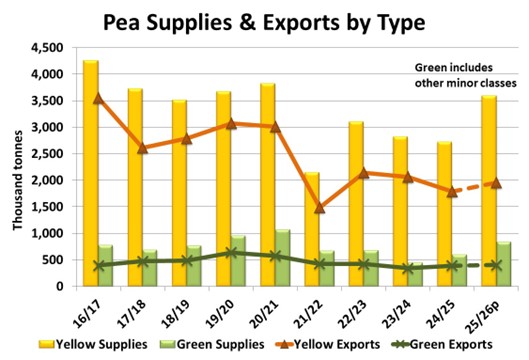
Our estimate of 2025/26 yellow pea supplies is 3.6 mln tonnes and even with increased shipments to China, full-year exports will still end up somewhere around 2.0 mln tonnes. That leaves more than enough yellow peas for feed and seed use, while still boosting ending stocks. It’s a similar picture for green (and minor) peas, with supplies around 850,000 tonnes compared to our export forecast of 400,000 tonnes. That will leave those ending stocks also at multiyear highs.

The bottom line is that while the resumption of pea exports to China is a good thing, it isn’t a quick fix, mainly because of this year’s big increase in Canadian supplies. But there is room for longer-term optimism. If Canadian farmers trim seeded acreage a bit and yields drop back to average, the 2026/27 crop will automatically be smaller. And if China and India don’t increase tariffs in 2026/27 (fingers crossed), a full year of demand from these two major buyers will certainly help draw down supplies and result in a more balanced market.

Pulse Market Insight provides market commentary from Chuck Penner of LeftField Commodity Research to help with pulse marketing decisions.

Pulse Market Insight #290

Good News for Pea Markets

The recent announcement that China will drop its import tariffs on Canadian peas was very welcome, although not a complete surprise. Typically, trade agreements are worked out ahead of the official trade mission, with politicians mainly there for the announcements and publicity. The odds were high that something positive was going to happen; it just wasn’t clear what or when.

A day or two before the announcement, we started hearing that some farmers with production contracts for maple and green peas were being called to start hauling. Clearly, buyers were already betting on a breakthrough for pea exports to China.

Those who might have expected a sharp spike in prices on the heels of this announcement are probably a bit disappointed by the size of the market’s reaction. Keep in mind, the scale of the chart below tends to downplay the latest changes. The response seems to vary between buyers; those with immediate sales to China showed larger gains.

We also noticed a larger response in maple pea bids than greens and yellows. In the past week, the average maple pea bid rose 75 cents per bushel, while the prairie-wide bid for greens was up 25 cents and yellows closer to 20 cents per bushel. It’s not that surprising that maple peas showed the biggest early reaction as it’s the market portion in which Canada and China are most interdependent.

Canadian export data this year is delayed more than usual but in the first quarter of 2025/26, exports of green and “other” (mostly maple) peas were only about half of the 5-year average, which reflects the impact of China’s import tariffs. At the same time, yellow pea exports were only 9% behind average, with India and Bangladesh picking up the slack. It’s also worth noting that Canada exported 77,000 tonnes of peas (mainly yellows) to China in October.

The drop in Chinese tariffs won’t take effect until March 1, but peas still need to be assembled for those shipments, in addition to the regular pea shipments to other destinations. These extra volumes should result in stronger bids as more peas need to be drawn into the export pipeline. That said, it won’t likely be a runaway rally, for a few reasons.

For one thing, farmers had contracted large volumes of green and maple peas last spring. Because there hasn’t been strong movement of those classes until now, these inventories are still waiting to enter the export channel before more uncontracted supplies are needed. That’s not so much the case for yellow peas, which have been moving to other destinations.

Secondly, the 2025/26 marketing year is already half over and the fall export surge is in the rearview mirror. China has been buying steady volumes of peas from other countries, including Russia, the US, Argentina and a few others. That’s not to say Chinese buyers are sitting on large supplies of peas. Inventory data shows stocks of peas (mainly yellows) in Chinese warehouses are currently at a multiyear low and will need to be replenished, indicating imports will need to pick up somewhat.

Upside potential could also be limited by large supplies of peas in Canada and other exporters, particularly Russia. Competition from Russian peas will act as a governor on prices in Canada, especially for yellow peas. And as bids start to firm up in western Canada, farmers will likely use the opportunity to empty a few bins, thus limiting the gains. Canadian pea supplies expanded by 1.1 mln tonnes in 2025/26 and even if exports to China reach 500,000 tonnes (versus 732,000 tonnes in 2024/25), inventories aren’t going to run low, by any means.

Even though the market response may not be huge and enthusiasm might need to be tempered, this trade agreement is still very good news. Compared to the gloomy outlook earlier, freer trade means more of the big 2025 crop will be able to find a home. More demand is always better than less.

Pulse Market Insight provides market commentary from Chuck Penner of LeftField Commodity Research to help with pulse marketing decisions.
Pulse Market Insight #289

Big Risks Dampen Price Signals for 2026 Crop

This is the time of year when new-crop bids for pulses usually start showing up, but not always. It’s not just the actual price that signals how urgently buyers are looking to lock in acres; the timing of new-crop bids is also an indicator.

For example, I recall years when new-crop bids for peas or lentils already started to show up in October, almost a year before the next crop is harvested. That happened when pea and lentil supplies were very short and importers wanted to ensure they would have access to next year’s crops.

In general though, the first new-crop bids are often seen in late December or early January. One rule of thumb some people use is the Saskatoon Crop Production Show in mid-January as the “real start” of the contracting season. But this year, it seems that new-crop bids are even scarcer than usual, with a few possible reasons.

The first is that overseas buyers aren’t very concerned about locking in next year’s supplies. Big 2025 pulse crops in Canada and elsewhere have created a general feeling of heaviness in the market, reducing the sense of urgency. This also means 2025/26 ending stocks will be historically large; in some cases, record high. This means that even if acres and production are reduced in 2026, next year’s supplies could remain comfortable.

In addition, pulse production has expanded in several other countries that have become larger export competitors with Canada. Importers have more options and aren’t as dependent on Canadian production as in the past. Thus, there’s less concern about having to “buy acres” in western Canada.

The added element this year is the ongoing risk of trade actions that could cause sharp changes in pulse markets. In the past 12 months, import tariffs were imposed on peas by Canada’s two largest customers with a large impact on prices. More Indian tariffs on lentil imports are possible in the coming months. Of course, reduced or eliminated tariffs are also a possibility, but the odds of that type of positive development are very hard to gauge. In any case, the risks of a large swing in the market could be discouraging traders from issuing new-crop bids.

At the very least, the extra caution would mean a larger than usual discount for new-crop bids. As a result, when new-crop prices are released, they won’t likely be very attractive to farmers. Not wanting to issue unappealing bids may also cause buyers to hold off. Weak prices also mean there won’t be a lot of forward contracting activity this spring.

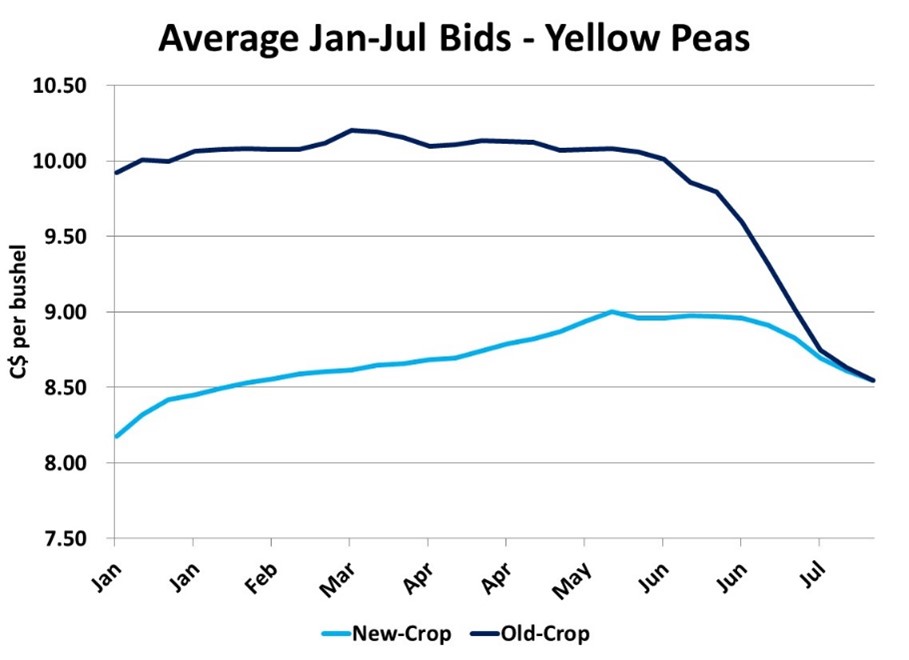
And in fact, it’s probably a good idea for farmers to be cautious about contracting the 2026 crop. Over the years, new-crop bids for most (but not all) crops tend to improve as the contracting season goes on. The chart above shows the average of old-crop and new-crop yellow pea bids from the last 10 years. Over that time, the most cautious new-crop bids have tended to occur early in the calendar year and improve as the season progresses. While it’s not a guarantee for 2026, it may not be a bad idea for farmers to remain patient.

Pulse Market Insight provides market commentary from Chuck Penner of LeftField Commodity Research to help with pulse marketing decisions.