Contact

Pulse Market Insight #290

Good News for Pea Markets

The recent announcement that China will drop its import tariffs on Canadian peas was very welcome, although not a complete surprise. Typically, trade agreements are worked out ahead of the official trade mission, with politicians mainly there for the announcements and publicity. The odds were high that something positive was going to happen; it just wasn’t clear what or when.

A day or two before the announcement, we started hearing that some farmers with production contracts for maple and green peas were being called to start hauling. Clearly, buyers were already betting on a breakthrough for pea exports to China.

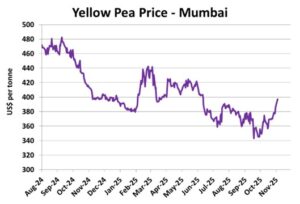
Those who might have expected a sharp spike in prices on the heels of this announcement are probably a bit disappointed by the size of the market’s reaction. Keep in mind, the scale of the chart below tends to downplay the latest changes. The response seems to vary between buyers; those with immediate sales to China showed larger gains.

We also noticed a larger response in maple pea bids than greens and yellows. In the past week, the average maple pea bid rose 75 cents per bushel, while the prairie-wide bid for greens was up 25 cents and yellows closer to 20 cents per bushel. It’s not that surprising that maple peas showed the biggest early reaction as it’s the market portion in which Canada and China are most interdependent.

Canadian export data this year is delayed more than usual but in the first quarter of 2025/26, exports of green and “other” (mostly maple) peas were only about half of the 5-year average, which reflects the impact of China’s import tariffs. At the same time, yellow pea exports were only 9% behind average, with India and Bangladesh picking up the slack. It’s also worth noting that Canada exported 77,000 tonnes of peas (mainly yellows) to China in October.

The drop in Chinese tariffs won’t take effect until March 1, but peas still need to be assembled for those shipments, in addition to the regular pea shipments to other destinations. These extra volumes should result in stronger bids as more peas need to be drawn into the export pipeline. That said, it won’t likely be a runaway rally, for a few reasons.

For one thing, farmers had contracted large volumes of green and maple peas last spring. Because there hasn’t been strong movement of those classes until now, these inventories are still waiting to enter the export channel before more uncontracted supplies are needed. That’s not so much the case for yellow peas, which have been moving to other destinations.

Secondly, the 2025/26 marketing year is already half over and the fall export surge is in the rearview mirror. China has been buying steady volumes of peas from other countries, including Russia, the US, Argentina and a few others. That’s not to say Chinese buyers are sitting on large supplies of peas. Inventory data shows stocks of peas (mainly yellows) in Chinese warehouses are currently at a multiyear low and will need to be replenished, indicating imports will need to pick up somewhat.

Upside potential could also be limited by large supplies of peas in Canada and other exporters, particularly Russia. Competition from Russian peas will act as a governor on prices in Canada, especially for yellow peas. And as bids start to firm up in western Canada, farmers will likely use the opportunity to empty a few bins, thus limiting the gains. Canadian pea supplies expanded by 1.1 mln tonnes in 2025/26 and even if exports to China reach 500,000 tonnes (versus 732,000 tonnes in 2024/25), inventories aren’t going to run low, by any means.

Even though the market response may not be huge and enthusiasm might need to be tempered, this trade agreement is still very good news. Compared to the gloomy outlook earlier, freer trade means more of the big 2025 crop will be able to find a home. More demand is always better than less.

Pulse Market Insight provides market commentary from Chuck Penner of LeftField Commodity Research to help with pulse marketing decisions.

Pulse Industry Welcomes Removal of 100% Tariff on Canadian Peas

January 16, 2026 – Winnipeg, MB – Pulse Canada welcomed today’s announcement that China will remove the 100% tariff on Canadian peas beginning March 1, 2026, following the Prime Minister’s visit to Beijing and meetings with Chinese President Xi Jinping. The decision will restore access to one of Canada’s most important pulse export markets and provide long-overdue certainty for growers, exporters, and processors across the country. Continue reading the Pulse Canada release here.

Provincial AGM to include Elections and Resolutions

The Alberta Pulse Growers Commission (APG) invites farmer-members and other industry stakeholders to attend its provincial annual general meeting on January 27 in Edmonton.

The AGM will take place during CrossRoads: Alberta’s Crop Conference at the DoubleTree by Hilton West Edmonton from 10:30 am to noon. The meeting will include a provincial update for growers, resolutions and director-at-large (bean and non-bean) elections. Resolutions and nomination forms must be submitted to the provincial office by January 15. Director-at-large forms are available on the homepage at albertapulse.com/.

“The provincial AGM is a good opportunity for pulse farmers from across Alberta to get together and help shape APG’s future,” said APG Chair Shane Strydhorst, who farms at Neerlandia. “We look forward to sharing APG’s accomplishments and plans for the future with our members and stakeholders as we work towards pulses on every farm, on every plate.”

Producers who have sold pulses in Alberta in the last two years are eligible to stand for election and to vote in person or online. Register in advance at albertapulse.com/event/ . The APG 2024-25 annual report is available at albertapulse.com/.

A CrossRoads pass is not required to attend the APG AGM. Alberta Canola and Alberta Grains will also be holding their AGMs during Crossroads. The agenda is available at crossroadscropconference.ca/agenda/

The Alberta Pulse Growers Commission represents 5,400 growers of field pea, dry bean, lentil, chickpea, faba bean, lupin and soybean in Alberta.

For more information, please contact:
Rachel Peterson, Communications Manager
Phone: 780-986-9398 ext. 108
rpeterson@albertapulse.com
www.albertapulse.com

Pulse Market Insight #289

Big Risks Dampen Price Signals for 2026 Crop

This is the time of year when new-crop bids for pulses usually start showing up, but not always. It’s not just the actual price that signals how urgently buyers are looking to lock in acres; the timing of new-crop bids is also an indicator.

For example, I recall years when new-crop bids for peas or lentils already started to show up in October, almost a year before the next crop is harvested. That happened when pea and lentil supplies were very short and importers wanted to ensure they would have access to next year’s crops.

In general though, the first new-crop bids are often seen in late December or early January. One rule of thumb some people use is the Saskatoon Crop Production Show in mid-January as the “real start” of the contracting season. But this year, it seems that new-crop bids are even scarcer than usual, with a few possible reasons.

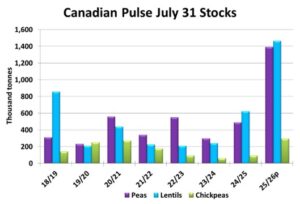
The first is that overseas buyers aren’t very concerned about locking in next year’s supplies. Big 2025 pulse crops in Canada and elsewhere have created a general feeling of heaviness in the market, reducing the sense of urgency. This also means 2025/26 ending stocks will be historically large; in some cases, record high. This means that even if acres and production are reduced in 2026, next year’s supplies could remain comfortable.

In addition, pulse production has expanded in several other countries that have become larger export competitors with Canada. Importers have more options and aren’t as dependent on Canadian production as in the past. Thus, there’s less concern about having to “buy acres” in western Canada.

The added element this year is the ongoing risk of trade actions that could cause sharp changes in pulse markets. In the past 12 months, import tariffs were imposed on peas by Canada’s two largest customers with a large impact on prices. More Indian tariffs on lentil imports are possible in the coming months. Of course, reduced or eliminated tariffs are also a possibility, but the odds of that type of positive development are very hard to gauge. In any case, the risks of a large swing in the market could be discouraging traders from issuing new-crop bids.

At the very least, the extra caution would mean a larger than usual discount for new-crop bids. As a result, when new-crop prices are released, they won’t likely be very attractive to farmers. Not wanting to issue unappealing bids may also cause buyers to hold off. Weak prices also mean there won’t be a lot of forward contracting activity this spring.

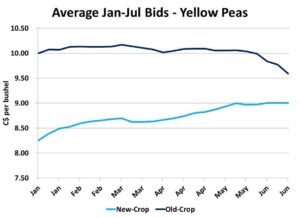
And in fact, it’s probably a good idea for farmers to be cautious about contracting the 2026 crop. Over the years, new-crop bids for most (but not all) crops tend to improve as the contracting season goes on. The chart above shows the average of old-crop and new-crop yellow pea bids from the last 10 years. Over that time, the most cautious new-crop bids have tended to occur early in the calendar year and improve as the season progresses. While it’s not a guarantee for 2026, it may not be a bad idea for farmers to remain patient.

Pulse Market Insight provides market commentary from Chuck Penner of LeftField Commodity Research to help with pulse marketing decisions.
Winter 2026 Pulse Crop News

Welcome to the Winter 2026 issue of Pulse Crop News. Click here to view the entire publication, including features on Pulse Advocacy Day at the Legislature, International Year of Pulses – 10 Years Later, New APG Directors and Advisors, research project updates and more. Click the links below to view individual stories.

Chair’s Report

Executive Director’s Message

Pulse Advocacy Day

Team Alberta Crops Breakfast

APG Researcher in Australia

Brief, Emerging & Notable

Harold Haugen Remembered

Chuck Penner on Markets

Pulse Canada Works to Keep Markets Open

Grain Farmers Bring Priorities to Ottawa

Pulse Forward Event

Zone Updates

Root Rot Research

Dry Bean Research

10 Years After International Year of Pulses

Recipe – Broccoli, Cheddar & Split Pea Soup


Pulse Market Insight #288

Crop Prospects for 2026

This seems to be the time of year when there’s a flood of reports looking back at the past year or gazing ahead to the new year. While looking backward allows a person to gauge their grain marketing performance, hindsight generally doesn’t provide much help for making decisions about the upcoming year.

In fact, every marketing year is different. Making next year’s decisions based on last year’s successes or failures can be counterproductive. After all, acreage will shift and while there are always hopes for big yields, the odds of record output happening again in 2026 are very unlikely. In addition, global trade will also change (hopefully for the better) and affect next year’s market prospects.

This is also the time of year when we start thinking about farmers’ planting decisions for next spring. There are many factors going into those decisions, especially crop rotation considerations, but prices and profitability are also important. Typically, we use basic production costs and new-crop bids to compare gross margins for a number of crops. Of course, each farm’s farming practices and cost structure are different, so we use a set of generic production costs.

Often, new-crop bids are available for most crops by now, but this year’s heavy supplies seem to be decreasing buyers’ urgency for contracting tonnage for 2026/27, especially for special crops. This means we need to use our best “judgement” of where new-crop bids could show up.

This gross margin analysis isn’t the be-all and end-all of our acreage guesstimates though. We also spend time talking to people on the front lines to get farmer feedback and a few themes seem to be emerging for 2026. First, maintaining crop rotations is the most important driver and will limit the size of shifts in and out of various crops. At the same time though, on-farm inventories of some crops are much larger than others and could discourage acres of the “heaviest crops”.

One other theme we’ve been hearing frequently is that seeded area of pulses will be trimmed, with peas mentioned most often. Ending stocks for all pulses will be historically large in 2025/26, meaning there will still be plenty of bins full of peas, lentils and chickpeas at seeding time. For some farmers, 2026 is seen as an opportunity to give pulse rotations a rest. That said, there aren’t other crops that are “big winners” in the 2026 acreage derby, and that could limit some of the losses in pulse acreage.

Our guesstimates include seeded area of peas slipping just below 3.0 mln acres, down 16% from last year. If so, it could be the smallest acreage base of peas since 2011 and would likely include reductions for all classes.

For lentils, we’re also looking at a decline in seeded area although not quite as severe at 3.9 mln acres, 11% less than last year and the lowest since 2023. We expect most of that decline would occur in green lentils, with very large supplies hanging over the market.

Acreage of chickpeas is also expected to slip by 12% to 475,000 acres. Even though chickpea prices continue to weaken, we’re still looking at historically sizable acreage as farmers have been having success growing chickpeas in the last few years.

Prices of black and pinto beans are somewhat depressed and we’re expecting that will allow dry bean acreage to also decline, although not as much as the other pulses.

Of course, these numbers are what we call “guesstimates”, which are a combination of analysis, feedback and a bit of gut feel. And if conditions change, especially with respect to trade barriers, the acreage projections could look a whole lot different.

If acreage of pulses does decline in 2026, we see that as a healthy and positive step. As the old saying goes, “the best cure for low prices is low prices.” Lower production is the way that markets recover from periods of depressed prices, a basic law of supply and demand. And if farmers in other countries do the same, it sets the stage for a price recovery in 2026/27.

Pulse Market Insight provides market commentary from Chuck Penner of LeftField Commodity Research to help with pulse marketing decisions.
U of C Call for Farmer Views on Carbon Markets

Centring Farmers and Ranchers Views on Carbon Markets

University of Calgary researchers are conducting a social science research study examining how greenhouse gas reduction initiatives, carbon sequestration efforts, carbon offset projects, and other climate-focused programs are being introduced within Alberta’s agricultural and livestock sectors.

They are seeking participation from farmers and ranchers who can share their experiences, perspectives, and insights on carbon offset or mitigation programs—whether you have taken part in these initiatives or have been affected by them in any way. Your contributions will help improve understanding of how climate-related policies and programs are shaping agricultural practice, and how they are experienced by farming and ranching communities in Alberta.

If you are an Albertan Rancher or Farmer, and are interested in participating, please fill out this survey:

https://iheid.qualtrics.com/jfe/form/SV_bdbfVzFFt72S9Se

This study is supported by a research grant from the Swiss National Science Foundation.

Pulse Market Insight #287

Big Crops But No Surprises From StatsCan

The long-awaited 2025 yield and production estimates from StatsCan were released this week but were a bit anticlimactic; anyone looking for a surprise in the numbers would have been disappointed. Yes, crops were certainly larger this year but that was already expected. During harvest, reports of very large yields kept coming in, well above StatsCan’s August and September numbers. As a result, this month’s higher yield estimates from StatsCan were anticipated. In fact, it would have been a shock if the yield numbers hadn’t changed.

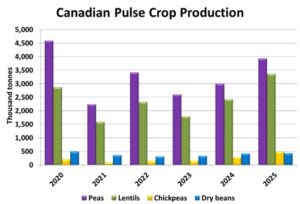
These latest estimates from StatsCan were based on a large farmer survey conducted in November and confirmed the positive harvest results. In fact, they may have understated the actual yields, as they sometimes do. The StatsCan numbers show the total 2025 pulse crop at 8.22 mln tonnes, a jump of more than 2 million tonnes from last year and the largest production since 2016/17. There were differences for each of the pulse crops though.

This year’s pea crop came in at 3.93 mln tonnes, up 31% from last year and 24% above the 5-year average. This increase from 3.00 mln tonnes in 2024 was the result of a 9% gain in seeded area and a 42.3 bu/acre yield, the highest since 2016/17. The StatsCan breakdown by type showed a larger percentage increase for green and “other” classes, up 38% and 44% respectively. The 185,000 tonnes of “other” peas (which include maples) was a record while green pea production of 582,000 tonnes was the most since 2020/21. Yellow pea production was up 29% at 3.17 mln tonnes, also the largest since 2020/21.

StatsCan reported 2025 lentil production at 3.36 mln tonnes, up 38% from last year and a new record. Seeded area was only 4% more than last year but the yield of 1,721 pounds (28.7 bushels) per acre was up 34% from last year and was the highest since 2013/14. StatsCan showed some very large differences between the various lentil classes, with red lentil production only up 1%, due to a drop in 2025 acreage. Meanwhile, both large green and small green lentil crops were new records, up 124% and 134% respectively while production of “other” lentils rose 186% from last year.

The sharpest increase in 2025 pulse production was seen in chickpeas, with StatsCan estimating the crop at 482,000 tonnes, 68% more than last year and 168% above the 5-year average. This record crop was the result of a combination of 13% more acres and a 50% jump in the 2025 yield at 1,970 pounds (32.8 bushels) per acre.

StatsCan revised dry bean acreage up considerably from its previous estimates but even so, the 2025 crop of 438,000 tonnes was only 3% more than last year. Because a sizable portion of the Canadian bean crop is grown in Ontario, where drought was an issue this year, the Canadian yield of 2,278 lb/acre was actually lower than last year and the limited the size of the 2025 crop.

These big 2025 pulse crops mean a large increase in exports will be needed to keep the market at least somewhat balanced. There have been some signs that lower prices are helping spur more demand, but export trade is facing headwinds due to increased competition and other challenges in the marketplace.

Pulse Market Insight provides market commentary from Chuck Penner of LeftField Commodity Research to help with pulse marketing decisions.

Pulse Market Insight #286

Another Headwind for Yellow Peas

The first quarter of the 2025/26 marketing year is now over and the pea market’s performance can be described as good, considering China’s 100% tariffs on Canadian pea imports, but not great. According to the CGC, farmers’ pea deliveries through 13 weeks were 1.13 mln tonnes, below the 5-year average of 1.21 mln and last year at 1.37 mln tonnes. Licensed pea exports totaled 865,000 tonnes, slightly above the 5-year average of 855,000, but trailing last year’s strong pace of 1.05 mln tonnes.

In a “normal” year, this movement of peas wouldn’t be a big concern but the 2025 pea crop is nearly a million tonnes larger than last year, including 700,000 tonnes more yellow peas. Canada needs to export more peas, not less, in 2025/26 to avoid a large buildup in ending stocks. Unfortunately, the Indian government’s recent announcement of a 30% import tariff on yellow peas (from all origins), effective November 1, won’t help the situation.

Several months ago, India announced the 0% import tariffs would remain in effect until March 31, 2026 but backtracked now in an effort to support domestic pea prices ahead of the rabi planting season. This wasn’t a total surprise, as pulse traders and farmers had been pressuring the government as pea prices in India continued to slide. The Indian government has a long history of using tariffs, tonnage limits and minimum support prices to influence prices.

These new 30% tariffs on yellow peas (green pea imports have been restricted for years) will have two effects on the Canadian market – export volumes and prices. Canada already exported a large amount of peas to India (and other destinations) this fall, helping offset the loss of China as a customer. Export volumes normally drop off after October, so these Indian tariffs starting in November will have less impact (at least for this year) than if they had happened a few months ago.

Some Indian traders have suggested Indian pea imports will actually increase because the tariff announcement has removed uncertainty from the marketplace. We have our doubts, but even if that’s the case, the tariffs will have a negative impact on Canadian yellow pea prices. It’s still early, but the tariffs had the desired effect on Indian pea prices, which are up US$30 per tonne since the announcement. That’s good, but it’s only a 7-8% increase, which is just a portion of the tariff, leaving 22-23% to be made up somewhere else.

Part of that “somewhere else” could come from thinner traders’ margins, but we expect the lion’s share will show up in lower bids to Canadian farmers. Yellow pea bids had been recovering recently from the harvest lows but right after India’s tariff announcement, some buyers dropped bids by 50-60 cents per bushel. Prices recovered fairly quickly from that initial reaction but only partially, with the average yellow pea bid in western Canada still down 18 cents per bushel or C$6.60 per tonne.

The bottom line is that while these tariffs won’t completely slam the door on yellow pea exports to India, volumes could suffer, especially if Russian traders are more willing to discount their peas to make a sale. For Canadian yellow peas, export sales will be done at reduced prices to absorb a portion of the tariffs and most of that will flow back as lower farmer bids. Another unwelcome challenge for 2025/26 pea markets.

Pulse Market Insight provides market commentary from Chuck Penner of LeftField Commodity Research to help with pulse marketing decisions.