Contact

Pulse Market Insight #285

Big Supplies Mean Patience and Modest Expectations Needed

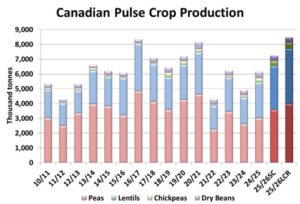
Not everyone had impressive pulse yields this year but there were enough positive results that big crops and big supplies are a key feature in the 2025/26 outlook. According to StatsCan’s September estimates, total pulse production this summer was just over 7.2 mln tonnes, over a million tonnes more than last year and the most since 2020/21.

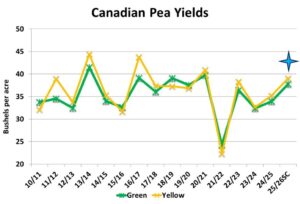
Other sources indicate yields were a lot bigger than StatsCan. Most feedback we received during harvest pointed to yields well above average and provincial crop reports seem to back up those claims. For example, pea yields reported by Alberta Ag and Sask Ag were both 6-7 bushels per acre higher than StatsCan’s estimates for those provinces. Likewise, the lentil yield from Sask Ag was 32.0 bu/acre versus StatsCan at 24.4.

If we plug in these higher yield estimates, the 2025 pulse crop moves from “large” to “record large”, rivaling production of 2016/17. Not each crop would be a record in 2025. In fact, only lentils would be the largest crop ever but total pulse production would be just shy of 8.5 mln tonnes, up 2.3 mln tonnes (38%) from last year.
If demand is strong enough, big pulse crops don’t have to mean extremely low prices, but they certainly don’t help. And it would be nice if the regular laws of supply and demand wouldn’t apply this year, especially for those who didn’t get the big yields this summer, but they do.

Western Canadian bids for peas and lentils since 2010/11 are shown in the chart below. Prices don’t always respond directly to the size of the crop, at least not every year. For example, pulse prices generally strengthened in 2020/21 even though production was close to a new record. That said, the gains that year were fairly modest, especially compared to the spike caused by the drought in 2021/22.

Most times though, markets responded as expected with bigger production resulting in weaker prices. The large pulse crop in 2016/17 triggered a drop in prices, and the market (aside from green peas) took several years to recover.

Pulse prices this fall have reacted according to the laws of supply and demand, but this year’s declines seem to be much more severe. That’s especially the case for green peas and green lentils, which had been historically high and had further to fall.

If prices would reverse course and strengthen in the face of record supplies, demand would need to pick up in a big way, and soon. Unfortunately, the outlook for increased export business is cloudy, at best. Canadian peas are still facing 100% import tariffs from China and although trade talks are ongoing, the odds of a resolution are still fairly low. Another big concern is India, Canada’s other major pulse buyer. Rumours are still circulating about the potential for increased import tariffs but even if that doesn’t happen, Indian buying has been quiet.

In this type of environment with big crops and limited demand, it will take longer than usual to clear the market of the large supplies. This means a fair amount of patience will be needed and price expectations should be limited, looking for opportunities to make small gains during the year rather than waiting for a major rally.

Pulse Market Insight provides market commentary from Chuck Penner of LeftField Commodity Research to help with pulse marketing decisions.

Pulse Market Insight #284

Strong Start for Pulse Exports Needs to Continue

Pulse crops were among the best performers in a year of surprisingly good yields. In September, StatsCan raised its 2025 pea, lentil and chickpea yields compared to August. The provincial crop reports from Alberta and Sask Ag have also boosted yield estimates this fall, in some cases by a lot. According to StatsCan (so far), combined 2025 production of peas, lentils and chickpeas is roughly 6.9 mln tonnes, up 1.2 mln tonnes from last year. And using provincial crop report yields, the total 2025 crop could be closer to 7.9 mln tonnes. That’s a lot more pulses that need to be exported or processed within Canada.

We follow the weekly grain handling data from the Canadian Grain Commission for clues about the movement of crops through the export pipeline. Through the first few weeks of 2025/26, those signals have been mostly positive, but not spectacular. Keep in mind, not all movement is reported by the CGC; only bulk exports are shown, not container exports. Still, the year-to-year comparisons are useful.

As of shipping week eight, bulk pea exports were 626,000 tonnes, running ahead of last year at 599,000 and the 5-year average of 538,000 tonnes. We expect this strong start is largely driven by quick movement to India and other south Asian destinations. This is good news, especially with China’s 100% import tariffs still in place.

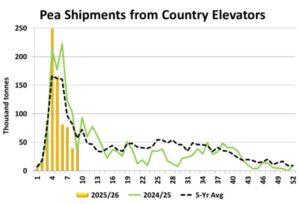
While the export numbers show what has already been moved outside our borders, two other CGC measures are leading indicators of whether that export pace will continue. Farmer deliveries are the earliest indication of how strongly peas are being pulled into the export pipeline. Farmer deliveries of peas always spike at harvest and at the start of 2025/26, those volumes were solid again. In more recent weeks though, pea deliveries dropped more sharply than usual. It’s a similar picture for shipments out of country elevators, which spiked earlier but have since dropped below average. Both indicators suggest a quieter-than-usual export movement ahead.

It’s a similar picture for lentils, with year-to-date bulk exports of 264,000 tonnes, ahead of last year at 181,000 and the 5-year average of 215,000 tonnes. A stronger-than-usual start is important for 2025/26, especially with a record lentil crop expected in Australia later this year.

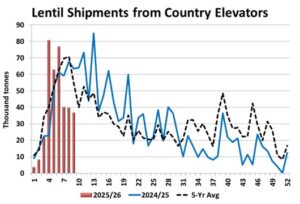
Just like peas, farmer deliveries of lentils also tend to spike in the first few weeks of the marketing year, followed by a quick drop in volumes. Deliveries were impressive in late August and early September but in more recent weeks, have already dropped below average levels. Similarly, shipments of lentils out of country elevators were very strong a few weeks ago but seem to have run out of steam more recently. This is a caution that exports will be quieter than usual in the weeks ahead.

This year’s bigger pulse crops mean exports will need to increase in 2025/26 and a large portion of export programs are already set within the first 2-3 months of the marketing year. It’s always possible the export market could improve later in the year, especially if low prices spur more demand. For peas, a sizable pickup in exports would need China withdrawing its import tariffs. A poor Indian rabi pulse crop could also increase demand for Canadian lentils and peas. That said, there are no indications of either of these things happening.

There are also risks that demand could be reduced, particularly if the Indian government decides to raise or impose import tariffs on one or more pulses. This means a marketing plan for pulses in 2025/26 should include some optimism, but also a good dose of realism. A certain amount of patience wouldn’t hurt either.

Pulse Market Insight provides market commentary from Chuck Penner of LeftField Commodity Research to help with pulse marketing decisions.
APG Seeks Advisors in All Zones to Grow Pulse Industry

Pulse producers who want to grow the province’s pulse industry while developing their own leadership skills are invited to let their names stand for election as an Alberta Pulse Growers (APG) Advisor at their zone meeting this fall.

“Any interested pulse farmers are strongly encouraged to join the APG team,” APG Chair Shane Strydhorst said. “I began as an Advisor like most APG Directors, and the experience has been more rewarding than I imagined. Becoming an Advisor is a great way to get involved in the industry. Each of our five zones has available positions and it’s a good introduction to the organization, working on committees, and making things happen for Alberta pulse farmers.”

A team of Advisors leads extension activities specific to each of APG’s five zones. Directors on APG’s provincial board often serve as Advisors first.

Available positions are presented below, along with this fall’s meeting dates.

Zone Number Available Advisor Positions Meeting Date Location
Zone 1 3 December 9 Taber
Zone 2 5 November 6 Red Deer
Zone 3 2 November 19 Fort Saskatchewan
Zone 4 3 November 13 Rycroft
Zone 5 4 November 18 Vegreville

Producers must have sold pulses and paid service charges since August 1, 2023 to be eligible as an Advisor. Anyone interested in letting their name stand for an Advisor position is asked to complete and submit a nomination form by Nov. 4, 2025. Each candidate must be endorsed by another pulse producer from their zone. The form is available on APG’s homepage at www.albertapulse.com .

The Alberta Pulse Growers Commission represents 5,400 growers of field pea, dry bean, lentil, chickpea, faba bean, lupin and soybean in Alberta. Our vision is to have Alberta pulses on every farm, on every plate.

For more information, please contact:
Rachel Peterson, Communications Manager
Phone: 780-986-9398 ext. 108
rpeterson@albertapulse.com
www.albertapulse.com

Pulse Market Insight #283

Changes in 2025 Market Sentiment

Every marketing year is different, from both the supply and the demand sides of the equation. That said, ever since the 2021/22 drought year, pulse prices were mostly positive with supply and demand relatively well-balanced, although there were still regular ups and downs in the market. Pulse exports moved more-or-less freely and kept ending stocks in check.

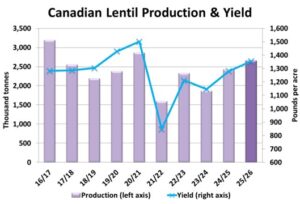
It also helped (for prices) that in the last few years, yields of Canadian pulses have been below long-term averages. In the three years after 2021/22, pea yields have averaged 35.0 bu/acre, almost four bushels less than the average before 2021/22. Likewise for lentils, yields averaged 1,200 lb/acre since 2021/22 versus 1,360 lb/acre prior to the drought year. These mediocre yields kept supplies limited and prices supported.

In 2025/26 though, pulse crops avoided the high temperatures of the last few years. Even though rainfall was variable, this year’s moderate temperatures during flowering and filling resulted in much stronger yields, and will likely end up well above StatsCan’s latest estimates. For example, StatsCan reported the Alberta pea yield at 40 bu/acre, while the Alberta Ag crop report showed a yield seven bushels higher, with a similar difference in Saskatchewan estimates. Lentil and chickpea estimates showed the same type of yield response.

The combination of increased acres of peas, lentils and chickpeas along with yields at multiyear highs have resulted in much larger Canadian pulse supplies needing to be sold. Word-of-mouth reports have also told us that forward contracting this year was slower than usual, partly due to concerns about short crops in the last few years. That’s understandable, but it also leaves even larger volumes that need to be sold in season.

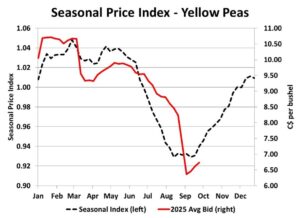
As this year’s pulse harvest progressed and the big yields became obvious to all, getting some of that crop sold took on more urgency. Prices were already declining through the summer but the increase in harvest selling triggered an even sharper downturn. It’s worth noting that this drop still fits the seasonal pattern for this time of year.

This year’s added urgency of selling off the combine exaggerated the move lower, but it also set the stage for a price rebound. It appears the heavy selling caused the price drop to be overdone. Once the rest of the crop was safely in the bin, bids already began to rebound, which also fits the seasonal pattern.

This bounce doesn’t mean there will be a sustained rally through the late fall and early winter. There’s no getting around that Canadian pulse supplies are very large. At the same time, the export market is facing challenges. Bigger crops are also reported in other exporters like Russia, Kazakhstan and Australia and competition will be more intense. Add to that, Chinese tariffs on imports are limiting demand for peas. There are also concerns that the Indian government could reinstate tariffs.

There is no doubt the pulse industry will face headwinds in 2025/26, which will limit how much prices can recover from the bottom. From a positive perspective though, the current low prices should also spur more demand from other sources. As the old saying goes, “the best cure for low prices is low prices.”

Pulse Market Insight provides market commentary from Chuck Penner of LeftField Commodity Research to help with pulse marketing decisions.
Pulse Market Insight #282

What Do the StatsCan Stocks Numbers Say?

This week, StatsCan released its estimates of crop stocks as of July 31. This was based on a farmer survey a couple of months earlier, so it is somewhat stale-dated. Despite its limitations, these numbers can be helpful in looking ahead to the new marketing year of 2025/26. The July 31 stocks are the carryover into the following year and, together with the incoming crop, determine the supply situation for 2025/26.

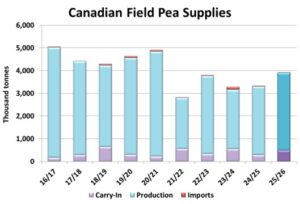
StatsCan reported July 31 stocks of peas at 489,000 tonnes, up nearly 200,000 tonnes from 2023/24 and about 100,000 tonnes above the 5-year average. Inventories would have been lower if China hadn’t imposed tariffs and is a mildly negative number (on its own). Together with StatsCan’s initial yield production estimate of 3.41 mln tonnes, total 2025/26 supplies would end up just shy of four million tonnes, nearly 600,000 tonnes more than last year.

From a longer term perspective, these supplies aren’t considered huge but must be viewed in light of the challenging export picture. There is considerable uncertainty in the export outlook with respect to both China and India and those outcomes could overshadow the Canadian supply situation. It’s also quite likely that later production estimates will be larger than these initial reports.

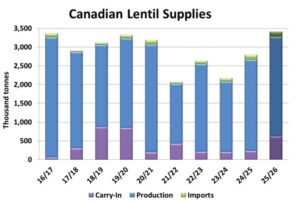
For lentils, StatsCan reported large 2024/25 ending stocks of 624,000 tonnes, up sharply from the previous year and the most since 2018/19. Based on production and exports in 2024/25, we expect most of those would be red lentils. At the same time, StatsCan’s initial estimate of the 2025 crop is also larger than last year and the combination of these two amounts would mean 3.4 mln tonnes of lentil supplies in 2025/26. That’s up 600,000 tonnes (22%) from last year and would be the largest on record.

These heavy supplies of Canadian lentils make the export prospects much more critical for the 2025/26 price outlook. It looks like exports could improve in the coming year, but they’ll need to pick up a lot to deal with the big supplies, which could get even bigger based on harvest results.

Chickpea exports were very positive in 2024/25 but StatsCan still reported an increase in July 31 stocks at 92,000 tonnes, up more than 50% from the previous year. StatsCan is also forecasting a sizable increase in the 2025 crop, which would push total supplies up to 440,000 tonnes, the most since 2020/21. That said, Canadian exports have been strong, helped by lower prices, and if that continues, these supplies won’t feel much heavier.

Keep in mind that these supply estimates are using StatsCan’s first production estimates issued in late August. Most observers (including us) expect the final production numbers will be higher, perhaps considerably larger. As a result, the supply estimates in the chart above should be considered the low watermark for the year.

Pulse Market Insight provides market commentary from Chuck Penner of LeftField Commodity Research to help with pulse marketing decisions.
Fall 2025 Pulse Crop News

Welcome to the Fall 2025 issue of Pulse Crop News. Click here to view the entire publication, including features on faba bean field scale trials, ag advocacy, crop tours, fall zone meetings and more. Click the links below to view individual stories.

If you are an APG member, enter to win a Yeti cooler by sending us your email address here to receive news electronically.

Chair Report

Executive Director Message

Advocacy in agriculture Why every voice matters

Pulse Canada Update

Summer of faba beans

Grain Growers of Canada

Team Alberta Crops Farm Tour

The BEAN Report – Brief Emerging & Notable

Chuck Penner – Planning without prediction

AgSafe Alberta new courses

Zone Reports

2025 Innovator Award Winner Dr. Syama Chatterton

APG seeks advisors in all zones

Supporting your mental health in challenging times

Nutrition Notes

Recipe – White bean berry cheesecake bars

APG Fall Zone Meetings


Pulse Market Insight #281

First StatsCan Crop Estimates for 2025

This week, StatsCan issued its first yield and production estimates for 2025 crops. These numbers are based on computer models using satellite vegetation images which, in our view, have been getting better at estimating yields. That said, these first estimates were based on the situation at the end of July; weather and crop conditions have changed considerably since then, some worse but mostly better.

As combines got rolling this fall, one common theme we’ve been hearing from many parts of the prairies has been that yields are coming in better than expected. Rainfall was variable across the prairies but in all regions, 2025 was a much milder summer than the last 3-4 years when extended periods of extreme heat reduced yields. If these early positive results continue through the rest of harvest, we wouldn’t be surprised if these initial StatsCan numbers are the low-water mark for the season.

For peas, StatsCan reported a yield of 36.6 bu/acre, up from 34.8 bu/acre last year and about three bushels better than the 5-year average. This higher yield, along with a 9% increase in seeded area would result in a 2025 Canadian pea crop of 3.41 mln tonnes, 400,000 tonnes (14%) larger than last year and the biggest crop since 2022/23. Back in June, StatsCan’s acreage estimates showed yellow pea area expanded the least, with larger gains for green and especially “other” peas, which includes maples.

In a normal year, this size of production increase could be absorbed by the market without too much difficulty, but 2025/26 isn’t normal for peas. Import tariffs by China, Canada’s largest customer, will restrict export potential and it will be difficult to find a home for that lost tonnage in other countries. Ultimately, 2025/26 ending stocks could end up at historically high levels.

StatsCan reported positive yields for lentils in 2025. Its estimate of 1,355 pounds (22.6 bushels) per acre was the highest since 2020/21 and, based on early harvest results, could still be too low. The improved yield, along with a 4% increase in seeded area, would mean a lentil crop of 2.66 mln tonnes, 225,000 tonnes (9%) larger than last year. And with a larger old-crop carryover, 2025/26 supplies could be in record territory. Keep in mind that back in June, StatsCan reported large increases in green lentil acreage while seeded area of reds actually declined. This suggests a sizable shift in Canadian lentil supplies toward greens while red lentils don’t appear as burdensome.

The lentil export market isn’t facing hurdles as serious as those for peas, but there are issues. Back in March, India imposed 10% tariffs on lentil imports which hasn’t stopped trade but does require discounted prices. Even so, Canadian red lentil exports could expand in 2025/26. The greater concern could be dealing with the large supplies of green lentils, with global trade tending to be more-or-less static.

StatsCan was more cautious with its estimate of chickpea yields, reporting output at 1,289 pounds (21.5 bushels) per acre, the lowest yield since 2021/22. Even with a lower yield, the 13% increase in seeded area would mean a 2025 chickpea crop of 309,000 tonnes, 8% more than last year. If yields end up close to this initial StatsCan estimate, 2025/26 supplies won’t be huge but still quite comfortable. Canadian chickpea exports have been strong for the last year and performance could be strong again in 2025/26, keeping stocks from feeling too heavy.

The StatsCan production estimate for dry beans show 2025 production at 353,000 tonnes, down 16% from last year. This is mainly due to a yield of 2,160 lb/acre, the lowest since 2021/22. That said, there are sizable questions not only about its bean yield but also StatsCan’s seeded area estimate, which could be understated by nearly 50,000 acres.

As always, these estimates are subject to debate. The next StatsCan model-based estimates will be released in only a few weeks, based on August conditions. Yields and production numbers will see changes, quite likely higher. The “final” crop estimate will be released in early December based on a farmer survey, but even that is prone to questions and debate.

Pulse Market Insight provides market commentary from Chuck Penner of LeftField Commodity Research to help with pulse marketing decisions.
 

Pulse Market Insight #280

China Trade Situation

The 100% import tariffs China placed on Canadian peas back in March already had a large impact on prices in western Canada. When that announcement came out, yellow pea bids immediately lost $1.25 per bushel and the loss for green peas was even larger at nearly $2.00 per bushel. Prices then went mostly sideways for the next few months until seasonal tendencies this summer took them even lower.

Now, the focus is on the situation in the 2025/26 market year and possibilities for exports and the impact on supplies. For the most part, I’m a fairly optimistic person but I’m having a hard time finding a silver lining for the coming year. It’s always possible that some negotiations are going on behind the scenes but on the surface, there doesn’t seem to be anything new in the pea tariff situation. On the other hand, China just announced 76% tariffs on Canadian canola after Ottawa placed additional tariffs on Chinese steel. It seems trade tensions between the two countries are rising rather than easing.

If China’s pea tariffs are going to remain in place, we need to look at the implications for the Canadian pea balance sheet. For the supply side, Canadian pea supplies could easily top 4.0 mln tonnes in 2025/26, 750-800,000 tonnes more than last year. If that’s the case, pea exports this year need to increase considerably to avoid extremely burdensome supplies. If the Chinese market is lost however, it would mean a lot fewer exports, exactly the opposite of what’s needed.

When we look specifically at yellow peas (2023/24 is the last complete year without tariffs), we see that China accounted for nearly half of Canadian exports. While some other countries will likely step in to increase purchases, none of them would be able to replace the nearly 900,000 tonnes of demand. Thus, the Chinese tariffs would seriously curtail yellow pea exports and cause a buildup in supplies.

In terms of China’s ability to find other sources to replace Canadian yellow peas, its imports from Russia have picked up in the last two years. Despite questions about Russian quality, Chinese buyers have been able to adjust and with a 4.5-4.7 million tonne Russian pea crop in 2025, supplies shouldn’t be an issue. China has also opened the door to Ukrainian peas in recent months.

The situation isn’t quite as severe for green peas, with China accounting for a quarter of Canadian exports in 2023/24. While more dispersed destinations for green peas are helpful, losing 40,000 tonnes of demand will still have a negative effect on the market.

If the trade dispute between Canada and China can’t be resolved soon, it will be a challenging (to say the least) year for marketing peas, especially yellows. India is expected to take decent amounts of peas during the busy fall shipping season and that will help but, with only one of the two big buyers taking peas during Sep-Nov, harvest selling pressure would add even more weight to prices. Looking out to the rest of the year, the prospect of very heavy 2025/26 ending stocks is daunting.

I wish I could be more positive about the outlook but unless something changes, I think a “heads up” is a lot more helpful than just pretending everything is fine. In the meantime, let’s hope that trade tensions can be ratcheted down and the situation resolved. If so, I would be happy to be wrong in my pessimistic outlook.

Pulse Market Insight provides market commentary from Chuck Penner of LeftField Commodity Research to help with pulse marketing decisions.