| CAUSED BY |
- Chocolate Spot is caused by two fungi: Botrytis fabae and Botrytis cinerea Pers. ex Fr. and can be residue or stubble-borne or seed-borne.
- Botrytis cinerea is the same species which infects lentils, causing grey mould on the stem and pod rot.
- Chocolate spot is the disease of most concern in faba beans grown in Western Canada.
- Disease development is highly dependent on weather conditions. The Chocolate Spot fungus thrives in moderately warm (15 to 25°C) and humid conditions. Higher plant density increases susceptibility, due to higher humidity within the canopy.
- Severity of the disease also depends on when the infection starts, with early disease development in the season or during flowering may cause more damage and result in large losses. Mid- to late-season infections, which are more often observed, may cause little or no yield loss.
- Conidia are spread to neighbouring plants and fields by wind and rain, where they cause new infections (water is essential for their germination).
- Botrytis can overwinter as sclerotia in the soil, in crop debris, and on seed.
- Spores produced by the fungus are spread by wind and rain splash within and between crops. Moisture on the plant surface is important for spore germination and infection.
- The disease builds up rapidly under moderately warm, moist conditions. Once the disease becomes established, it spreads quickly in the crop and within four to five days of infection, spores can be produced on infected tissue, initiating secondary infection and further spread of the disease.
|
| SYMPTOMS |
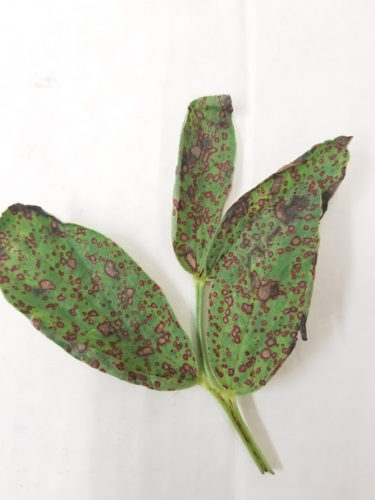
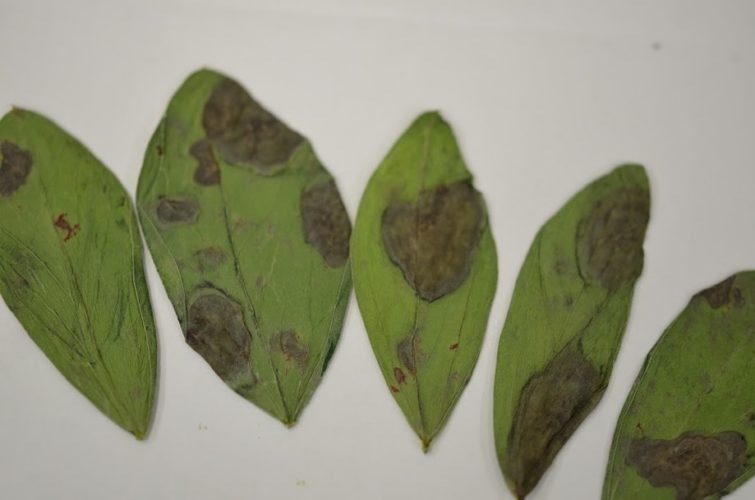
- Small brown coloured lesions appear first on leaves. The chocolate coloured lesions start small, but begin to expand and coalesce if moisture is available under warmer temperatures, eventually merging so that the whole leaf turns brown.
- After two or three weeks, the larger lesions will turn grey, looking similar to botrytis or grey mould in other crops. The disease does produce small sclerotia bodies similar to Sclerotinia sclerotium (White Mould). The sclerotia bodies can be found inside the stems of badly disease plants.
- Chocolate spot also damages the seeds, producing dark-coloured sunken lesions. Chocolate spot lesions on lower leaves can be confused with other types of injury such as herbicide or surfactant burn and frost damage, however in these cases the damage is localized to the leaves exposed during time of application, or youngest tissues encountering freezing temperatures.
|
| PREVENTION AND CONTROL |
- Choose the most resistant varieties.
- Plant good quality seed or disease-free seed with low infection rates. Growers should use different seed if levels of Botrytis on the seed are over 10%.
- Testing seed for disease levels prior to planting can help reduce the risk of infection at the seedling stage and early disease onset in a field, and should be considered when doing germination tests. Growers should use different treated seed or plant disease-free seed.
- Avoid growing faba beans after lentils in areas where this disease is present.
- Follow a crop rotation of four years between successive crops of faba beans and avoid buckwheat or lentils in the rotation. However, Botrytis spp. can survive in the absence of a host crop, so crop rotations will not eliminate the disease.
- Fungicides should be applied at early flower or before the onset of symptoms.
|
| IMPACT |
- Chocolate spot is the disease of most concern in faba beans grown for Western Canada.
|