
Faba Bean
Seeding
One of the most important inputs for any pulse crop is inoculant. Inoculating faba bean with the correct strain of rhizobium (Rhizobium leguminosarum) has the potential to fix up to 90% of nitrogen required through nitrogen fixation. Properly inoculated faba bean should not require any extra nitrogen fertilizer. Rhizobium leguminosarum strains will nodulate peas, faba beans, and lentils but some strains may be more effective on certain crops or certain varieties.
Rhizobium bacteria can live in the soil for a number of years. However, the most efficient nitrogen-fixing bacteria may not be among those that survive. Generally, native soil strains of Rhizobium leguminosarum are not the optimum strains. This reinforces the recommendation to inoculate each time peas are seeded. Western Canadian research indicates a significant yield response to inoculation of grain legumes in 30% to 50% of the cases. For this reason, most experienced faba bean producers use an inoculant on their faba bean crop every year.
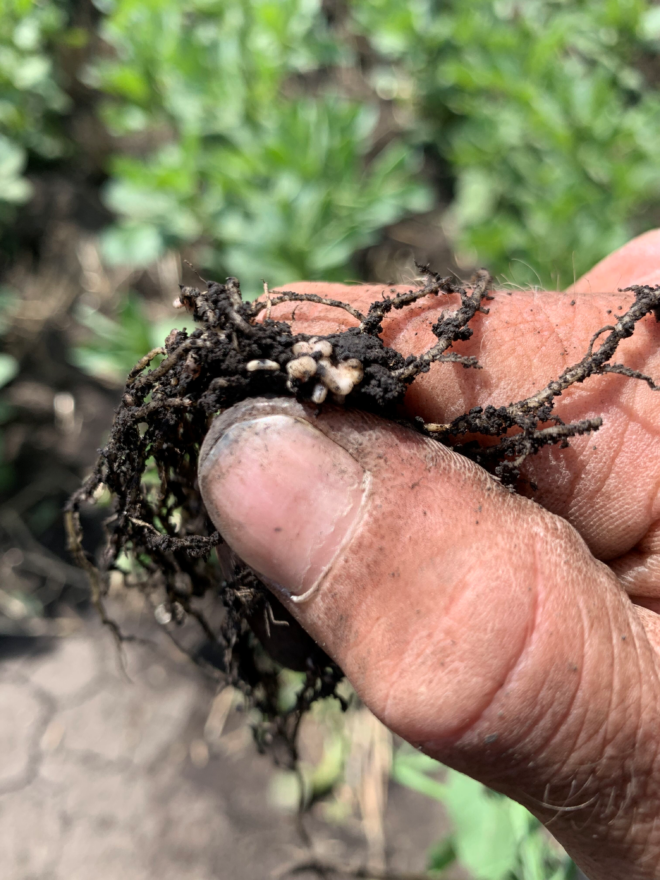
Faba Bean Nodules
Faba bean inoculants come in three formulations. Manufacturers may package the inoculant as either a mixed strain inoculant that contains a mixture of the strains, or a single-strain inoculant which contains only one rhizobia strain. In either case the best strains are chosen based on their ability to nodulate the crop on the label.
All inoculant formulations will perform equally well if the inoculant is properly applied and if environmental conditions are ideal. Under adverse conditions the best performing formulation should be granular, followed by peat, and then liquid.
| TIMING |
|
| Peat Powder Inoculant |
|
| Liquid Inoculant |
|
| Granular Soil Inoculant |
|
| MIXING WITH FERTILIZERS AND PESTICIDES |
|
| Maximizing Rhibozia Survivability |
|
TIMING |
|
Peat Powder Inoculant |
|
Liquid Inoculant |
|
Granular Soil Inoculant |
|
MIXING WITH FERTILIZERS AND PESTICIDES |
|
Maximizing Rhibozia Survivability |
|
| TIMING |
|
| HOW TO CHECK |
|
| WHAT SHOULD I EXPECT? |
|
| NATURALLY OCCURRING |
|
| USE AT RECOMMENDED RATES |
|
TIMING |
|
HOW TO CHECK |
|
WHAT SHOULD I EXPECT? |
|
NATURALLY OCCURRING |
|
USE AT RECOMMENDED RATES |
|
Special thanks to Saskatchewan Pulse Growers