Contact

Team Alberta providing input to government to help farmers deal with over $3 billion in unharvested crops


Team Alberta is alerting Alberta Agriculture and Forestry officials to over $3 billion in crops that remain in the field to ensure government agencies are prepared to respond promptly to unharvested acre claims and consider all options to help farmers deal with a difficult harvest.

“The conditions at this point in the fall are worse this year than in 2016 when weather caused many acres to remain unharvested in Alberta,” said D’Arcy Hilgartner, Alberta Pulse Growers Chair. “Team Alberta is working to help ease the burden on farmers by initiating proactive discussions with government officials who are in a position to help farmers.”

As of Oct. 10, it was estimated that the amount of harvest completed for Alberta’s major crops included: 26% of canola, 57% of wheat, 57% of barley and 34% of pulses, with approximately 7.8 million acres unharvested overall.

“Farmers need an early and clear indication of what the next steps might be in dealing with severely downgraded and high moisture crops,” said Jason Lenz, Alberta Barley Chair. “Agriculture Financial Services Corporation (AFSC) needs to make prompt decisions to deal with claims and communicate information to farmers in a timely manner.”

Many of the crops are being harvested wet, which is testing growers’ abilities to dry product to retain some quality considering the challenging situation and also adds additional production costs.

“For growers who have access to grain drying or aeration equipment, there is an additional cost to use of those tools that would not be as prevalent in drier conditions,” said Renn Breitkreuz, Alberta Canola Chair “To add to the problems of farmers without grain dryers, some grain buyers with drying capacity have reportedly stopped accepting grain as they are at capacity.”

“Much of the wheat crop left in the field will be downgraded to feed, even after drying, resulting in losses of up to $240 million from milling quality,” said Kevin Bender, Alberta Wheat Commission Chair. “We remain hopeful farmers can get back to harvesting soon but 2018 will be a major hit to the bottom line.”

Meanwhile, Team Alberta wants to also share resources available to help producers deal with the challenging harvest.

Team Alberta wants to remind our fellow producers that we are in this together. Harvest is usually a stressful time for farmers, but the stress is compounded this year by the pressure of not knowing when or if the crop can be combined since snow started falling in early September.

Resources available to farmers to help manage the added stress include Six Things You Can Do To Stay Resilient This Harvest Season at Domore.ag, and the Alberta Health Services Mental Health Help Line at 1-877-303-2642.

Oct 11 – 18 – NR Team Alberta on Delayed Harvest – Final

Media contacts:

Rachel Peterson
Communications Coordinator
Alberta Pulse Growers
rpeterson@albertapulse.com
780-986-9398 ext. 108

Michelle Chunyua
Communications Coordinator
Alberta Canola
michelle@albertacanola.com
780-224-7970

Victoria Decker
Communications Manager
Alberta Wheat and Barley Commissions
vdecker@albertawheat.com

403-219-7906

Team Alberta says PMRA’s proposed cancellation of Strychnine could cause severe economic consequences for farmers in controlling gopher populations

With the Pest Management Regulatory Agency (PMRA) proposing the complete cancellation of Strychnine for its use in controlling Richardson’s Ground Squirrel (gopher) populations, Team Alberta says farmers must be able to retain access to this product since there are currently no safe or effective alternatives to protect crops from damage. Severe gopher outbreaks could result in hundreds of thousands of dollars in crop damages to farms. Team Alberta is also calling for a long-term integrated pest management strategy to be in place prior to a final decision being made.

Team Alberta outlined its concerns and made several recommendations in a submission to the PMRA’s 90-day consultation for proposed re-revaluations of several products. Team Alberta recommends: 1) a long-term integrated pest management strategy to control the pests be developed prior to any final decisions from the PMRA, 2) the proposed decision be reconsidered taking into account all available scientific research and be based on peer-reviewed science, and 3) the PMRA should study the effectiveness and safety of alternative chemical options.

“Gophers are a common problem across Alberta and Saskatchewan, and have the potential to cause substantial economic losses, especially in drier years,” said Kevin Bender, AWC Chair.

“It’s absolutely imperative that farmers be able to retain the only tools that allow us to quickly gain control of outbreaks,” said Renn Breitkreuz, Alberta Canola Chair.

The PMRA has cancelled liquid concentrate Strychnine for use in gophers on at least two occasions in the past, only to bring in subsequent emergency product registrations to respond to population surges that caused the decimation of crops across the Prairies.

“Past emergency registrations demonstrate that cancellation is not a long-term solution,” said Jason Lenz, Alberta Barley Chair. “For this reason, one of our recommendations is for the development of a long-term integrated pest management strategy which has been discussed by the PMRA in the past.”

“Not only do farmers find Strychnine effective in protecting their crops, there is no other viable or safer alternative currently available to control severe outbreaks when this product is used according to the label,” said D’Arcy Hilgartner, Alberta Pulse Growers Chair.

Farmers can review the full Team Alberta submission here: PMRA_Strychnine_TeamAB_Submission_Final

View a pdf of the news release here: Oct 4 – 18 – NR Team Alberta on PMRA’s Proposed Cancellation of Strychnine

Media contacts:

Victoria Decker
Communications Manager
Alberta Wheat and Barley Commissions
vdecker@albertawheat.com
403-219-7906

Rachel Peterson
Communications Coordinator
Alberta Pulse Growers
rpeterson@albertapulse.com
780-986-9398 ext. 108

Michelle Chunyua
Communications Coordinator
Alberta Canola
michelle@albertacanola.com
780-224-7970

Alberta Pulse Growers Invests $2.4 Million in Partner Funding for Federal Cluster Research Projects

Alberta Pulse Growers committed $2.4 million to Pulse Science Cluster projects announced today by Agriculture and Agri-Food Minister Lawrence MacAulay.

“This is the largest commitment Alberta Pulse Growers has ever made into Science Clusters in the history of the federal program,” said Chair D’Arcy Hilgartner of Alberta Pulse Growers. “This investment demonstrates the commitment of APG and the Government of Canada to research programs that benefit pulse growers. We really appreciate Agriculture and Agri-Food Canada’s continued investment into pulse research. Participation in Cluster projects helps APG research dollars go further.”

The Pulse Science Cluster brings together researchers from across Canada to work on pulse specific issues that were prioritized through a collaborative effort between Alberta Pulse Growers, Manitoba Pulse & Soybean Growers, Saskatchewan Pulse Growers and Ontario Bean Growers, as well as Pulse Canada.

APG is involved in the following Pulse Science Cluster projects: Selection for disease resistance in early maturing bean lines for Alberta; Identification of dry bean lines in Ontario and the Prairies with improved canning and cooking quality; Optimizing disease management strategies for white mould and bacterial blights of dry bean; Development of genetically improved field pea varieties and germplasm for the Canadian pulse industry and the evaluation of flavour, physiochemical and functional characteristics in high protein pea breeding lines; Breeding, physiology and agronomy to mitigate yield loss caused by root rots of pea; Vigilance towards plant nematodes to sustain pulse production on the Canadian Prairies; and Integrated pest management of pea leaf weevil using biological control and low insecticide-input alternatives.

The funding for these projects is in addition to APG’s investment of $111,000 for three projects as part of the Integrated Crop Agronomy Cluster, which was announced in July. Those projects are: Coordination of a crop disease monitoring network for Western Canada; Spray drift management under changing operational requirements; and Optimizing systems productivity, resilience and sustainability in the major Canadian ecozones.

The Alberta Pulse Growers Commission represents 6,000 growers of field pea, dry bean, lentil, chickpea, faba bean and soybean in Alberta. Our vision is to have Alberta pulses recognized by consumers as environmentally friendly, healthy, nutritious, and recognized by all producers as being an essential element in a sustainable cropping system. 

For more information, please contact:
Rachel Peterson, Communications Coordinator
Phone: 780-986-9398 ext. 108
rpeterson@albertapulse.com
www.albertapulse.com

Tasty Lunch Ideas for Back to School

Thinking about school lunches? Pulses – such as chickpeas, lentils and beans – offer an easy lunch alternative for parents who are looking for a new source of protein and fibre to pack in their child’s lunchbox as another school year gears up.

“Many parents are looking for tasty and nutritious lunch ideas that their kids will actually eat or a source of protein to replace peanut butter, which is often not allowed in schools due to allergies,” said Debra McLennan, Food and Nutrition Coordinator with Alberta Pulse Growers (APG) and a Registered Dietitian. “Pulses are a delicious source of protein and other nutrients that are easy to add into lunches to give kids the energy they need for a busy school day.”

The Alberta Pulse Growers recipe for Red Lentil & Roasted Carrot Dip is a simple dish that packs 6 g of protein and 4 g of fibre into a 60 mL serving. This dip is a delicious, versatile recipe that can be used as a spread for breads and wraps that pairs well with fillings like lettuce, tomato, cucumber, spinach, green onion and assorted coloured peppers. Kids also enjoy it for dunking vegetables and crackers. Using roasted carrots adds a sweetness along with an appealing orange colour to the dip.

Another kid-friendly recipe that’s a great addition to lunches or snacks-on-the-go is APG’s Cinnamon & Sugar Roasted Chickpeas.  Loaded with 5 g of protein and 3 g of fibre in a 60 mL serving, these tasty chickpeas can easily be eaten as a crunchy snack, added to salads or tossed into your favourite granola.

Both recipes mentioned above are gluten-free and vegetarian. The recipes are available for reprinting with credit in the attachment below. The Alberta Pulse Growers website (https://albertapulse.com/recipe/ ) offers many other recipes that feature chickpeas, beans, lentils and field peas in appetizers, soups, salads, main courses and desserts.

The Alberta Pulse Growers Commission represents 6,000 growers of field pea, dry bean, lentil, chickpea, faba bean and soybean in Alberta. Our vision is to have Alberta pulses recognized by consumers as environmentally friendly, healthy, nutritious, and recognized by all producers as being an essential element in a sustainable cropping system. 

For more information, please contact:

Rachel Peterson, Communications Coordinator
Alberta Pulse Growers
Phone: 780-986-9398 ext. 108
rpeterson@albertapulse.com


Introducing FarmSustainability.ca – an online tool to advance farm sustainability

Team Alberta is pleased to launch farmsustainability.ca. This farm sustainability readiness tool is a web-based, voluntary, self-assessment and action planning resource that aims to advance on-farm sustainability in Canada.

“Interest in our food system is ever-increasing,” said Jason Lenz, Chair of Alberta Barley. “Consumers not only want food that is safe, nutritious and affordable, but also grown using environmentally and ethically responsible methods.”

“As end-users grow increasingly interested in sourcing sustainable food options, this tool will increase producers’ readiness to take advantage of sustainability-driven market demands,” said Kevin Bender, Alberta Wheat Commission Chair.

The readiness tool removes the guesswork by asking questions compiled from three of the most comprehensive, internationally recognized, sustainability certification programs in a user-friendly format. The tool addresses the drivers behind sustainable sourcing and certification and will increase producers’ understanding of sustainability in Canada. Farmers can complete an assessment of their farm when they visit farmsustainability.ca, which will generate an action plan tailored to their operation. The aggregated data gleaned from this tool will give the commissions insight for directing future resources for research and extension of beneficial management practices.

“As producers of food and stewards of the land, sustainability has been fundamental to farming with every generation,” said Don Shepert, Vice-Chair of Alberta Pulse Growers and Industry Co-Chair for the Agri-Environmental Partnership of Alberta. “The action plan component of this readiness tool will help farmers continue to improve the overall performance of their operations.”

“The readiness tool is simple and intuitive for farmers to use, especially those who are interested in completing a sustainability certification program. I encourage any grower open to learning more about their operation to check out farmsustainability.ca,” said John Guelly, Vice-Chair of Alberta Canola and industry advisor for the Alberta Environmental Farm Plan. “The readiness tool will help tell our industry’s sustainability story which is important for earning public trust.”

The farm sustainability readiness tool was developed by the four crop commissions in conjunction with Alberta Agriculture and Forestry and Groupe Agéco.

Farm Sustainability Readiness Tool Press Release pdf


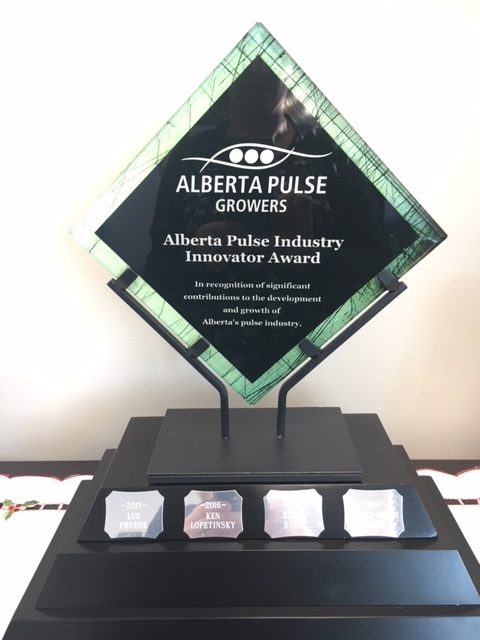
Nominations Open for 2019 Pulse Industry Innovator Award

The Alberta Pulse Growers Commission is pleased to announce the fifth annual Alberta Pulse Industry Innovator Award. An industry innovator is a person or organization that has worked to help nurture and shape the pulse industry and has helped contribute to the success of the industry as it is today. Innovators may have contributed to the industry through various areas from production, marketing, research, extension, processing, management, promotion and innovation.

To nominate someone please see the Pulse Industry Innovator Nomination Form below.

Nominations may be forwarded to the APG office and will be accepted until December 7, 2018.

2018_APGPulseInnovator_Nomination_Form_final

Qualified Alberta Pulse Growers Eligible for 13.7% Tax Credit for Investing in Research

The Alberta Pulse Growers Commission advises Alberta pulse producers that 13.7 per cent of their 2017 check-off payment is eligible for the Scientific Research & Experimental Development (SR&ED) tax credit for their investment in APG-funded research and development (R&D) projects. For example in 2017, producers who paid $100 in check-off to APG, $13.70 is eligible to earn in tax credits. Producers who have paid check-off this past year and have not asked for refunds are eligible claimants for this year’s credits.

For more detailed information about the SR&ED Tax Credit APG advises you to contact an accountant or the Canada Revenue Agency.  For a history of SR&ED with Alberta Pulse Growers visit https://albertapulse.com/growing-pulses/sred-tax-credit/ .

A summary of APG research investments in 2016-17 is available at https://albertapulse.com/research/.

The federal SR&ED tax program is administered by the Canada Revenue Agency (CRA) and encourages businesses to invest in and perform research and development (R&D) in Canada.

The SR&ED Tax Credit application form can be downloaded directly from the CRA website at https://www.cra-arc.gc.ca/txcrdt/sred-rsde/clmng/clmngsrd-eng.html. Individual producers need to apply using the form T2038 (IND) and Canadian controlled private corporations should utilize the form T2SCH31.

The Alberta Pulse Growers Commission represents 6,000 growers of field pea, dry bean, lentil, chickpea, faba bean and soybean in Alberta.  Our vision is to have Alberta pulses recognized by consumers as environmentally friendly, healthy, nutritious, and recognized by all producers as being an essential element in a sustainable cropping system. 

For more information, please contact:

Rachel Peterson, Communications Coordinator

Phone: 780-986-9398 ext. 108
rpeterson@albertapulse.com
www.albertapulse.com

New Provincial government changes require you to register for your 2018 carbon credits now or risk not being able to participate in the program this year.

Memo to Alberta Farmers: NEW Provincial government changes requires you to register for your 2018 carbon credits now or risk not being able to participate in the program this year. Farmers interested in getting paid for their reduced tillage practices must contact an aggregation company as soon as possible.

FOR IMMEDIATE RELEASE

Changes to the Alberta Carbon Offset System will impact how farmers use the Conservation Cropping Protocol. Farmers used to have some flexibility as to when they applied for their tillage credits; however, under this new system they are now required to forward plan. This means farmers must register with an aggregator as soon as possible to identify fields they are considering for the 2018 growing season. Actual emissions will still be reconciled at the end of the crop year. Aggregators are required to identify a list of all farmers and land locations that are planning to receive credit for generating emission offsets in 2018 to the provincial government by April 30, 2018. If farmers miss this deadline, then they will lose out on this revenue stream for 2018.

This new reporting requirement is aligned with the government’s shift from the Specified Gas Emitters Regulation (SGER) system to the Carbon Competitiveness Incentive Regulation (CCIR), which is a new output-based allocation system. Team Alberta will be advocating on behalf of farmers to ensure that systematic changes do not curtail the ability of farmers to be retroactively acknowledged for voluntary practice improvements, which have provided significant environmental benefit over the decades.

Farmers can contact the following aggregation companies for more information and to register for 2018 credits:

Carbon Credit Solutions www.carboncreditsolutions.ca
Agri-Trend https://www.agritrend.com/services/carbon-credits/service-overview.aspx
Farmers Edge https://www.farmersedge.ca/carbon-credits/


Farmers can also contact Alberta Environment and Parks for more information.

Tel: 780-427-5200 (for toll free access anywhere in Alberta, first dial 310-0000)

Email: AEP.GHG@gov.ab.ca


Media Contacts

Victoria Decker
Interim Communications Manager
Alberta Wheat Commission and Alberta Barley
vrussell@albertawheat.com
(403) 219-7906

Michelle Chunyua
Communications Coordinator
Alberta Canola Producers Commission
michelle@albertacanola.com
(780) 224-7970

Rachel Peterson
Communications Coordinator
Alberta Pulse Growers Commission
rpeterson@pulse.ab.ca
(780) 986-9398


Additional Background Resources:

A carbon offset is when one party receives credits for reducing their greenhouse gas emissions and these credits can then be purchased by another party to “offset” their emissions levels. One option for large industrial emitters to comply with their reduction obligation under the Carbon Competitiveness Incentive Regulation (CCIR) is to purchase offset credits from other activities that have voluntarily reduced their emissions in Alberta.

Allowing regulated facilities to use market-based compliance tools such as offsets creates incentive for Albertans from all areas of the economy to innovate and invest in activities that will reduce greenhouse gas emissions – from farmers to municipalities to small industry developers. (Source: Alberta Environment and Parks, Alberta Carbon Offset System)

The Conservation Cropping Protocol is the most widely used ‘offset’ for the cropping sector and one of the only protocols currently available.

January 2018 Offsets Update

Overview of the Regulatory Program P. 12

Dr. Hans-Henning Muendel Honoured as 2018 Recipient of Alberta Pulse Industry Innovator Award

The Alberta Pulse Growers (APG) today presented the fourth annual Alberta Pulse Industry Innovator Award to Dr. Hans-Henning Muendel, who was instrumental in developing numerous bean cultivars for Alberta growers.

“Each year, APG recognizes a person or organization whose progressive thinking and tireless efforts helped build Alberta’s pulse industry into the flourishing sector that it is today,” said APG Chair D’Arcy Hilgartner. “Dr. Muendel dedicated his career to developing the dry bean cultivars that now set the standard for small red, black, pinto, and great northern cultivars in Western Canada. He truly deserves to receive the Alberta Pulse Industry Innovator Award for his many contributions.”

In 1996, there weren’t any dry bean cultivars being grown in Western Canada that had been bred in this region. Over the next 11 years, as the Senior Research Scientist at the Agriculture and Agri-Food Canada Research Centre in Lethbridge, Muendel and his team developed 14 dry bean cultivars in seven bean classes, and co-developed one other new bean cultivar. Muendel’s bean breeding program concentrated on producing early maturing, upright bean cultivars that are well-suited to the short growing seasons of southern Alberta, Saskatchewan and Manitoba. Many of the dry bean cultivars from Muendel’s program also had improved resistance to white mould while maintaining high yield and quality. Muendel also served as an ex-officio director for Alberta Pulse Growers.

Zone 1 Director Rodney Volk had high praise for Muendel’s contributions to the pulse industry that continue to benefit dry bean growers like himself.

“Dr. Muendel was instrumental in establishing the breeding program that developed dry bean cultivars specific to southern Alberta growing conditions,” Volk said. “The success of dry bean production in southern Alberta today can be largely credited to his program’s development of local varieties with improved standability and disease resistance. Many of today’s pinto and great northern varieties still have a direct connection to the lines Dr. Muendel developed.”

Muendel said that he was honoured to learn that he was chosen as the recipient of the fourth annual Industry Innovator Award: “It has been 10 years since I retired, and now – with our bean varieties having spread throughout the Alberta dry bean growing area – on behalf of my breeding team, it is such an honour to accept this award.”

The Alberta Pulse Growers Commission represents 6,000 growers of field pea, dry bean, lentil, chickpea, faba bean and soybean in Alberta. Our vision is to have Alberta pulses recognized by consumers as environmentally friendly, healthy, nutritious, and recognized by all producers as being an essential element in a sustainable cropping system.

For more information, please contact:
Rachel Peterson, Communications Coordinator
Phone: 780-986-9398 ext. 108
rpeterson@albertapulse.com
www.albertapulse.com

Join APG as 2018 Innovator Award Winner Shares How Teamwork in Breeding for Local Conditions Helped Build Alberta’s Pulse Industry

The Alberta Pulse Growers (APG) selected Dr. Hans-Henning Muendel, who was instrumental in developing Alberta’s pulse industry, as the recipient of the fourth annual Alberta Pulse Industry Innovator Award. Muendel will accept the award in person at a ceremony on Wednesday, January 31. Please join APG to hear from a true industry innovator about how breeding dry beans suited for local conditions contributed to a flourishing pulse industry in Alberta today.

When: 2:45 pm on Wednesday, January 31

Where: Hall F at the Edmonton EXPO Centre at Northlands

In 1996, there weren’t any dry bean cultivars being grown in Western Canada that were well adapted to this region. Over the next 11 years as the head of the dry bean breeding program at the Lethbridge Research Centre, Muendel developed 14 dry bean cultivars in seven bean classes, and co-developed one other new bean cultivar. Muendel’s bean breeding program concentrated on producing early maturing bean cultivars, with a more upright growth habit, that are well-suited to the short growing seasons of southern Alberta, Saskatchewan and Manitoba. Many of the dry bean cultivars from Muendel’s program also had improved resistance to white mould while maintaining high yield and quality. Muendel also served as an ex-officio director for Alberta Pulse Growers.

The award presentation will take place during APG’s Annual General Meeting. Members of the media are welcome to attend and learn more about what’s new with APG.

This year’s AGM will also be broadcast live for the first time at www.albertapulse.com .

The Alberta Pulse Growers Commission represents more than 6,000 growers of field pea, dry bean, lentil, chickpea, faba bean and soybean in Alberta.  Our vision is to have Alberta pulses recognized by consumers as environmentally friendly, healthy, nutritious, and recognized by all producers as being an essential element in a sustainable cropping system. 

For more information, please contact:

Rachel Peterson, Communications Coordinator
Phone: 780-986-9398 ext. 108
rpeterson@albertapulse.com
www.albertapulse.com