
Contact

Pulse Market Insight #280

China Trade Situation

The 100% import tariffs China placed on Canadian peas back in March already had a large impact on prices in western Canada. When that announcement came out, yellow pea bids immediately lost $1.25 per bushel and the loss for green peas was even larger at nearly $2.00 per bushel. Prices then went mostly sideways for the next few months until seasonal tendencies this summer took them even lower.

Now, the focus is on the situation in the 2025/26 market year and possibilities for exports and the impact on supplies. For the most part, I’m a fairly optimistic person but I’m having a hard time finding a silver lining for the coming year. It’s always possible that some negotiations are going on behind the scenes but on the surface, there doesn’t seem to be anything new in the pea tariff situation. On the other hand, China just announced 76% tariffs on Canadian canola after Ottawa placed additional tariffs on Chinese steel. It seems trade tensions between the two countries are rising rather than easing.

If China’s pea tariffs are going to remain in place, we need to look at the implications for the Canadian pea balance sheet. For the supply side, Canadian pea supplies could easily top 4.0 mln tonnes in 2025/26, 750-800,000 tonnes more than last year. If that’s the case, pea exports this year need to increase considerably to avoid extremely burdensome supplies. If the Chinese market is lost however, it would mean a lot fewer exports, exactly the opposite of what’s needed.

When we look specifically at yellow peas (2023/24 is the last complete year without tariffs), we see that China accounted for nearly half of Canadian exports. While some other countries will likely step in to increase purchases, none of them would be able to replace the nearly 900,000 tonnes of demand. Thus, the Chinese tariffs would seriously curtail yellow pea exports and cause a buildup in supplies.

In terms of China’s ability to find other sources to replace Canadian yellow peas, its imports from Russia have picked up in the last two years. Despite questions about Russian quality, Chinese buyers have been able to adjust and with a 4.5-4.7 million tonne Russian pea crop in 2025, supplies shouldn’t be an issue. China has also opened the door to Ukrainian peas in recent months.

The situation isn’t quite as severe for green peas, with China accounting for a quarter of Canadian exports in 2023/24. While more dispersed destinations for green peas are helpful, losing 40,000 tonnes of demand will still have a negative effect on the market.

If the trade dispute between Canada and China can’t be resolved soon, it will be a challenging (to say the least) year for marketing peas, especially yellows. India is expected to take decent amounts of peas during the busy fall shipping season and that will help but, with only one of the two big buyers taking peas during Sep-Nov, harvest selling pressure would add even more weight to prices. Looking out to the rest of the year, the prospect of very heavy 2025/26 ending stocks is daunting.

I wish I could be more positive about the outlook but unless something changes, I think a “heads up” is a lot more helpful than just pretending everything is fine. In the meantime, let’s hope that trade tensions can be ratcheted down and the situation resolved. If so, I would be happy to be wrong in my pessimistic outlook.

Pulse Market Insight provides market commentary from Chuck Penner of LeftField Commodity Research to help with pulse marketing decisions.

Pulse Market Insight #279

Pulse Crop Conditions & Yield Guesses
Let’s be honest, when trying to figure out crop yields, there’s always plenty of guesswork involved. There are lots of information sources, including 60-mph crop tours, reports from people in the field, satellite vegetation maps, comparisons to previous years and provincial crop reports. Each one has its place and we try to incorporate them all when coming up with our own yield guesses.
The provincial crop reports are one of the more useful sources. In part, that’s because they’ve been around for quite a while, which allows for year-to-year comparisons. They also use a consistent approach each year and cover a lot of ground; I could spend my whole summer driving all over the prairies each week and still wouldn’t be able to reach all the areas covered by the crop reporters. Just like StatsCan’s numbers, the crop reports aren’t perfect, but they provide some valuable input.
There have been a lot of ups and downs in prairie weather so far this summer, with some areas experiencing more downs than ups. Overall though, one theme we’ve been hearing fairly often is that pulses are handling this year’s weather better than most other crops. While there are some trouble spots, disease seems to be less of an issue than the last few years and cooler temperatures this July are positive for pulses in the blooming and podding stages.
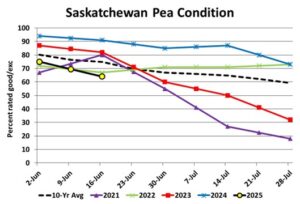
These reports we’re getting from the field are confirmed by the ratings in Alberta and Sask Ag crop reports, which show improvements in the last few weeks. In Alberta, the pea crop ratings have moved higher and are now at 65% good or excellent, slightly ahead of the 10-year average while in Saskatchewan, the good/exc rating has improved to 73%, well above the average. Keep in mind, the “average” line on the chart shows that ratings tend to head lower during the summer season and the fact that ratings are rising this year is a more important signal than the absolute number.

Early in the growing season, we use an olympic average yield which looks at the five last years, tossing out the high and the low yield. For 2025, this olympic average yield for peas is 35.0 bu/acre. Earlier, StatsCan showed a 9% expansion in seeded area and together with this average yield, production would come in at 3.28 mln tonnes, compared to 3.00 mln last year. If we plug in a 7.5% yield increase for peas, production would end up at 3.51 mln tonnes, 500,000 tonnes larger than last year. That production increase could make supplies feel quite heavy, especially with questions/concerns about 2025/26 export demand.
It’s a similar picture for lentils on the prairies; conditions are improving as of mid-July, rather than declining like they normally do. Crop ratings for both Saskatchewan (68% good/exc) and Alberta (66% good/exc) are both well above the 10-year average for this time of year.

These above-average and improving crop ratings suggest the overall 2025 lentil yield could be higher than the olympic average of 1,213 pounds (20.2 bushels) per acre. Keep in mind though, front-line reports are telling us that lentils grown further south, where green lentil acreage is concentrated, are in rougher shape than those in central areas, where more reds are grown. That’s similar to last year’s situation, when red lentils performed much better than greens. Still, it seems reasonable to peg the overall yield at 5% above average, which would mean a 2025 lentil crop of 2.49 mln tonnes, 3% more than last year.
Normally, we’re hesitant to start adjusting yields too early in the season but by now, that potential is becoming more certain. Some areas are certainly very dry but forecasts for mild or even cool temperatures over the next week or 10 days will help reduce moisture stress. Bigger pulse yields in 2025 would be good to see but might also suggest a review of next year’s marketing plan.

Pulse Market Insight provides market commentary from Chuck Penner of LeftField Commodity Research to help with pulse marketing decisions.

Pulse Market Insight #278

Updated StatsCan Acreage Eye-Opening

Amid all the other uncertainty about pulse crops in 2025, we now have bit more clarity about seeded area. StatsCan has released updated acreage numbers based on a large survey of farmers and although its estimates are always debatable, they provide a good starting point.

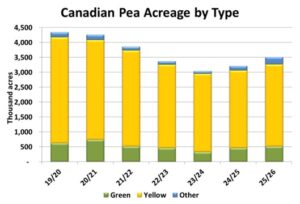
StatsCan estimated 2025 seeded area of peas at 3.50 mln acres, up 9% from last year and the most since 2021/22. Clearly, farmers weren’t scared off by Chinese import tariffs and the prospect (at the time of seeding) of tariffs by India. Green pea area rose to 520,000 acres, 12% more than last year, and yellow pea area expanded to 2.74 mln acres, up 6% from the previous year. The biggest percentage change showed up in the “other” category, which includes maple peas. Seeded area of minor classes was reported at 240,000 acres, 55% more than last year and a new record.

While yields are far from certain, the increased pea acreage has the potential to cause supplies to expand for 2025/26. Larger old-crop carryover and a bigger 2025 crop would mean sizable supplies, which means next year’s export outlook becomes even more important. If exports to China and India are reduced, 2025/26 ending stocks could end up very large.

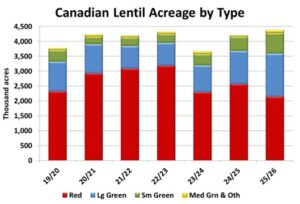
For lentils, StatsCan added 200,000 acres to its earlier estimate, with seeded area now at 4.38 mln acres, 4% more than last year. That wasn’t really a surprise, but the breakdown by type was much more interesting. According to StatsCan, seeded area of red lentils dropped to 2.15 mln acres, 16% less than last year and the lowest since 2018/19. At the same time, seeded area of green lentils hit 2.23 mln acres, 36% more than last year.

The big increase for green lentil area raises the potential for overproduction, which seems to be the main driver of lower prices in the last few months. Of course, the crop is far from being in the bin and the main growing areas for green lentils are once again the driest parts of the prairies. Even though conditions might be a bit better in red lentil areas, the drop in acreage will mean a smaller crop in 2025.

StatsCan reversed course for chickpea plantings, from a decline in its March estimate to a sizable 13% increase in late June. The total area of 541,000 acres is the most since way back in 2001/02 and even if yields are reduced this year, 2025 production will be up and supplies will be very comfortable.

Seeded area of dry beans was also bumped up from StatsCan’s March estimates but still lower than last year. StatsCan reported 382,000 acres of dry beans, 5% less than a year ago, with gains in white bean acreage while coloured bean area was reduced. Fababean area was reported down 15% at 69,000 acres.

Of course, yield prospects are still very uncertain. Sizable parts of the southern prairies, especially where green lentils and chickpeas are grown, are most vulnerable. Key growing regions for peas started off poorly but some (not all) are looking a bit better. At the same time, hot dry conditions are kicking in during key flowering and podding stages. Acreage is just one part of the picture, with the yield portion still to be determined.

Pulse Market Insight provides market commentary from Chuck Penner of LeftField Commodity Research to help with pulse marketing decisions.
Pulse Market Insight #277

Weather Market or Not?

There’s no shortage of question marks about 2025 crop production. StatsCan will issue updated acreage numbers on June 27 and the USDA will release its latest acreage estimates on June 30. These reports should provide some direction for the 2025/26 crop outlooks. It will be interesting to see whether all the trade uncertainty caused farmers to shift acreage, including for pulses. But that’s just the beginning of the story.

We’re still just in the first month of the growing season and already, it’s been a roller coaster in many parts of the prairies, in some ways similar to 2024. Prior to seeding in late March, there were a few dry areas on the prairies but overall, conditions seemed positive and there was some early optimism. Move forward to the end of April though and the AAFC Drought Monitor map showed expanding areas of drought, particularly in the northern prairies, where pea acreage is concentrated. By the end of May, the drought situation had spread across most of the prairies, with the most serious shortfalls in northern Saskatchewan and the Peace River region.

The dryness in the northern half of the prairies caused a poor start for the 2025 pea crop in Saskatchewan. According to Sask Ag, the crop rating for peas at the beginning of June was 75% good or excellent. On the surface, that doesn’t sound too bad, but it was worse than the 10-year average of 80% and far below last year’s starting point of 94% good/exc. Fast-forward two weeks and the mid-June ratings worsened, dropping to 64% good/exc versus the 10-year average of 75%. So far, crop ratings aren’t available from Alberta but based on rainfall and soil moisture maps, we expect conditions there to be a bit better than Saskatchewan.

For lentils, conditions started the 2025 growing season a bit better than peas. Largely, that’s because earlier this spring, it wasn’t quite as dry where most lentils are grown in the southern half of the prairies, at least as compared to the north. At the beginning of June, 79% of Saskatchewan lentils were rated good or excellent, a bit better than the 10-year average of 77% but still trailing last year at 96% good/exc. Since then though, there’s been a noticeable drop as the southern prairies dried out. In mid-June, the crop ratings dropped to 60% good/exc, the lowest mid-June score since 2019 (which improved later in the year).

So far, these deteriorating conditions haven’t caused any price reaction for either old-crop or new-crop pea or lentil bids. Those have mostly been steady to lower in recent weeks. This isn’t unusual as it fits with the normal seasonal tendency when overseas buyers wait for fresh supplies from the upcoming harvest. Even in the epic 2021 drought, bids for peas and lentils slipped lower seasonally in the early summer. That weakness in 2021 was short-lived though, only lasting until early July before turning strongly higher.

The other reason for the lack of price response is that prairie weather in the last week has become more unsettled and forecasts have turned optimistic for many parts of the prairies. While the worst hit areas are already facing losses, there is potential for recovery in other places. There are no guarantees with the forecasts, but it’s simply too early to write off the crop in most parts of the prairies.

At this point, 2025 crops could pivot in either direction. At the risk of stating the blinding obvious, a return to hot dry conditions would do serious damage and boost prices, although that reaction would likely be delayed. At the same time, if the latest forecasts pan out and an unsettled weather pattern continues, prices will continue to run lower seasonally in the short-term. The good news is that prices usually start to recover shortly after harvest regardless, even if crops turn out well.

Pulse Market Insight provides market commentary from Chuck Penner of LeftField Commodity Research to help with pulse marketing decisions.
 

Pulse Market Insight #276

Glimmers of Hope for Peas

A couple of very large clouds have been looming over the Canadian pea market in recent months and added a lot of risk to the market outlook. The Canadian market was especially vulnerable as the “clouds” refer to two major importers that together, have accounted for roughly three-quarters of total Canadian pea exports so far in 2024/25.

The first cloud showed up very unexpectedly in March, when China suddenly announced 100% import tariffs on peas, as well as other agricultural products. Those tariffs took effect almost immediately and caused huge concern. Up to that point in the 2024/25 marketing year, China was the destination for 30% of both yellow and green peas from Canada. A loss of 30% of the market is serious and caused an immediate sharp drop in bids across the prairies.

The second cloud for Canadian peas has been lurking on the horizon for much longer. In late 2017, India imposed 50% tariffs and volume restrictions on yellow pea imports, which essentially shut down that trade. This situation lasted until late 2023 when tariffs were reduced to 0%, but that reprieve always had a deadline attached. Since then, the deadline has been extended numerous times, sometimes only a couple of months at a time, which still discouraged active trade. The latest deadline was May 31, 2025. So far in 2024/25, India has accounted for 47% of Canadian yellow pea exports, which makes the possibility of tariffs a critical concern.

The recent tariffs from China and the potential for India to reimpose tariffs has been keeping a damper on the Canadian pea market, with an even greater impact possible for 2025/26. Recently though, those situations have become less threatening.

Last week, India announced another extension to the zero tariffs on yellow peas, but this time the deadline is longer, scheduled for March 31, 2026. This “extended extension” is good news because it reaches well into the 2025/26 marketing year and allows trading of new-crop peas. While this is positive, it’s not going to trigger a huge flood of Canadian peas moving into India in the short-term.

The chart shows that Indian purchases have already been very quiet in the past few months, as importers there are still sitting on large inventories of imported peas brought in earlier. In addition, those sizable inventories have weighed on pea prices in India and buyers there aren’t willing to pay more for Canadian peas, just to lose money. At some point, those Indian stockpiles of peas will get worked lower, prices will recover and trade will resume in a bigger way, but that will likely be a few months off.

The chart of monthly pea exports also reveals something very interesting about the Chinese trade situation. Remember that China’s 100% tariffs on Canadian peas took effect in March 2025, but curiously, Canada managed to export 170,000 tonnes of peas to China in April, most of which were yellow peas. We’re not quite sure how or why that happened, but if this means further exports to China are possible in the coming months, it’s certainly a positive sign.

Just a few weeks ago, when we were updating our Canadian pea supply and disposition tables for 2024/25 and 2025/26, the outlook was quite concerning. The worst-case scenario, with both India and China stopping imports, was bleak with the potential for burdensome supplies and lower prices. At the same time though, we suggested that if one or both of these trade situations were resolved, the outlook could look very different. Now it seems a few rays of light are shining from behind the clouds.

Pulse Market Insight provides market commentary from Chuck Penner of LeftField Commodity Research to help with pulse marketing decisions.

Pulse Market Insight #275

New-Crop Price Patterns

Seasonal price behaviour is an important signal for market timing and direction; we talk about it a lot. Our analysis so far though has only looked at seasonal patterns for spot (nearby) prices, but we were challenged to see what happens with new-crop bids in the lead-up to the next marketing year. We also wanted to see whether there are differences between the patterns for old-crop and new-crop bids at this time of year, either in terms of timing or direction.

We calculated average new-crop bids over the last nine years, which provide a reasonable view of seasonal price behaviour. These historical patterns may not apply every year, but they do reflect “normal” or typical pattern during the forward-contracting period from January to July.

When we compare prices for new-crop delivery with spot bids during the Jan-Jul timeframe, new-crop bids are almost always lower than old-crop; that’s hardly a surprise. Toward the end of the Jan-Jul time period, old-crop and new-crop bids tend to converge. Again, that’s expected, but the price movements that cause the convergence are different for various crops. In some cases, most of the move is caused by declines in old-crop bids while for other crops, the convergence occurs as new-crop bids rise. Most times though, old-crop and new-crop bids move somewhere toward the middle.

The comparison for yellow peas shows the average new-crop bid tends to rise from the beginning of January and peak in the second half of May. Over the last nine years, the peak of the new-crop bid has been, on average, 10% higher than the beginning of January. The old-crop bid doesn’t show a meaningful increase. On average, the old-crop bid starts to decline earlier, around late May while the new-crop bid only starts to turn lower in early July. Early in the season, the spread between average old-crop and new-crop yellow pea bids is quite wide, starting at $1.75 per bushel and remains large through most of the timeframe. The convergence between old-crop and new-crop bids is largely caused by declines in the old-crop, although both slip lower later in the season.

Both old-crop and new-crop red lentil bids show similar patterns. The average new-crop bid is roughly flat until early March and rises to a peak in mid-May before starting to head lower again late in the season. From the beginning of January, the peak in the average new-crop red lentil bid is 11% higher. The average old-crop bid shows a more pronounced decline in the first few months of the calendar year but then turns higher to peak in late April. By early June, it turns sharply lower. Both old-crop and new-crop tend to peak at roughly the same time of the year. At the beginning of January, the spread between average old-crop and new-crop red lentil bids is 5.1 cents per pound, which essentially disappears by the end of July. Although both old-crop and new-crop average bids decline late in the season, the sharper drop-off for old-crop bids drive the move toward convergence.

Prices tend to follow seasonal tendencies most closely in a non-extreme years. In 2025, several crop markets are currently experiencing extreme events and uncertainty, although not so much due to the weather. Tariffs on pulses mean that prices aren’t as connected to the usual supply and demand factors. Because of this year’s significant market interference, the seasonally-based patterns may not have quite the same usefulness as they would in a more “normal” year.

Pulse Market Insight provides market commentary from Chuck Penner of LeftField Commodity Research to help with pulse marketing decisions.
Tariffs top of mind as Team Alberta Crops shared farmers’ priorities with Government

Team Alberta Crops met with Alberta Ministers, other Members of the Legislative Assembly (MLAs) and government officials in March to share Alberta farmers’ top concerns. Farmer directors and staff from the seven organizations that comprise Team Alberta Crops advocated for government support in the areas of competitiveness through innovation, environmental sustainability, regulatory hurdles, and market access.

Continue reading here.

Right to Repair Survey

Faced hurdles repairing your own farm equipment or getting tech to work across brands? Team Alberta Crops wants your input on Right to Repair and interoperability issues. Take the five-minute survey here.

Pulse Market Insight #274

Running out of Runway

Even though farmers are out busy in the field and focused on the next crop, we often get questions at this time of year about selling the remainder of last year’s crop. For most farmers, there isn’t much left to sell but there are often a few tonnes held in reserve for a possible spring or summer rally, or just in case the upcoming crop runs into trouble.

The question is often phrased something like, “What are the things that could push the market higher?” or “Could we see a bounce yet?” At that point, we usually start listing possible (usually weather-related) factors that could give prices a lift but in most cases, our answer is that a meaningful rally at this time of year is quite unlikely. Of course, we then get the classic Jim Carrey line, “So you’re telling me there’s a chance.” Yes, there’s always a chance but the odds of a summer rally are quite low.

We often talk about seasonal price tendencies and one of the most consistent patterns is for prices to decline during the summer; no surprise to anyone. By summer, supplies are drawn down to the lowest levels all year, but buyers are typically waiting on the sidelines for the next crop. And this is also when farmers are finishing old-crop sales and cleaning out their bins. Both these typical behaviours weigh on prices through the summer.

If memory serves, the only exception we’ve seen to this pattern occurred in the summer of 2021, when a wicked drought was on everyone’s minds. Even then, prices for most crops had started to dip seasonally in May and June before turning quickly higher again as the drought took hold. But so far (fingers crossed), 2025 doesn’t look anything like 2021.

Besides a drought scare like we had in 2021, for prices to move higher at this time of year when they normally head lower, a large spike in demand would be needed. The problem for peas and lentils is that a late surge in demand doesn’t appear likely. The clearest indicator of demand is the CGC weekly data for crop movement. In particular, shipments from country elevators are a good gauge of the strength of demand as crops are pulled toward export terminals. One thing to note; the CGC data mainly reflects yellow peas and red lentils, and not so much greens.

The pattern of pea shipments in 2024/25 shows movement was stronger than usual in the first quarter of the year but then got very quiet in Q2 and Q3, even before the tariff threats. In the last few weeks however, elevator shipments have recovered back to average levels, a bit surprising given the gloom about Chinese tariffs. That said, movement tends to slide lower during the final quarter of the marketing year, which is now in front of us. A large spike in movement at this time of year would be almost unheard of, which makes the odds of a meaningful rally quite low.

The lentil chart is a bit different, in that movement tends to have two high points, one in the fall and another right about now (the week 39 spike arrived like clockwork again this year). This second surge is the main reason why the seasonal price index for red lentils tends to peak in Apr/May. Shipments of lentils had been strong through the first half of 2024/25 but actually got much weaker in the last eight weeks, aside from the week 39 bump. Unless there’s a strong recovery in the next few weeks, the final quarter of 2024/25 will be very quiet.

As far as we can tell, the CGC “tea leaves” aren’t pointing to an abnormally strong finish to the marketing year for peas or lentils. As a result, there’s little reason to expect prices will be able to escape the normal tendency lower, without a serious weather issue (“so you’re telling me there’s a chance”).

Pulse Market Insight provides market commentary from Chuck Penner of LeftField Commodity Research to help with pulse marketing decisions.