Contact

Qualified Alberta Pulse Growers Eligible for 30.3% Tax Credit for Investing in Research

The Alberta Pulse Growers Commission (APG) has confirmed that 30.3% of eligible producers’ 2025 check-off payment is eligible for the Scientific Research & Experimental Development (SR&ED) tax credit for their investment in APG-funded research and development projects.

Producers are eligible to claim up to a maximum of 15% for non-incorporated farm operations and up to a maximum of 35% for incorporated operations of the determined 30.3%.

Producers who have paid check-off this past year and have not asked for refunds are eligible claimants for this year’s credits.

For more detailed information about the SR&ED Tax Credit, APG advises you to contact an accountant or the Canada Revenue Agency. For a history of SR&ED with Alberta Pulse Growers visit https://albertapulse.com/research-tax-credit/ . Information about APG research investments in 2024-25 is available at https://albertapulse.com/resource-library/ .

The federal SR&ED tax program is administered by the Canada Revenue Agency (CRA) and encourages businesses to invest in and perform research and development in Canada.

The SR&ED Tax Credit application forms for individual producers and Canadian controlled private corporations can be downloaded directly from the CRA website at https://www.canada.ca/en/revenue-agency/services/scientific-research-experimental-development-tax-incentive-program.html .

The Alberta Pulse Growers Commission represents 5,400 growers of field pea, dry bean, lentil, chickpea, faba bean, lupin and soybean in Alberta. Our vision is to have pulses on every farm, on every plate.

For more information, please contact:
Rachel Peterson, Communications Manager
Phone: 780-986-9398 ext. 108
rpeterson@albertapulse.com

APG Launches New Website with Enhanced Features

Alberta Pulse Growers (APG) unveiled its new website today at albertapulse.com. This enhanced resource makes it easy for Alberta pulse farmers to find useful information about growing and marketing pulses, and for consumers to learn how best to eat more pulses.

The APG website is the heart of all APG communications. It is divided into main sections of About Us, Growing Pulses, Eating Pulses, Marketing Pulses, and News & Events, as well as adding Advocacy as a major component to reflect APG’s increased activity in this area.

“When producers look for information, they need it fast and they need to be able to depend on it to be accurate,” said APG Chair Will Muller. “APG’s new website is a reliable source of information that farmers can access from out in the field, or just about anywhere. The new site also provides an opportunity for consumers to learn more about how peas, beans, lentils, chickpeas and other pulses are sustainably produced by Alberta farmers.”

Common questions are answered in the About Us section to save time and reduce frustration, while other topics are also easily found via dropdown menus. New and enhanced features include an event “add to calendar” button, contact forms, simplified dealer list, and a new Research resource library section. The Eating Pulses section is tailored to be a consumer hub for pulse information and recipes, including online ordering of recipe resources for teachers and health professionals, and an email newsletter.

“We are very proud of the resources available through APG for growers and consumers,” Muller added. “This website makes use of the latest technology to put up-to-date, reliable pulse information at the fingertips of visitors when they need it in keeping with APG’s vision of pulses on every farm, on every plate.”

APG is committed to providing the best information in an attractive and responsive format to promote the benefits of including pulses in a sustainable crop rotation and in a healthy diet through research and marketing initiatives to increase the sustainability and profitability of pulse production in Alberta. The Alberta Pulse Growers Commission represents 5,400 growers of field pea, dry bean, lentil, chickpea, faba bean, lupin and soybean in Alberta.

For more information, please contact:
Rachel Peterson, Communications Manager
Phone: 780-986-9398 ext. 108
rpeterson@albertapulse.com

Winter 2026 Pulse Crop News

Welcome to the Winter 2026 issue of Pulse Crop News. Click here to view the entire publication, including features on Pulse Advocacy Day at the Legislature, International Year of Pulses – 10 Years Later, New APG Directors and Advisors, research project updates and more. Click the links below to view individual stories.

Chair’s Report

Executive Director’s Message

Pulse Advocacy Day

Team Alberta Crops Breakfast

APG Researcher in Australia

Brief, Emerging & Notable

Harold Haugen Remembered

Chuck Penner on Markets

Pulse Canada Works to Keep Markets Open

Grain Farmers Bring Priorities to Ottawa

Pulse Forward Event

Zone Updates

Root Rot Research

Dry Bean Research

10 Years After International Year of Pulses

Recipe – Broccoli, Cheddar & Split Pea Soup


Fall 2025 Pulse Crop News

Welcome to the Fall 2025 issue of Pulse Crop News. Click here to view the entire publication, including features on faba bean field scale trials, ag advocacy, crop tours, fall zone meetings and more. Click the links below to view individual stories.

If you are an APG member, enter to win a Yeti cooler by sending us your email address here to receive news electronically.

Chair Report

Executive Director Message

Advocacy in agriculture Why every voice matters

Pulse Canada Update

Summer of faba beans

Grain Growers of Canada

Team Alberta Crops Farm Tour

The BEAN Report – Brief Emerging & Notable

Chuck Penner – Planning without prediction

AgSafe Alberta new courses

Zone Reports

2025 Innovator Award Winner Dr. Syama Chatterton

APG seeks advisors in all zones

Supporting your mental health in challenging times

Nutrition Notes

Recipe – White bean berry cheesecake bars

APG Fall Zone Meetings


Winter 2025 Pulse Crop News – APG 35th Anniversary

Welcome to the Winter 2025 special edition of Pulse Crop News in celebration of APG’s 35th anniversary as a commission. Click here to view the entire publication. Click the links below to view individual stories.

If you are an APG member, enter to win a Yeti cooler by sending us your email address here to receive news electronically.

Letter from Minister Sigurdson

Chair’s Report

Development of the Field Pea Industry

APG Commission Milestones

Evolution of Advocacy

Pulse Research

Pulse Canada Congratulations

Grain Growers of Canada Congratulations

Prices – 35 Years of Changes

Nukrop News – Historical President’s Report

Innovator Award Recipients

35 Years of PCN Covers

Past APG Directors Reflect on 35 Years

Alberta Pulse Marketing over 35 Years

Collaboration with AFSC

Celebrating 35 Years of Pulse Recipes

Recipe – Lemony Chickpea Cupcake

Executive Director’s Message


Summer 2024 Pulse Crop News

Welcome to the Summer 2024 issue of Pulse Crop News. Click here to view the entire publication, including features on the winner of the 10th annual Innovator Award, 2024 Keep it Clean Product Advisory, Pre-Harvest Intervals, Food Labels, and more. Click the links below to view individual stories.

Chair’s Report

Executive Director’s Message

New APG Board

National Data Collection Framework

Pulse Canada

Team Alberta Crops

Pulse Industry Innovator Award Winner

Chuck Penner on Prices

APG Invests $2 Million in Cluster Research

Pre-Harvest Intervals

SR&ED Tax Credit at 11.9% for 2023

Ascochyta Scorecard

Keep it Clean 2024 Product Advisory

Zone Updates

Beneficial Insects Control Pea Aphids

Nutrition Notes – What’s in a Food Label

Recipe – Best-Ever Nut Bread

APG’s Combine Loss Calculator

Pulse Market Insight #246

Half-Time Analysis

The end of January is officially the halfway point of the Aug-Jul marketing year, and pulse markets have seen some interesting developments. The short crops of 2023 resulted in record prices for green peas and green lentils. The yellow pea market got a spark from India’s decision to allow imports, even if only temporarily. Exports of kabuli chickpeas and dry beans have been exceptionally strong, even if they haven’t yet given prices a lift. Red lentils are the only market that could be described as boring.

Just like a football game, half-time is a good chance to take stock of performance and make changes if necessary. Circumstances frequently change and there’s often a shift in momentum during the second half.

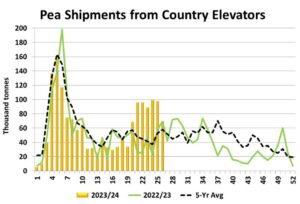
The yellow pea market was dull for the first few months of 2023/24, as exports to China were running at a typical pace, despite the influx of large volumes of Russian peas into China. Prices were mostly flat until early December, when India decided to drop its import restrictions and purchase Canadian yellow peas for the first time in years. That created an unusual midseason bulge in movement and a bump in yellow pea bids.

The yellow pea outlook for the second half of 2023/24 (and early 2024/25) will largely hinge on whether India extends its zero-tariff decision beyond March 31. Without question, Canadian supplies will be tight in the second half of 2023/24 but if India and China are both buying at the same time, prices would see more upside. We think the odds of an extension are roughly 50/50 but India may not announce a decision until late March.
For green peas, there’s been no shortage of excitement, with very low supplies and very high prices. That won’t change in the short-term as there are no fresh supplies of green peas hitting the global market until the next North American harvest. That said, there’s plenty of talk about boosting 2024 acreage, raising the potential (with decent weather) of pulling the market lower eventually. So far, old-crop and new-crop bids are very positive but could start tipping lower as summer approaches.

The green lentil market is much like green peas. Supplies are low and prices are record high, with new-crop bids also exceptionally strong. Canada and the US are the two dominant exporters of green lentils and fresh supplies won’t show up until the fall. Old-crop bids will likely remain “frothy” until the 2024 crop is looking more certain. With a big increase in Canadian and US acres expected, new-crop bids could start to weaken earlier.

Red lentil prices haven’t met farmers’ expectations so far in 2023/24. Earlier, bids turned higher due to strong demand from India but that seems to have faded. So far, exports to other regular customers like Turkey have been disappointing and Australia continues to ship large volumes of red lentils. The key risk for the red lentil outlook is the potential for a large Indian harvest in February and March, which could reduce its demand for imports.
Canadian exports of kabuli chickpeas have been very strong early in 2023/24. Based on StatsCan’s 2023 crop estimate, very few chickpeas will be available for export in the second half. That said, those production numbers are often underreported and get revised higher. So far, the tightening supply situation hasn’t given a boost to bids, but they’re not exactly low either. The tight supplies could mean more strength is possible in the second half of the year.

The main development in the dry bean market has been the small Mexican crop, triggering very heavy imports from both Canada and the US this year. That situation isn’t expected to change in the short-term and this strong trade will draw down supplies in Canada and the US, keeping prices well supported through the rest of 2023/24.

Pulse Market Insight provides market commentary from Chuck Penner of LeftField Commodity Research to help with pulse marketing decisions.

Fall 2023 Pulse Crop News

Welcome to the Fall 2023 issue of Pulse Crop News. Click here to view the entire publication, including features on Soil Health, PMRA Transformation, Farm Safety, Crop Walks, Farm to Table Dinner and more. Click the links below to view individual stories.

Chair’s Report

ED Report

PMRA Transformation

Zone Advisors Wanted

Team Alberta Crops Column

Pulse Canada Column

Harvest Management & Storage of Pulse Crops

Crop Walks in Pictures

Chuck Penner on Prices

Putting Your Mental Health First at Harvest

Troubling Farm Safety Stats

Soil Health Starts with Plants

Zone Updates

Crossroads Conference

Farm to Table Dinner

Nutrition Notes – Pulses for Kids

Recipe – Chicken Lentil Dippers

Zone AGMs

Pulse Processing Research Pushes Market Demand

A research project focused on the processing potential of pulses is creating marketable opportunities for Canadian farmers.
“Modifying pulse ingredients and increasing their utilization will create more demand from processors, leading to more demand from farmers,” said Dr. Michael Nickerson, project leader and University of Saskatchewan professor. “The food industry and markets are pushing for plant-based foods. The goal of this project was to focus on pulse ingredients and how we can modify them to give a wider performance range and applicable to the food industry for product-development purposes.”
This project looked at the functionality of the ingredients found in pulse crops, such as yellow pea, green lentil, Kabuli chickpea, and navy bean, as well as their nutritional profiles. It also worked to develop new processing strategies aimed at the Canadian food sector.
“We sought to increase demand for seed, helping breeding programs from the science side, but also, we wanted this research to provide useful information to farmers seeking value-added opportunities,” Nickerson said. “This project will help support them and provide them with needed knowledge.”
Nickerson’s work investigated a myriad of processing techniques, including milling practices and the resulting particle sizes.
Particle size, according to Nickerson, impacts an ingredient’s performance and functionality. In collaboration with industry partners and milling experts, such as Cereals Canada, he is adding to the small, yet growing body of research connecting pulse flour particle size to a variety of applications and market opportunities for growers.
“In some cases, a milled pulse may be best suited for baking, while in other instances, a processed pulse may be an ideal salad dressing additive,” Nickerson explained. “From milling to functionality to application, this project really spanned the whole spectrum.”
For example, his research found that extruded snacks made with roasted yellow pea or green lentil flours showed great commercialization potential.
Nickerson’s work also looked at isolates. The protein isolate levels in pulse flour was around 25%, but when submitted to a wet extraction process, the same pulse product recorded protein levels of up
to 90%.
As more and more pulse processing facilities start coming online across the Prairies and as those companies seek ways to maximize the potential of their products using processing like wet extraction, Nickerson’s research is, and will continue to be, paramount.
“Product utilization in the food industry is extremely important,” Nickerson said. “It is only going to cause increased demand for the crops Western Canadian pulse farmers grow. Research spans from the field to the fork, and we need to work collaboratively on tailoring flavour profiles, protein quality, and developing breeding programs aimed at producing varieties that will meet market demand and ensure farmers have a good home for their pulse crops.”
Nickerson’s work is not short on practical applications, from food processors seeking efficiencies to companies seeking new products to farmers determining rotations that will maximize profits while meeting a growing demand. In fact, according to Nickerson, growers have been using his research to build processing facilities on their own farms.
The Pulse Research Cluster includes Alberta Pulse Growers, Manitoba Pulse and Soybean Growers, Ontario Bean Growers, Saskatchewan Pulse Growers and Pulse Canada and is supported by the Agriculture and Agri-Food Canada AgriScience Clusters Program under the Canadian Agricultural Partnership.